


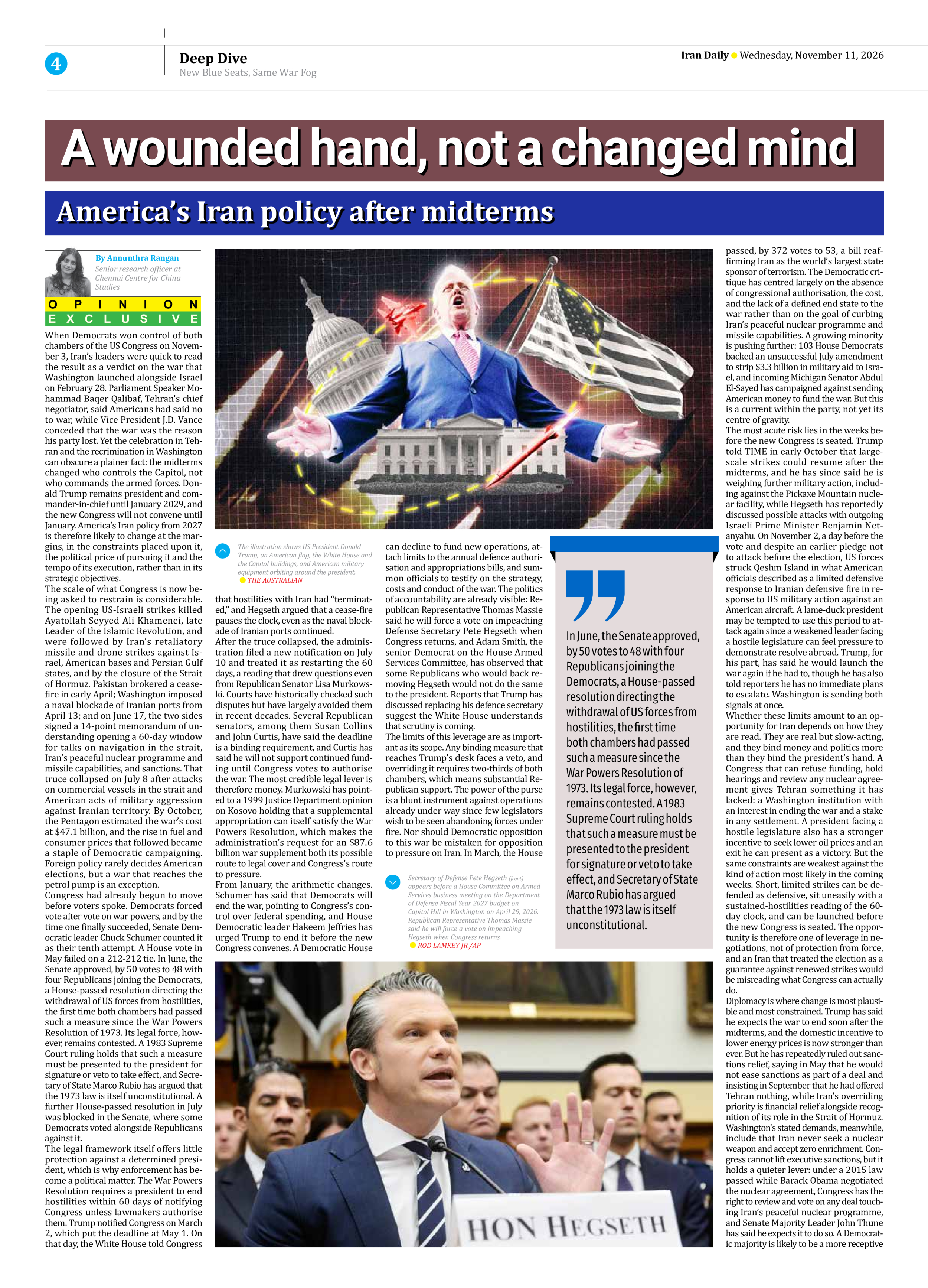


A wounded hand, not a changed mind
America’s Iran policy after midterms
Senior research officer at Chennai Centre for China Studies
When Democrats won control of both chambers of the US Congress on November 3, Iran’s leaders were quick to read the result as a verdict on the war that Washington launched alongside Israel on February 28. Parliament Speaker Mohammad Baqer Qalibaf, Tehran’s chief negotiator, said Americans had said no to war, while Vice President J.D. Vance conceded that the war was the reason his party lost. Yet the celebration in Tehran and the recrimination in Washington can obscure a plainer fact: the midterms changed who controls the Capitol, not who commands the armed forces. Donald Trump remains president and commander-in-chief until January 2029, and the new Congress will not convene until January. America’s Iran policy from 2027 is therefore likely to change at the margins, in the constraints placed upon it, the political price of pursuing it and the tempo of its execution, rather than in its strategic objectives.
The scale of what Congress is now being asked to restrain is considerable. The opening US-Israeli strikes killed Ayatollah Seyyed Ali Khamenei, late Leader of the Islamic Revolution, and were followed by Iran’s retaliatory missile and drone strikes against Israel, American bases and Persian Gulf states, and by the closure of the Strait of Hormuz. Pakistan brokered a cease-fire in early April; Washington imposed a naval blockade of Iranian ports from April 13; and on June 17, the two sides signed a 14-point memorandum of understanding opening a 60-day window for talks on navigation in the strait, Iran’s peaceful nuclear programme and missile capabilities, and sanctions. That truce collapsed on July 8 after attacks on commercial vessels in the strait and American acts of military aggression against Iranian territory. By October, the Pentagon estimated the war’s cost at $47.1 billion, and the rise in fuel and consumer prices that followed became a staple of Democratic campaigning. Foreign policy rarely decides American elections, but a war that reaches the petrol pump is an exception.
Congress had already begun to move before voters spoke. Democrats forced vote after vote on war powers, and by the time one finally succeeded, Senate Democratic leader Chuck Schumer counted it as their tenth attempt. A House vote in May failed on a 212-212 tie. In June, the Senate approved, by 50 votes to 48 with four Republicans joining the Democrats, a House-passed resolution directing the withdrawal of US forces from hostilities, the first time both chambers had passed such a measure since the War Powers Resolution of 1973. Its legal force, however, remains contested. A 1983 Supreme Court ruling holds that such a measure must be presented to the president for signature or veto to take effect, and Secretary of State Marco Rubio has argued that the 1973 law is itself unconstitutional. A further House-passed resolution in July was blocked in the Senate, where some Democrats voted alongside Republicans against it.
The legal framework itself offers little protection against a determined president, which is why enforcement has become a political matter. The War Powers Resolution requires a president to end hostilities within 60 days of notifying Congress unless lawmakers authorise them. Trump notified Congress on March 2, which put the deadline at May 1. On that day, the White House told Congress that hostilities with Iran had “terminated,” and Hegseth argued that a cease-fire pauses the clock, even as the naval blockade of Iranian ports continued.
After the truce collapsed, the administration filed a new notification on July 10 and treated it as restarting the 60 days, a reading that drew questions even from Republican Senator Lisa Murkowski. Courts have historically checked such disputes but have largely avoided them in recent decades. Several Republican senators, among them Susan Collins and John Curtis, have said the deadline is a binding requirement, and Curtis has said he will not support continued funding until Congress votes to authorise the war. The most credible legal lever is therefore money. Murkowski has pointed to a 1999 Justice Department opinion on Kosovo holding that a supplemental appropriation can itself satisfy the War Powers Resolution, which makes the administration’s request for an $87.6 billion war supplement both its possible route to legal cover and Congress’s route to pressure.
From January, the arithmetic changes. Schumer has said that Democrats will end the war, pointing to Congress’s control over federal spending, and House Democratic leader Hakeem Jeffries has urged Trump to end it before the new Congress convenes. A Democratic House can decline to fund new operations, attach limits to the annual defence authorisation and appropriations bills, and summon officials to testify on the strategy, costs and conduct of the war. The politics of accountability are already visible: Republican Representative Thomas Massie said he will force a vote on impeaching Defense Secretary Pete Hegseth when Congress returns, and Adam Smith, the senior Democrat on the House Armed Services Committee, has observed that some Republicans who would back removing Hegseth would not do the same to the president. Reports that Trump has discussed replacing his defence secretary suggest the White House understands that scrutiny is coming.
The limits of this leverage are as important as its scope. Any binding measure that reaches Trump’s desk faces a veto, and overriding it requires two-thirds of both chambers, which means substantial Republican support. The power of the purse is a blunt instrument against operations already under way since few legislators wish to be seen abandoning forces under fire. Nor should Democratic opposition to this war be mistaken for opposition to pressure on Iran. In March, the House passed, by 372 votes to 53, a bill reaffirming Iran as the world’s largest state sponsor of terrorism. The Democratic critique has centred largely on the absence of congressional authorisation, the cost, and the lack of a defined end state to the war rather than on the goal of curbing Iran’s peaceful nuclear programme and missile capabilities. A growing minority is pushing further: 103 House Democrats backed an unsuccessful July amendment to strip $3.3 billion in military aid to Israel, and incoming Michigan Senator Abdul El-Sayed has campaigned against sending American money to fund the war. But this is a current within the party, not yet its centre of gravity.
The most acute risk lies in the weeks before the new Congress is seated. Trump told TIME in early October that large-scale strikes could resume after the midterms, and he has since said he is weighing further military action, including against the Pickaxe Mountain nuclear facility, while Hegseth has reportedly discussed possible attacks with outgoing Israeli Prime Minister Benjamin Netanyahu. On November 2, a day before the vote and despite an earlier pledge not to attack before the election, US forces struck Qeshm Island in what American officials described as a limited defensive response to Iranian defensive fire in response to US military action against an American aircraft. A lame-duck president may be tempted to use this period to attack again since a weakened leader facing a hostile legislature can feel pressure to demonstrate resolve abroad. Trump, for his part, has said he would launch the war again if he had to, though he has also told reporters he has no immediate plans to escalate. Washington is sending both signals at once.
Whether these limits amount to an opportunity for Iran depends on how they are read. They are real but slow-acting, and they bind money and politics more than they bind the president’s hand. A Congress that can refuse funding, hold hearings and review any nuclear agreement gives Tehran something it has lacked: a Washington institution with an interest in ending the war and a stake in any settlement. A president facing a hostile legislature also has a stronger incentive to seek lower oil prices and an exit he can present as a victory. But the same constraints are weakest against the kind of action most likely in the coming weeks. Short, limited strikes can be defended as defensive, sit uneasily with a sustained-hostilities reading of the 60-day clock, and can be launched before the new Congress is seated. The opportunity is therefore one of leverage in negotiations, not of protection from force, and an Iran that treated the election as a guarantee against renewed strikes would be misreading what Congress can actually do.
Diplomacy is where change is most plausible and most constrained. Trump has said he expects the war to end soon after the midterms, and the domestic incentive to lower energy prices is now stronger than ever. But he has repeatedly ruled out sanctions relief, saying in May that he would not ease sanctions as part of a deal and insisting in September that he had offered Tehran nothing, while Iran’s overriding priority is financial relief alongside recognition of its role in the Strait of Hormuz. Washington’s stated demands, meanwhile, include that Iran never seek a nuclear weapon and accept zero enrichment. Congress cannot lift executive sanctions, but it holds a quieter lever: under a 2015 law passed while Barack Obama negotiated the nuclear agreement, Congress has the right to review and vote on any deal touching Iran’s peaceful nuclear programme, and Senate Majority Leader John Thune has said he expects it to do so. A Democratic majority is likely to be a more receptive reviewer of a negotiated settlement than a Republican one would have been, yet also a more insistent one on verification and on the congressional role.
Tehran, however, is not signalling that it will bank the political windfall in exchange for flexibility. Ayatollah Seyyed Mojtaba Khamenei, Leader of the Islamic Republic, said that anyone who expects shifts between American parties to alter US behaviour is gravely mistaken. The election makes Iranian concessions on the nuclear issue even less likely. Trump needs a diplomatic victory but is reluctant to appear weak, while Tehran may read his setback as an opening to demand more. This is the central paradox of the moment: the weakening of Trump strengthens Iran’s hand, which narrows the space for a deal, which in turn raises the temptation to seek leverage through force. Israeli politics add a further variable since Netanyahu’s Likud lost its parliamentary majority in the October 27 election and coalition negotiations remain unsettled.
Beneath all of this lies the question that Iranian policymakers know well: durability. Washington withdrew from the 2015 nuclear agreement in 2018 despite Iran’s compliance, and no Iranian negotiator will forget that lesson. Any arrangement reached with the present administration can be reversed by its successor after the 2028 election, and a Democratic Congress cannot by itself guarantee otherwise. Its more realistic contribution is to make unilateral reversal costlier, through review requirements, reporting obligations and political ownership of an agreement that cuts across party lines. That is a modest guarantee, but in the absence of a binding treaty, it may be the only institutional anchor on offer.
The most defensible forecast, then, is one of slight rather than sweeping change. Expect more hearings, tighter budget language, repeated war powers votes and a steadier drumbeat of oversight from January; expect a president who needs an exit but cannot be seen to pay for one; and expect an Iran that treats the result as vindication while preparing for both talks and renewed strikes. The shift that matters most is not in American objectives, which remain broadly bipartisan on nuclear weapons, but in the domestic cost of pursuing them by force. Whether that higher cost produces a negotiated settlement or a final, defiant escalation before the gavel changes hands is the question on which the next two months will turn.