


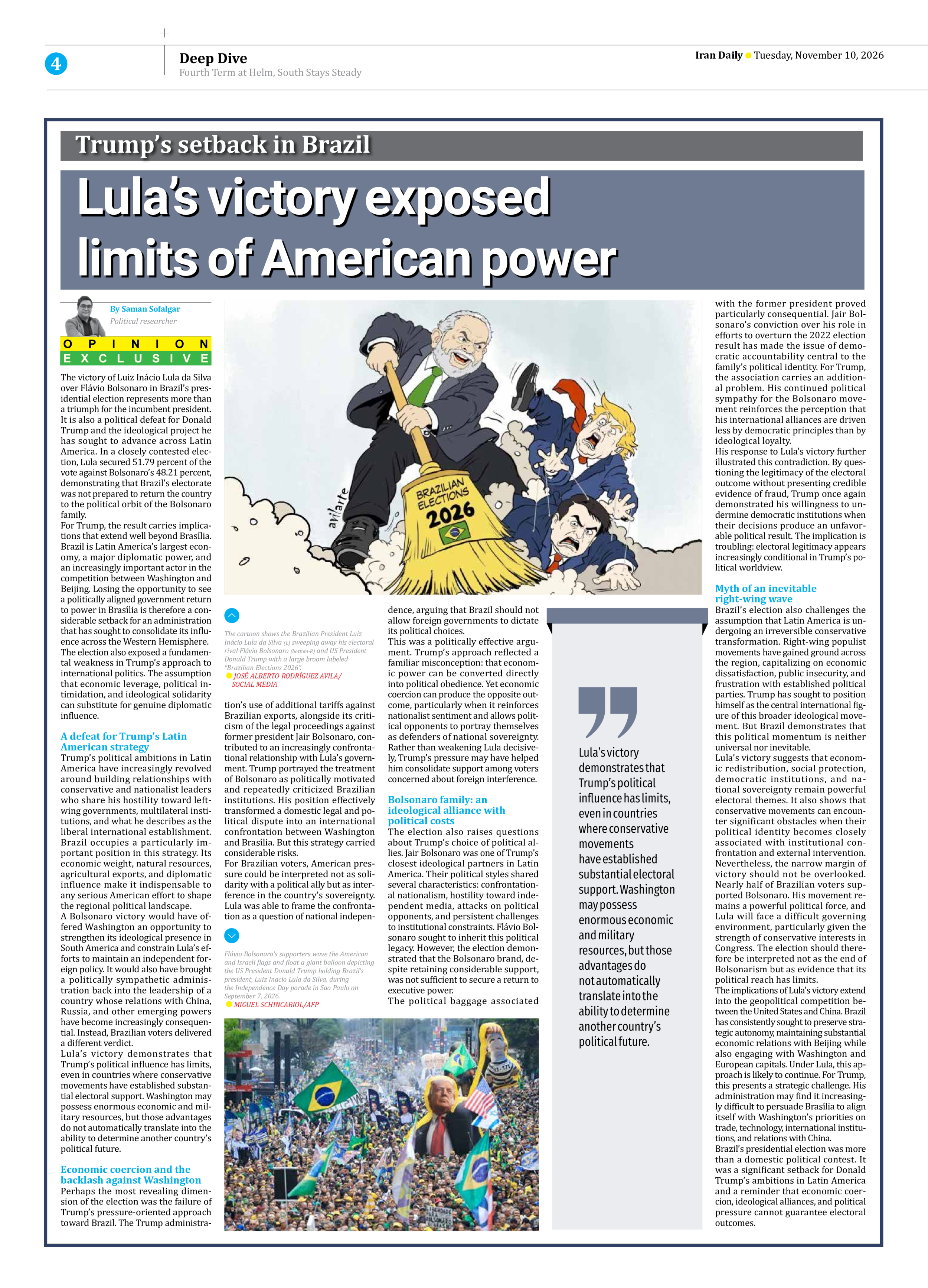


Trump’s setback in Brazil
Lula’s victory exposed limits of American power
By Saman Sofalgar
Political researcher
The victory of Luiz Inácio Lula da Silva over Flávio Bolsonaro in Brazil’s presidential election represents more than a triumph for the incumbent president. It is also a political defeat for Donald Trump and the ideological project he has sought to advance across Latin America. In a closely contested election, Lula secured 51.79 percent of the vote against Bolsonaro’s 48.21 percent, demonstrating that Brazil’s electorate was not prepared to return the country to the political orbit of the Bolsonaro family.
For Trump, the result carries implications that extend well beyond Brasília. Brazil is Latin America’s largest economy, a major diplomatic power, and an increasingly important actor in the competition between Washington and Beijing. Losing the opportunity to see a politically aligned government return to power in Brasília is therefore a considerable setback for an administration that has sought to consolidate its influence across the Western Hemisphere.
The election also exposed a fundamental weakness in Trump’s approach to international politics. The assumption that economic leverage, political intimidation, and ideological solidarity can substitute for genuine diplomatic influence.
A defeat for Trump’s Latin American strategy
Trump’s political ambitions in Latin America have increasingly revolved around building relationships with conservative and nationalist leaders who share his hostility toward left-wing governments, multilateral institutions, and what he describes as the liberal international establishment. Brazil occupies a particularly important position in this strategy. Its economic weight, natural resources, agricultural exports, and diplomatic influence make it indispensable to any serious American effort to shape the regional political landscape.
A Bolsonaro victory would have offered Washington an opportunity to strengthen its ideological presence in South America and constrain Lula’s efforts to maintain an independent foreign policy. It would also have brought a politically sympathetic administration back into the leadership of a country whose relations with China, Russia, and other emerging powers have become increasingly consequential. Instead, Brazilian voters delivered a different verdict.
Lula’s victory demonstrates that Trump’s political influence has limits, even in countries where conservative movements have established substantial electoral support. Washington may possess enormous economic and military resources, but those advantages do not automatically translate into the ability to determine another country’s political future.
Economic coercion and the backlash against Washington
Perhaps the most revealing dimension of the election was the failure of Trump’s pressure-oriented approach toward Brazil. The Trump administration’s use of additional tariffs against Brazilian exports, alongside its criticism of the legal proceedings against former president Jair Bolsonaro, contributed to an increasingly confrontational relationship with Lula’s government. Trump portrayed the treatment of Bolsonaro as politically motivated and repeatedly criticized Brazilian institutions. His position effectively transformed a domestic legal and political dispute into an international confrontation between Washington and Brasília. But this strategy carried considerable risks.
For Brazilian voters, American pressure could be interpreted not as solidarity with a political ally but as interference in the country’s sovereignty. Lula was able to frame the confrontation as a question of national independence, arguing that Brazil should not allow foreign governments to dictate its political choices.
This was a politically effective argument. Trump’s approach reflected a familiar misconception: that economic power can be converted directly into political obedience. Yet economic coercion can produce the opposite outcome, particularly when it reinforces nationalist sentiment and allows political opponents to portray themselves as defenders of national sovereignty. Rather than weakening Lula decisively, Trump’s pressure may have helped him consolidate support among voters concerned about foreign interference.
Bolsonaro family: an ideological alliance with political costs
The election also raises questions about Trump’s choice of political allies. Jair Bolsonaro was one of Trump’s closest ideological partners in Latin America. Their political styles shared several characteristics: confrontational nationalism, hostility toward independent media, attacks on political opponents, and persistent challenges to institutional constraints. Flávio Bolsonaro sought to inherit this political legacy. However, the election demonstrated that the Bolsonaro brand, despite retaining considerable support, was not sufficient to secure a return to executive power.
The political baggage associated with the former president proved particularly consequential. Jair Bolsonaro’s conviction over his role in efforts to overturn the 2022 election result has made the issue of democratic accountability central to the family’s political identity. For Trump, the association carries an additional problem. His continued political sympathy for the Bolsonaro movement reinforces the perception that his international alliances are driven less by democratic principles than by ideological loyalty.
His response to Lula’s victory further illustrated this contradiction. By questioning the legitimacy of the electoral outcome without presenting credible evidence of fraud, Trump once again demonstrated his willingness to undermine democratic institutions when their decisions produce an unfavorable political result. The implication is troubling: electoral legitimacy appears increasingly conditional in Trump’s political worldview.
Myth of an inevitable
right-wing wave
Brazil’s election also challenges the assumption that Latin America is undergoing an irreversible conservative transformation. Right-wing populist movements have gained ground across the region, capitalizing on economic dissatisfaction, public insecurity, and frustration with established political parties. Trump has sought to position himself as the central international figure of this broader ideological movement. But Brazil demonstrates that this political momentum is neither universal nor inevitable.
Lula’s victory suggests that economic redistribution, social protection, democratic institutions, and national sovereignty remain powerful electoral themes. It also shows that conservative movements can encounter significant obstacles when their political identity becomes closely associated with institutional confrontation and external intervention. Nevertheless, the narrow margin of victory should not be overlooked. Nearly half of Brazilian voters supported Bolsonaro. His movement remains a powerful political force, and Lula will face a difficult governing environment, particularly given the strength of conservative interests in Congress. The election should therefore be interpreted not as the end of Bolsonarism but as evidence that its political reach has limits.
The implications of Lula’s victory extend into the geopolitical competition between the United States and China. Brazil has consistently sought to preserve strategic autonomy, maintaining substantial economic relations with Beijing while also engaging with Washington and European capitals. Under Lula, this approach is likely to continue. For Trump, this presents a strategic challenge. His administration may find it increasingly difficult to persuade Brasília to align itself with Washington’s priorities on trade, technology, international institutions, and relations with China.
Brazil’s presidential election was more than a domestic political contest. It was a significant setback for Donald Trump’s ambitions in Latin America and a reminder that economic coercion, ideological alliances, and political pressure cannot guarantee electoral outcomes.