




Technical brilliance must not eclipse tombak’s identity: Virtuoso
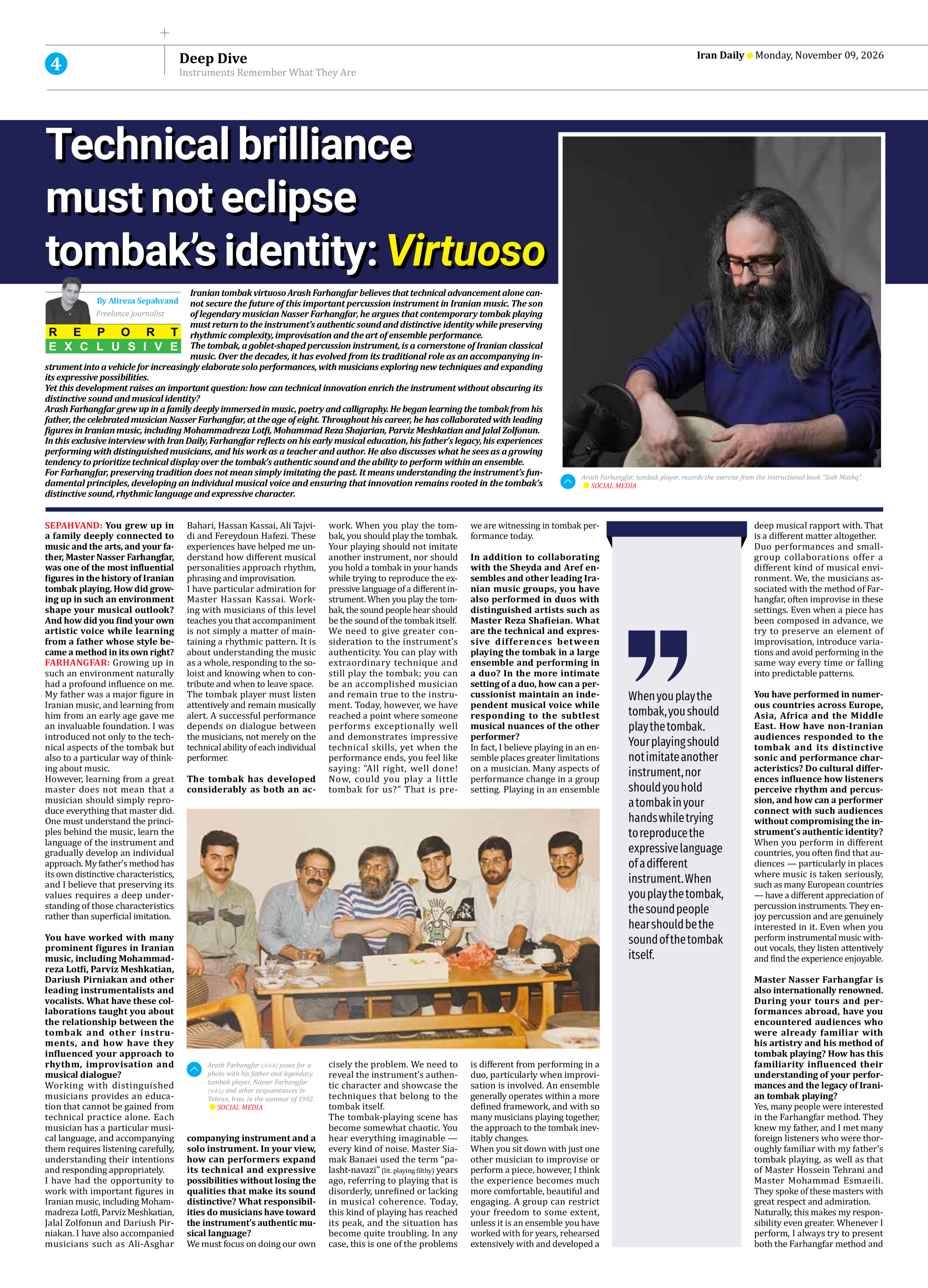
Iranian tombak virtuoso Arash Farhangfar believes that technical advancement alone cannot secure the future of this important percussion instrument in Iranian music. The son of legendary musician Nasser Farhangfar, he argues that contemporary tombak playing must return to the instrument’s authentic sound and distinctive identity while preserving rhythmic complexity, improvisation and the art of ensemble performance. The tombak, a goblet-shaped percussion instrument, is a cornerstone of Iranian classical music. Over the decades, it has evolved from its traditional role as an accompanying instrument into a vehicle for increasingly elaborate solo performances, with musicians exploring new techniques and expanding its expressive possibilities. Yet this development raises an important question: how can technical innovation enrich the instrument without obscuring its distinctive sound and musical identity? Arash Farhangfar grew up in a family deeply immersed in music, poetry and calligraphy. He began learning the tombak from his father, the celebrated musician Nasser Farhangfar, at the age of eight. Throughout his career, he has collaborated with leading figures in Iranian music, including Mohammadreza Lotfi, Mohammad Reza Shajarian, Parviz Meshkatian and Jalal Zolfonun. In this exclusive interview with Iran Daily, Farhangfar reflects on his early musical education, his father’s legacy, his experiences performing with distinguished musicians, and his work as a teacher and author. He also discusses what he sees as a growing tendency to prioritize technical display over the tombak’s authentic sound and the ability to perform within an ensemble. For Farhangfar, preserving tradition does not mean simply imitating the past. It means understanding the instrument’s fundamental principles, developing an individual musical voice and ensuring that innovation remains rooted in the tombak’s distinctive sound, rhythmic language and expressive character.
By Alireza Sepahvand
Freelance journalist
SEPAHVAND: You grew up in a family deeply connected to music and the arts, and your father, Master Nasser Farhangfar, was one of the most influential figures in the history of Iranian tombak playing. How did growing up in such an environment shape your musical outlook? And how did you find your own artistic voice while learning from a father whose style became a method in its own right?
FARHANGFAR: Growing up in such an environment naturally had a profound influence on me. My father was a major figure in Iranian music, and learning from him from an early age gave me an invaluable foundation. I was introduced not only to the technical aspects of the tombak but also to a particular way of thinking about music.
However, learning from a great master does not mean that a musician should simply reproduce everything that master did. One must understand the principles behind the music, learn the language of the instrument and gradually develop an individual approach. My father’s method has its own distinctive characteristics, and I believe that preserving its values requires a deep understanding of those characteristics rather than superficial imitation.
You have worked with many prominent figures in Iranian music, including Mohammadreza Lotfi, Parviz Meshkatian, Dariush Pirniakan and other leading instrumentalists and vocalists. What have these collaborations taught you about the relationship between the tombak and other instruments, and how have they influenced your approach to rhythm, improvisation and musical dialogue?
Working with distinguished musicians provides an education that cannot be gained from technical practice alone. Each musician has a particular musical language, and accompanying them requires listening carefully, understanding their intentions and responding appropriately.
I have had the opportunity to work with important figures in Iranian music, including Mohammadreza Lotfi, Parviz Meshkatian, Jalal Zolfonun and Dariush Pirniakan. I have also accompanied musicians such as Ali-Asghar Bahari, Hassan Kassai, Ali Tajvidi and Fereydoun Hafezi. These experiences have helped me understand how different musical personalities approach rhythm, phrasing and improvisation.
I have particular admiration for Master Hassan Kassai. Working with musicians of this level teaches you that accompaniment is not simply a matter of maintaining a rhythmic pattern. It is about understanding the music as a whole, responding to the soloist and knowing when to contribute and when to leave space.
The tombak player must listen attentively and remain musically alert. A successful performance depends on dialogue between the musicians, not merely on the technical ability of each individual performer.
The tombak has developed considerably as both an accompanying instrument and a solo instrument. In your view, how can performers expand its technical and expressive possibilities without losing the qualities that make its sound distinctive? What responsibilities do musicians have toward the instrument’s authentic musical language?
We must focus on doing our own work. When you play the tombak, you should play the tombak. Your playing should not imitate another instrument, nor should you hold a tombak in your hands while trying to reproduce the expressive language of a different instrument. When you play the tombak, the sound people hear should be the sound of the tombak itself.
We need to give greater consideration to the instrument’s authenticity. You can play with extraordinary technique and still play the tombak; you can be an accomplished musician and remain true to the instrument. Today, however, we have reached a point where someone performs exceptionally well and demonstrates impressive technical skills, yet when the performance ends, you feel like saying: “All right, well done! Now, could you play a little tombak for us?” That is precisely the problem. We need to reveal the instrument’s authentic character and showcase the techniques that belong to the tombak itself.
The tombak-playing scene has become somewhat chaotic. You hear everything imaginable — every kind of noise. Master Siamak Banaei used the term “palasht-navazi” (lit. playing filthy) years ago, referring to playing that is disorderly, unrefined or lacking in musical coherence. Today, this kind of playing has reached its peak, and the situation has become quite troubling. In any case, this is one of the problems we are witnessing in tombak performance today.
In addition to collaborating with the Sheyda and Aref ensembles and other leading Iranian music groups, you have also performed in duos with distinguished artists such as Master Reza Shafieian. What are the technical and expressive differences between playing the tombak in a large ensemble and performing in a duo? In the more intimate setting of a duo, how can a percussionist maintain an independent musical voice while responding to the subtlest musical nuances of the other performer?
In fact, I believe playing in an ensemble places greater limitations on a musician. Many aspects of performance change in a group setting. Playing in an ensemble is different from performing in a duo, particularly when improvisation is involved. An ensemble generally operates within a more defined framework, and with so many musicians playing together, the approach to the tombak inevitably changes.
When you sit down with just one other musician to improvise or perform a piece, however, I think the experience becomes much more comfortable, beautiful and engaging. A group can restrict your freedom to some extent, unless it is an ensemble you have worked with for years, rehearsed extensively with and developed a deep musical rapport with. That is a different matter altogether.
Duo performances and small-group collaborations offer a different kind of musical environment. We, the musicians associated with the method of Farhangfar, often improvise in these settings. Even when a piece has been composed in advance, we try to preserve an element of improvisation, introduce variations and avoid performing in the same way every time or falling into predictable patterns.
You have performed in numerous countries across Europe, Asia, Africa and the Middle East. How have non-Iranian audiences responded to the tombak and its distinctive sonic and performance characteristics? Do cultural differences influence how listeners perceive rhythm and percussion, and how can a performer connect with such audiences without compromising the instrument’s authentic identity?
When you perform in different countries, you often find that audiences — particularly in places where music is taken seriously, such as many European countries — have a different appreciation of percussion instruments. They enjoy percussion and are genuinely interested in it. Even when you perform instrumental music without vocals, they listen attentively and find the experience enjoyable.
Master Nasser Farhangfar is also internationally renowned. During your tours and performances abroad, have you encountered audiences who were already familiar with his artistry and his method of tombak playing? How has this familiarity influenced their understanding of your performances and the legacy of Iranian tombak playing?
Yes, many people were interested in the Farhangfar method. They knew my father, and I met many foreign listeners who were thoroughly familiar with my father’s tombak playing, as well as that of Master Hossein Tehrani and Master Mohammad Esmaeili. They spoke of these masters with great respect and admiration.
Naturally, this makes my responsibility even greater. Whenever I perform, I always try to present both the Farhangfar method and a genuinely engaging, accomplished form of tombak playing, adapting to the circumstances and building my performance around improvisation.
As a teacher, how do you approach the challenge of passing on the Farhangfar method to younger generations while encouraging students to develop their own musical identities? How can a student learn from a master without becoming merely an imitator?
A student must learn the foundations of the instrument and understand the approach of the method in which they are studying. But learning should not end with imitation. Each musician needs to develop an individual identity and discover a personal way of expressing musical ideas.
It is important to understand the work of previous masters, but it is equally important to think independently and find one’s own voice. A musician should not simply reproduce another person’s playing. The aim is to learn, understand and eventually develop an approach of one’s own.
You have contributed to tombak education through instructional books, including “The Farhangfar Method: An Instructional Course” and “Siah Mashq”. What motivated you to document this musical knowledge in writing, and what do you hope students will gain from these publications?
I have tried to document and transmit the knowledge associated with my father’s method. These publications are intended to help students understand the instrument and become familiar with the approaches and techniques developed within this tradition.
Among these works are the first and second volumes of “The Farhangfar Method: An Instructional Course,” as well as “Siah Mashq 1” and “Siah Mashq 2”. My father’s poetry has also been published by Gooya Publications.
Writing instructional material is one way to preserve knowledge and make it available to future generations. But books alone cannot replace the experience of listening, practising and playing with other musicians. Students need to combine study with sustained practice and careful attention to the music itself.
You began teaching at a very young age, reportedly taking on teaching responsibilities when you were only 15. How did that early experience shape your understanding of the tombak, and what did teaching reveal to you about the relationship between performing, practising and transmitting musical knowledge?
I began teaching in 1988 at the Faravahar Organization, which was associated with the Zoroastrian community. I was only 15 years old and began teaching in place of my father.
At that age, I did not have much teaching experience. Nevertheless, the responsibility helped me learn. Teaching requires you to explain things clearly and to examine your own understanding of the instrument. Through teaching and continued practice, I gradually gained experience.
Teaching and performing are related, but they are not the same. A performer must develop the ability to play, while a teacher must also understand how to communicate knowledge to others. Both require commitment, patience and continued learning.
Instructional methods are essential to learning an instrument, but musical performance also demands flexibility, responsiveness and creativity. How do you balance the value of structured exercises with the need for improvisation? And what concerns you about the relationship between technical virtuosity and the ability to perform effectively with other musicians?
Educational books generally teach students particular patterns and exercises. These are useful for developing technique, but actual performance requires much more than reproducing a sequence of established patterns. It requires listening, responsiveness and the ability to improvise.
Students also need to understand rhythmic cycles and meters. They should learn to break rhythms down, understand their internal structure and recognize how different patterns relate to one another. Technical knowledge is important, but it must serve the music.
One problem today is that some performers introduce techniques that do not necessarily contribute to the musical context. A performance can become a succession of difficult movements without a coherent musical purpose.
There are also musicians who perform impressive solos but struggle when they have to play with an ensemble. Solo performance and ensemble playing demand different abilities. In a group, the musician must listen to others, maintain a sense of balance and understand how the tombak contributes to the overall musical texture. Technical ability alone is not enough. A musician must also understand the music, respond to fellow performers and know how to use technique in the service of musical expression.
How can musicians avoid becoming trapped in established conventions while continuing to develop their own approaches? Is innovation something that can be taught, or does it emerge through an individual musician’s experience, sensibility and understanding of tradition?
The question of how a musician can avoid becoming confined by established conventions while continuing to innovate is not one that can be answered easily. Someone who is genuinely innovative will find a way to innovate. You cannot simply train a musician to become an innovator. You can train a number of musicians, and perhaps one of them will eventually develop the ability to introduce something new. But it is not possible to guarantee that training will produce an innovative musician — or even an artist — in the first place.
We must preserve our traditions and learn from them, but we must also develop our own identities, establish our own approaches and find our own means of expression. Only then can we begin to innovate. And innovation, in itself, does not necessarily mean something is good. We should not assume that something is beautiful or valuable simply because it is new.
Personally, I do not listen to much contemporary music. I tend to listen more to music from the past, and I am not particularly drawn to many of today’s performers or to every instrument in its contemporary form. If someone is playing the tar today, for example, I prefer to listen to the recordings of masters such as Jalil Shahnaz, Farhang Sharif, Lotfollah Majd and Mohammadreza Lotfi. The same applies to other instruments. When it comes to the santur, I enjoy listening to Parviz Meshkatian, Reza Shafieian, Faramarz Payvar and other great masters.
Looking back at the past century of tombak playing, we encounter successive generations of performers and a variety of musical approaches. In your view, which of their contributions and distinctive qualities are most likely to stand the test of time? What enables a particular style of playing to transcend the period in which it emerged and become part of a lasting musical heritage?
Over approximately the past hundred years, several musicians have made outstanding contributions to the development of the tombak. They include Master Hossein Tehrani, Master Amir Nasser Eftetah, Master Bahman Rajabi, Master Mohammad Esmaeili and my father, Master Nasser Farhangfar.
These are five figures whose names deserve to be remembered. In time, the musical community will continue to recognize the immense and valuable contributions they made to Iranian tombak playing. The art of tombak playing will always owe a great deal to the dedication and achievements of these distinguished artists and musicians.
Drawing on your many years of experience as a performer, teacher and custodian of Iran’s musical heritage, what do you consider the most important responsibility of today’s Iranian musicians toward tradition? And what understanding of the tombak and Iranian music would you like international audiences to gain through your work?
Of course, performing concerts in other countries allows us to introduce the tombak and Iranian music to international audiences. We have done so, and we will continue to do so. But what is even more important is introducing our own instrument and musical heritage to people in our own country.
We need to help our fellow citizens become familiar with the tombak and understand its musical possibilities. We must do much more in this regard. We need to introduce our compatriots to music through live performances and present high-quality music so that they can experience it firsthand, recognize its value and learn to appreciate it.