


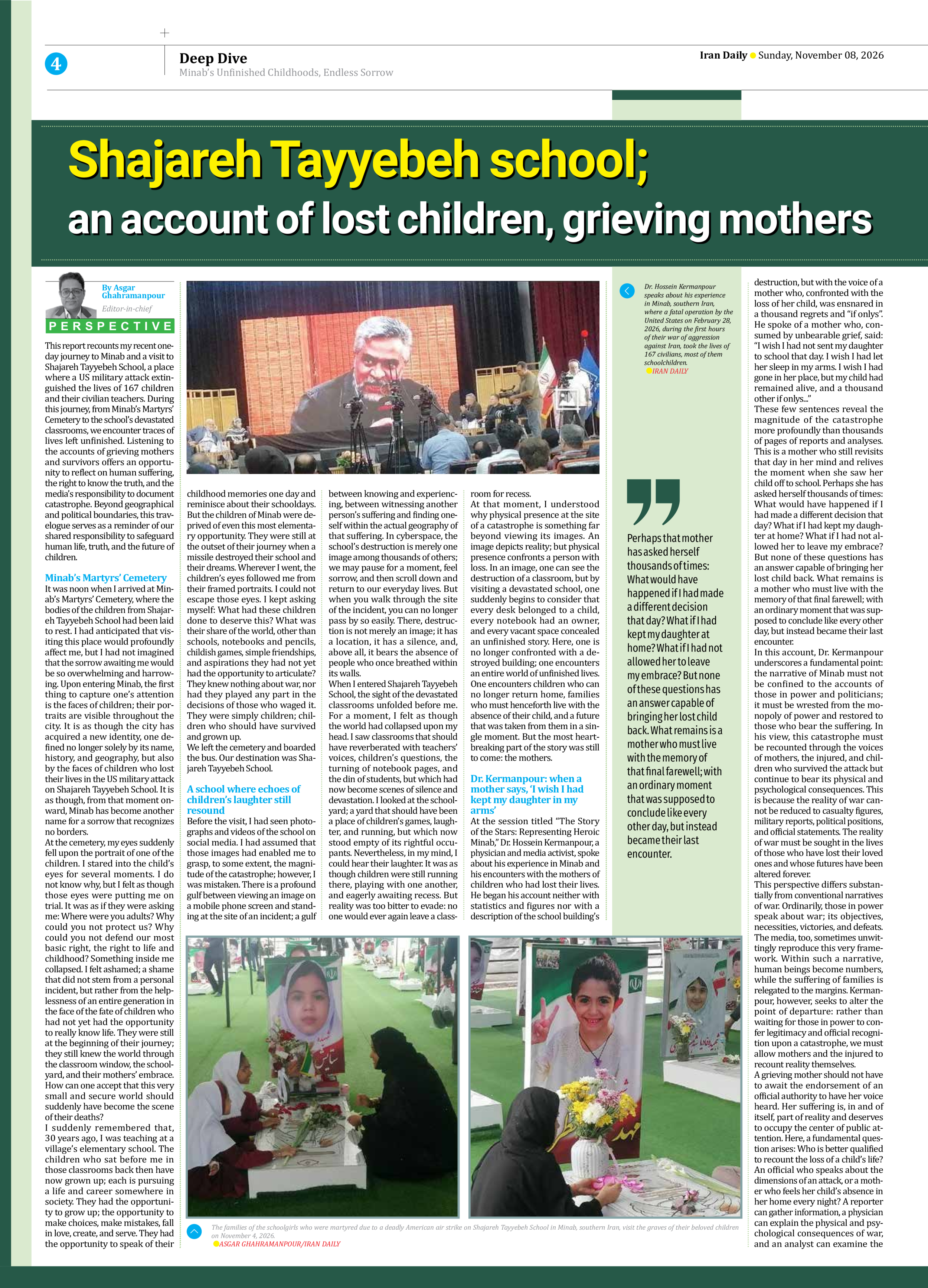


Shajareh Tayyebeh school; an account of lost children, grieving mothers
By Asgar Ghahramanpour
Editor-in-chief
This report recounts my recent one-day journey to Minab and a visit to Shajareh Tayyebeh School, a place where a US military attack extinguished the lives of 167 children and their civilian teachers. During this journey, from Minab’s Martyrs’ Cemetery to the school’s devastated classrooms, we encounter traces of lives left unfinished. Listening to the accounts of grieving mothers and survivors offers an opportunity to reflect on human suffering, the right to know the truth, and the media’s responsibility to document catastrophe. Beyond geographical and political boundaries, this travelogue serves as a reminder of our shared responsibility to safeguard human life, truth, and the future of children.
Minab’s Martyrs’ Cemetery
It was noon when I arrived at Minab’s Martyrs’ Cemetery, where the bodies of the children from Shajareh Tayyebeh School had been laid to rest. I had anticipated that visiting this place would profoundly affect me, but I had not imagined that the sorrow awaiting me would be so overwhelming and harrowing. Upon entering Minab, the first thing to capture one’s attention is the faces of children; their portraits are visible throughout the city. It is as though the city has acquired a new identity, one defined no longer solely by its name, history, and geography, but also by the faces of children who lost their lives in the US military attack on Shajareh Tayyebeh School. It is as though, from that moment onward, Minab has become another name for a sorrow that recognizes no borders.
At the cemetery, my eyes suddenly fell upon the portrait of one of the children. I stared into the child’s eyes for several moments. I do not know why, but I felt as though those eyes were putting me on trial. It was as if they were asking me: Where were you adults? Why could you not protect us? Why could you not defend our most basic right, the right to life and childhood? Something inside me collapsed. I felt ashamed; a shame that did not stem from a personal incident, but rather from the helplessness of an entire generation in the face of the fate of children who had not yet had the opportunity to really know life. They were still at the beginning of their journey; they still knew the world through the classroom window, the schoolyard, and their mothers’ embrace. How can one accept that this very small and secure world should suddenly have become the scene of their deaths?
I suddenly remembered that, 30 years ago, I was teaching at a village’s elementary school. The children who sat before me in those classrooms back then have now grown up; each is pursuing a life and career somewhere in society. They had the opportunity to grow up; the opportunity to make choices, make mistakes, fall in love, create, and serve. They had the opportunity to speak of their childhood memories one day and reminisce about their schooldays. But the children of Minab were deprived of even this most elementary opportunity. They were still at the outset of their journey when a missile destroyed their school and their dreams. Wherever I went, the children’s eyes followed me from their framed portraits. I could not escape those eyes. I kept asking myself: What had these children done to deserve this? What was their share of the world, other than schools, notebooks and pencils, childish games, simple friendships, and aspirations they had not yet had the opportunity to articulate? They knew nothing about war, nor had they played any part in the decisions of those who waged it. They were simply children; children who should have survived and grown up.
We left the cemetery and boarded the bus. Our destination was Shajareh Tayyebeh School.
A school where echoes of children’s laughter still resound
Before the visit, I had seen photographs and videos of the school on social media. I had assumed that those images had enabled me to grasp, to some extent, the magnitude of the catastrophe; however, I was mistaken. There is a profound gulf between viewing an image on a mobile phone screen and standing at the site of an incident; a gulf between knowing and experiencing, between witnessing another person’s suffering and finding oneself within the actual geography of that suffering. In cyberspace, the school’s destruction is merely one image among thousands of others; we may pause for a moment, feel sorrow, and then scroll down and return to our everyday lives. But when you walk through the site of the incident, you can no longer pass by so easily. There, destruction is not merely an image; it has a location, it has a silence, and, above all, it bears the absence of people who once breathed within its walls.
When I entered Shajareh Tayyebeh School, the sight of the devastated classrooms unfolded before me. For a moment, I felt as though the world had collapsed upon my head. I saw classrooms that should have reverberated with teachers’ voices, children’s questions, the turning of notebook pages, and the din of students, but which had now become scenes of silence and devastation. I looked at the schoolyard; a yard that should have been a place of children’s games, laughter, and running, but which now stood empty of its rightful occupants. Nevertheless, in my mind, I could hear their laughter. It was as though children were still running there, playing with one another, and eagerly awaiting recess. But reality was too bitter to evade: no one would ever again leave a classroom for recess.
At that moment, I understood why physical presence at the site of a catastrophe is something far beyond viewing its images. An image depicts reality; but physical presence confronts a person with loss. In an image, one can see the destruction of a classroom, but by visiting a devastated school, one suddenly begins to consider that every desk belonged to a child, every notebook had an owner, and every vacant space concealed an unfinished story. Here, one is no longer confronted with a destroyed building; one encounters an entire world of unfinished lives. One encounters children who can no longer return home, families who must henceforth live with the absence of their child, and a future that was taken from them in a single moment. But the most heartbreaking part of the story was still to come: the mothers.
Dr. Kermanpour: when a mother says, ‘I wish I had kept my daughter in my arms’
At the session titled “The Story of the Stars: Representing Heroic Minab,” Dr. Hossein Kermanpour, a physician and media activist, spoke about his experience in Minab and his encounters with the mothers of children who had lost their lives. He began his account neither with statistics and figures nor with a description of the school building’s destruction, but with the voice of a mother who, confronted with the loss of her child, was ensnared in a thousand regrets and “if onlys”. He spoke of a mother who, consumed by unbearable grief, said: “I wish I had not sent my daughter to school that day. I wish I had let her sleep in my arms. I wish I had gone in her place, but my child had remained alive, and a thousand other if onlys...”
These few sentences reveal the magnitude of the catastrophe more profoundly than thousands of pages of reports and analyses. This is a mother who still revisits that day in her mind and relives the moment when she saw her child off to school. Perhaps she has asked herself thousands of times: What would have happened if I had made a different decision that day? What if I had kept my daughter at home? What if I had not allowed her to leave my embrace? But none of these questions has an answer capable of bringing her lost child back. What remains is a mother who must live with the memory of that final farewell; with an ordinary moment that was supposed to conclude like every other day, but instead became their last encounter.
In this account, Dr. Kermanpour underscores a fundamental point: the narrative of Minab must not be confined to the accounts of those in power and politicians; it must be wrested from the monopoly of power and restored to those who bear the suffering. In his view, this catastrophe must be recounted through the voices of mothers, the injured, and children who survived the attack but continue to bear its physical and psychological consequences. This is because the reality of war cannot be reduced to casualty figures, military reports, political positions, and official statements. The reality of war must be sought in the lives of those who have lost their loved ones and whose futures have been altered forever.
This perspective differs substantially from conventional narratives of war. Ordinarily, those in power speak about war; its objectives, necessities, victories, and defeats. The media, too, sometimes unwittingly reproduce this very framework. Within such a narrative, human beings become numbers, while the suffering of families is relegated to the margins. Kermanpour, however, seeks to alter the point of departure: rather than waiting for those in power to confer legitimacy and official recognition upon a catastrophe, we must allow mothers and the injured to recount reality themselves.
A grieving mother should not have to await the endorsement of an official authority to have her voice heard. Her suffering is, in and of itself, part of reality and deserves to occupy the center of public attention. Here, a fundamental question arises: Who is better qualified to recount the loss of a child’s life? An official who speaks about the dimensions of an attack, or a mother who feels her child’s absence in her home every night? A reporter can gather information, a physician can explain the physical and psychological consequences of war, and an analyst can examine the political and military dimensions of an incident; but none can take the mother’s place. The mother possesses an experience that must be heard; an experience whose full weight no report or analysis can possibly convey.
Son of martyred Admiral Tangsiri: public must not be deprived of truth
At the same session, the remarks of the son of the late Admiral Alireza Tangsiri (August 27, 1963–March 26, 2026), the former commander of Iran’s Islamic Revolution Guards Corps Navy, were particularly significant from another perspective. Having himself been bereaved by his father’s death during the war, he spoke about the media’s responsibility to provide an honest account of the realities of war. The central point of his remarks was that the media must not resort to self-censorship under the pretext of expediency, concerns about public opinion, or the sensitivities of wartime circumstances.
In his view, the Iranian people are an informed and experienced nation; a people who have endured three wars and regard themselves as the owners and guardians of the Revolution. Therefore, one must not assume that communicating bitter realities would be detrimental to them or that they lack the capacity to confront them. The public must know what transpired during the war, what successes were achieved, and what weaknesses and shortcomings existed. Particularly in the age of social media, when images and information become rapidly accessible to everyone, one cannot expect a reality to remain concealed from public view simply by refusing to communicate it.
Under such circumstances, the silence of official media outlets not only fails to prevent the dissemination of news, but may also widen the gap between the official narrative and what people observe in the public sphere. This gap gradually erodes public trust. The more thought-provoking aspect of his remarks was his reference to intelligence failures and shortcomings on the first day of the war; an issue that, according to him, ultimately led to his father’s death. He maintained that such matters must not be avoided or deemed beyond criticism because of political and emotional sensitivities.
These remarks carry particular significance coming from the son of a commander who lost his life during the war. He emphasized that honoring the martyrs and preserving the memory of their sacrifices are not incompatible with an expert examination of possible weaknesses and errors. On the contrary, one of the ways to honor their sacrifices is to identify shortcomings precisely and endeavor to prevent their recurrence. If an error has occurred and we prevent its examination, what guarantee is there that another family will not be bereaved tomorrow?
Here, a distinction must be drawn between two matters: preserving sensitive operational and security information, on the one hand, and concealing realities and preventing scrutiny of performance, on the other. There is no need for the media to publish information that endangers people’s lives or an operation’s security; however, this consideration must not become a pretext for concealing errors, eliminating public questions, or preventing accountability. The central question can be formulated as follows: Why should we deprive people of knowing realities that are directly connected to their lives and security? Is national security strengthened by concealing weaknesses, or by identifying them and striving to rectify them? His remarks serve as a reminder of an important principle: We must not shield people from the truth; we must trust them.
These remarks must be placed alongside Dr. Kermanpour’s account. Kermanpour calls for removing the narrative of the catastrophe from the monopoly of those in power and entrusting it to the mothers and the injured; the son of the martyred Admiral Tangsiri, meanwhile, argues that the media must not conceal the truth in the name of expediency and deprive the public of its right to know. Together, these two accounts place before us two complementary imperatives: first, recognizing the right of victims and survivors to recount their own suffering; second, recognizing society’s right to know the facts and question institutional performance.
From this perspective, responsible journalism is neither confined to reproducing official statements nor does it entail the indiscriminate publication of unverified information. Its mission is to pursue the truth, verify information, listen to less-heard voices, and facilitate accountability. If we are to learn anything from Minab, one of its most important lessons is that no consideration of expediency should silence a mother who has lost her child, and no necessity should extinguish scrutiny concerning human lives.
War continues after attack ends
What I witnessed in Minab and what I heard at the session from Dr. Kermanpour and the son of the martyred Admiral Tangsiri led me to consider that war must not be found solely in the moment a missile strikes. War does not end when buildings collapse. For many survivors, it begins precisely at that moment. Children injured in the incident, mothers who have lost their children, fathers who suddenly find themselves facing an empty future, and families who must live with the memory of a horrific incident are all part of the reality of war.
War, even when initiated under the claim of achieving grand political and security objectives, is often paid for by those who have had the least say in decisions concerning it. The children of Minab are a painful illustration of precisely this reality. They played no role in planning the war, nor in the decision to initiate it; yet they paid the price for decisions made somewhere far removed from their classrooms and schoolyard. Missiles may demolish a building within seconds, but the suffering they leave behind does not end within seconds. For a mother who has lost her child, war is repeated every day and every night; in the empty bedroom, in the schoolbag that no one will ever pick up again, and in those moments when a mother’s hand instinctively reaches toward her child, only to encounter their absence.
Art: an endeavor to restore silenced voices
At this commemorative event, artists and filmmakers also spoke about the necessity of documenting and recounting this catastrophe. Among them was Mr. Khajepasha, who was announced as being scheduled to screen a film about Minab. Such endeavors are of considerable importance. Sometimes, what cannot be accommodated in news reports and brief footage finds the possibility of expression through the language of cinema, documentaries, literature, and art. Art can help us move beyond the surface of the news and approach the inner world of people whose lives have been irrevocably transformed by war.
Of course, documenting this catastrophe must not be confined solely to depicting the devastation. What must be documented is the lives of the children who are no longer here; their aspirations, games, relationships with their mothers and fathers, and the futures they could have had. They must be remembered as human beings with their own personalities, interests, friendships, and dreams, not merely as victims of an incident. The lives that follow the catastrophe must also be recounted; the lives of mothers who are compelled to face tomorrow without their children. Perhaps this is precisely the most important responsibility of artists and journalists: to ensure that the children of Minab do not become statistics among the statistics of war; to ensure that their names and faces are not forgotten amid the deluge of new headlines.
I returned from Minab, but Minab never left my mind
After visiting the school and listening to the mothers’ accounts, I could no longer bear to remain there. I went somewhere to rest for a while. My emotional state was profoundly disturbed. I felt that something was weighing heavily inside me; something that neither silence nor physical distance from the site of the incident could easily dispel. The images of the children remained in my mind: the eyes that had gazed at me from the portraits in the Martyrs’ Cemetery, the classrooms in which no student would ever sit again, and the voice of a mother saying: “I wish I had kept my daughter in my arms that day.” But now, another voice was also reverberating in my mind; the voice of the son of the martyred Admiral Tangsiri, who had urged the media not to conceal the truth and regarded the public as deserving of knowledge.
I reflected that perhaps we have spoken for years about war, politics, security, great powers, and international relations, but have sometimes forgotten that behind all these concepts are human beings with real lives. We must ask ourselves: When we speak of security, whose security do we have in mind? When we speak of victory, who pays its price? When we discuss a country’s future, are its children at the center of that future? And, most importantly, do people have the right to know the realities of war, even its most bitter aspects?
For me, Minab is no longer merely the name of a city in southern Iran. Minab has now become the name of a profound human question: What does the world do about children whose schools are targeted in military attacks? What responsibility do the institutions established to prevent the recurrence of such catastrophes bear in the face of this reality? Why must the voices of grieving mothers still pass through the cacophony of politics and power before they can be heard? And why must a child who should be learning about the future in a classroom become the victim of decisions in which they had no part whatsoever?
Perhaps one day, politicians will speak at length about the reasons for the war, its military objectives, and its strategic outcomes. Perhaps each side will present its own account of victory and defeat. But the mothers of Minab will have another account; one that no statement can ever bring to a conclusion. They will speak of children who left home in the morning with their schoolbags and never returned; of the clothes they had prepared, the unfinished notebooks, the aspirations that never had the opportunity to materialize, and the nights that will never again resemble those that preceded them. For these mothers, war does not end with the conclusion of military operations; every morning begins with their children’s absence, and every night concludes with that same emptiness. The media, too, must offer a different narrative; one in which the suffering of survivors is neither pushed to the margins, nor the public’s questions left unanswered, nor possible errors rendered immune to scrutiny and criticism in the name of expediency. Honoring the martyrs, preserving the memory of the sacrifices made by the country’s defenders, and safeguarding national security are not incompatible with telling the truth and exercising fair criticism. On the contrary, public trust and society’s capacity to overcome crises depend precisely on such honesty. If we wish to prevent the recurrence of such a catastrophe, we must both listen to the voices of its victims and question decisions, errors, and responsibilities.
But for me, Minab is not merely the account of a catastrophe; it is also a reminder of a greater responsibility. When I look at the faces of those children, I consider that we are responsible not only for the past and the memory of the victims, but also for a future that must never again take such children from us. One cannot love one’s homeland solely through speeches, slogans, and commemorative occasions. Caring for one’s homeland means protecting the lives of its people; safeguarding a school that must be a place of learning — a home that must be a secure refuge for families — a truth that must never be sacrificed to expediency, and a future that is the right of this land’s children.
We have paid dearly for this land; we have lost cherished lives, mothers have been bereaved, families have endured suffering, and generations have borne the heavy burden of war and insecurity. These costs must not be reduced to a distant memory or a statistic in history books. Every drop of this suffering places a responsibility upon us: the responsibility to ensure that destruction and loss never become commonplace; the responsibility to safeguard human lives, people’s rights, and the possibility of a secure and dignified existence. Caring for the homeland is not the duty of a particular group or those in power; it is the shared responsibility of all of us. Everyone, whatever their position, must fulfill their share in preserving this common home.
Perhaps we cannot return the children of Shajareh Tayyebeh to their mothers’ arms; no word, film, or memorial can fill their absence. But we can ensure that their suffering does not remain unheard. We can pursue the truth, support their mothers, identify errors, and act more responsibly to ensure that no other school suffers a similar fate. This is the least we can do to honor the memory of children who were deprived of the opportunity to live.
I returned from Minab, but Minab never left my mind. I still feel that those eyes are watching me and repeating the same question: Why? To tell the truth, I still have no adequate answer for them. But I know that I can no longer leave this question solely to those who wage wars and those in power. Those eyes are asking all of us what we intend to do with this homeland, this common home, and the future of its children. Perhaps our answer lies not in a single sentence, but in the way we live and the responsibility we assume from this point onward: that we must care for Iran; care for its people, its children, its truth, and the hope that must remain alive for generations to come.