




Iran’s freestyle wrestling needs a rethink ahead of Olympics, Akbarnejad insists
Iran’s freestyle campaign at the recently concluded Wrestling World Championships was marked by mixed results across the 10 weight classes, as the country settled for third place behind the United States and Russia in the team standings, relinquishing its title defense in Astana. While Ahmad Mohammadnejad-Javan, against the odds, claimed the 61kg crown at the expense of defending champion Zaur Uguev of Russia in the final, and Amirhossein Zare’ maintained his dominance in the 125kg division, the results in the other categories were hardly impressive by Iranian wrestling standards. Rahman Amouzad was far from his ruthless best in the 65kg division, while Hassan Yazdani, making his debut at 97kg, received a reality check ahead of his bid for a second Olympic gold. Both wrestlers had to settle for consolation bronzes. Mohammad Nokhodi (79kg) suffered another defeat in the final, settling for the fourth world silver medal of his career, while Amir-Mohammad Yazdani (74kg) bounced back from a quarterfinal setback to claim bronze. Meanwhile, two-time world champion Kamran Qassempour (86kg), Amirhossein Firouzpour (92kg), Sina Khalili (70kg), and Milad Valizadeh (57kg) all finished empty-handed. Although two years remain until the Los Angeles 2028 Olympic Games, an assessment of Iran’s performance across the different weight classes in Astana can offer a clearer picture of the team’s potential, strengths, and challenges ahead. Against this backdrop, Taqi Akbarnejad spoke to Iran Daily about the prospects in each weight class, the medal chances of Iran’s leading wrestlers, and the need for long-term planning to build a team capable of challenging for Olympic honors.
By Sadeq Dehqan
Staff writer
IRAN DAILY: Looking ahead to the next Olympics, which weight classes currently offer Iran the best prospects of winning medals?
AKBARNEJAD: I believe we have more promising prospects in the 125kg category, with Amirhossein Zare, but we should not assume that our chances in the other weight classes are over.
We also have considerable potential at 65kg. If Rahman Amouzad receives the right planning and his weight, physical condition and other requirements are properly managed, we can expect him to contend for an Olympic medal. Even at this World Championships, he had some difficulty making weight.
At 86kg, Kamran Ghasempour is an exceptionally talented wrestler. Unfortunately, he has suffered several injuries in recent years. With a carefully designed programme, I believe we can still hope for valuable medals from him in this category.
The situation at 97kg, however, is more complicated. Hassan Yazdani faces a difficult challenge following his move up in weight, and his situation requires very careful consideration.
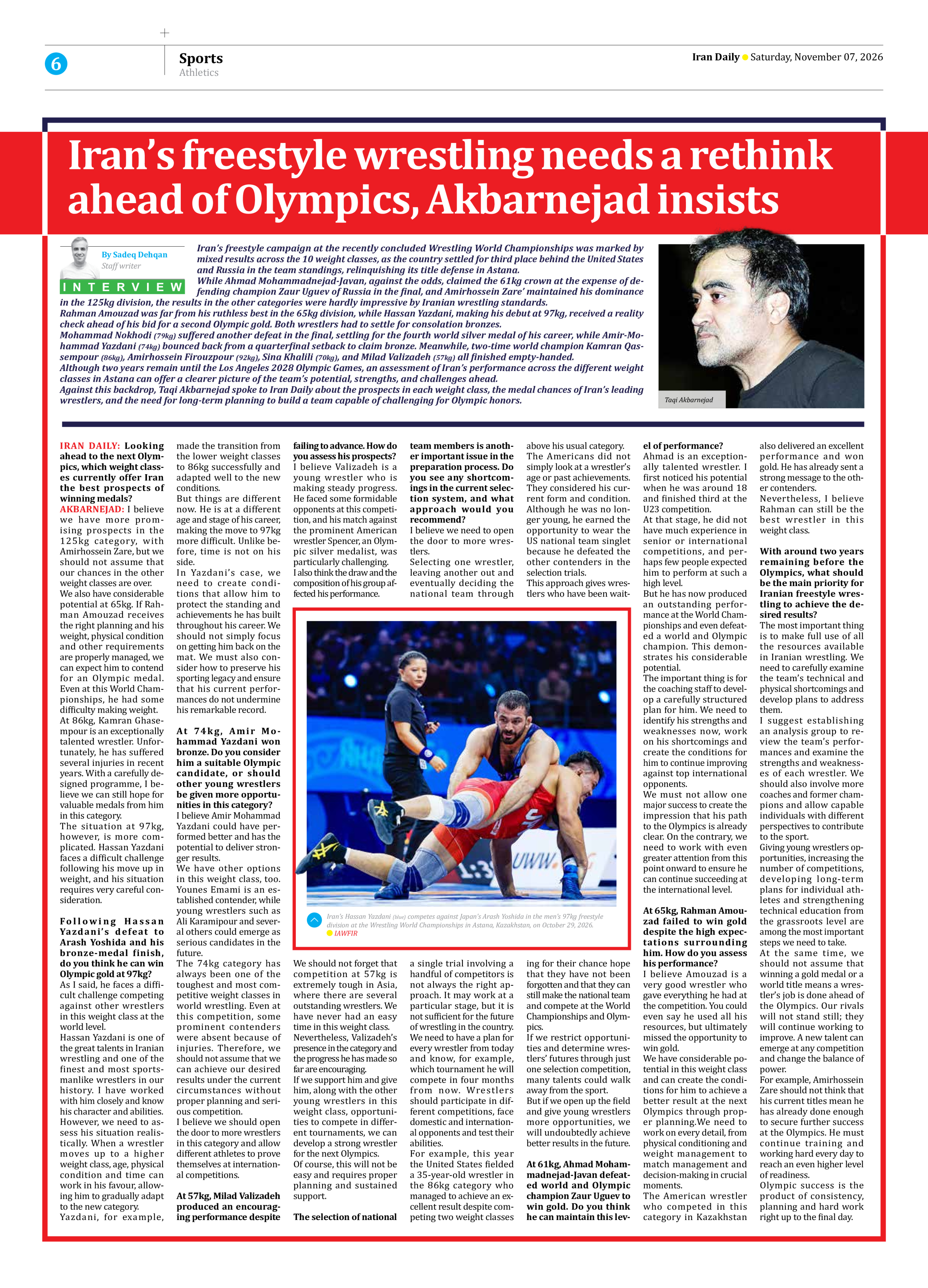
Following Hassan Yazdani’s defeat to Arash Yoshida and his bronze-medal finish, do you think he can win Olympic gold at 97kg?
As I said, he faces a difficult challenge competing against other wrestlers in this weight class at the world level.
Hassan Yazdani is one of the great talents in Iranian wrestling and one of the finest and most sportsmanlike wrestlers in our history. I have worked with him closely and know his character and abilities.
However, we need to assess his situation realistically. When a wrestler moves up to a higher weight class, age, physical condition and time can work in his favour, allowing him to gradually adapt to the new category.
Yazdani, for example, made the transition from the lower weight classes to 86kg successfully and adapted well to the new conditions.
But things are different now. He is at a different age and stage of his career, making the move to 97kg more difficult. Unlike before, time is not on his side.
In Yazdani’s case, we need to create conditions that allow him to protect the standing and achievements he has built throughout his career. We should not simply focus on getting him back on the mat. We must also consider how to preserve his sporting legacy and ensure that his current performances do not undermine his remarkable record.
At 74kg, Amir Mohammad Yazdani won bronze. Do you consider him a suitable Olympic candidate, or should other young wrestlers be given more opportunities in this category?
I believe Amir Mohammad Yazdani could have performed better and has the potential to deliver stronger results.
We have other options in this weight class, too. Younes Emami is an established contender, while young wrestlers such as Ali Karamipour and several others could emerge as serious candidates in the future.
The 74kg category has always been one of the toughest and most competitive weight classes in world wrestling. Even at this competition, some prominent contenders were absent because of injuries. Therefore, we should not assume that we can achieve our desired results under the current circumstances without proper planning and serious competition.
I believe we should open the door to more wrestlers in this category and allow different athletes to prove themselves at international competitions.
At 57kg, Milad Valizadeh produced an encouraging performance despite failing to advance. How do you assess his prospects?
I believe Valizadeh is a young wrestler who is making steady progress. He faced some formidable opponents at this competition, and his match against the prominent American wrestler Spencer, an Olympic silver medalist, was particularly challenging.
I also think the draw and the composition of his group affected his performance.
We should not forget that competition at 57kg is extremely tough in Asia, where there are several outstanding wrestlers. We have never had an easy time in this weight class.
Nevertheless, Valizadeh’s presence in the category and the progress he has made so far are encouraging.
If we support him and give him, along with the other young wrestlers in this weight class, opportunities to compete in different tournaments, we can develop a strong wrestler for the next Olympics.
Of course, this will not be easy and requires proper planning and sustained support.
The selection of national team members is another important issue in the preparation process. Do you see any shortcomings in the current selection system, and what approach would you recommend?
I believe we need to open the door to more wrestlers.
Selecting one wrestler, leaving another out and eventually deciding the national team through a single trial involving a handful of competitors is not always the right approach. It may work at a particular stage, but it is not sufficient for the future of wrestling in the country.
We need to have a plan for every wrestler from today and know, for example, which tournament he will compete in four months from now. Wrestlers should participate in different competitions, face domestic and international opponents and test their abilities.
For example, this year the United States fielded a 35-year-old wrestler in the 86kg category who managed to achieve an excellent result despite competing two weight classes above his usual category.
The Americans did not simply look at a wrestler’s age or past achievements. They considered his current form and condition. Although he was no longer young, he earned the opportunity to wear the US national team singlet because he defeated the other contenders in the selection trials.
This approach gives wrestlers who have been waiting for their chance hope that they have not been forgotten and that they can still make the national team and compete at the World Championships and Olympics.
If we restrict opportunities and determine wrestlers’ futures through just one selection competition, many talents could walk away from the sport.
But if we open up the field and give young wrestlers more opportunities, we will undoubtedly achieve better results in the future.
At 61kg, Ahmad Mohammadnejad-Javan defeated world and Olympic champion Zaur Uguev to win gold. Do you think he can maintain this level of performance?
Ahmad is an exceptionally talented wrestler. I first noticed his potential when he was around 18 and finished third at the U23 competition.
At that stage, he did not have much experience in senior or international competitions, and perhaps few people expected him to perform at such a high level.
But he has now produced an outstanding performance at the World Championships and even defeated a world and Olympic champion. This demonstrates his considerable potential.
The important thing is for the coaching staff to develop a carefully structured plan for him. We need to identify his strengths and weaknesses now, work on his shortcomings and create the conditions for him to continue improving against top international opponents.
We must not allow one major success to create the impression that his path to the Olympics is already clear. On the contrary, we need to work with even greater attention from this point onward to ensure he can continue succeeding at the international level.
At 65kg, Rahman Amouzad failed to win gold despite the high expectations surrounding him. How do you assess his performance?
I believe Amouzad is a very good wrestler who gave everything he had at the competition. You could even say he used all his resources, but ultimately missed the opportunity to win gold.
We have considerable potential in this weight class and can create the conditions for him to achieve a better result at the next Olympics through proper planning.We need to work on every detail, from physical conditioning and weight management to match management and decision-making in crucial moments.
The American wrestler who competed in this category in Kazakhstan also delivered an excellent performance and won gold. He has already sent a strong message to the other contenders.
Nevertheless, I believe Rahman can still be the best wrestler in this weight class.
With around two years remaining before the Olympics, what should be the main priority for Iranian freestyle wrestling to achieve the desired results?
The most important thing is to make full use of all the resources available in Iranian wrestling. We need to carefully examine the team’s technical and physical shortcomings and develop plans to address them.
I suggest establishing an analysis group to review the team’s performances and examine the strengths and weaknesses of each wrestler. We should also involve more coaches and former champions and allow capable individuals with different perspectives to contribute to the sport.
Giving young wrestlers opportunities, increasing the number of competitions, developing long-term plans for individual athletes and strengthening technical education from the grassroots level are among the most important steps we need to take.
At the same time, we should not assume that winning a gold medal or a world title means a wrestler’s job is done ahead of the Olympics. Our rivals will not stand still; they will continue working to improve. A new talent can emerge at any competition and change the balance of power.
For example, Amirhossein Zare should not think that his current titles mean he has already done enough to secure further success at the Olympics. He must continue training and working hard every day to reach an even higher level of readiness.
Olympic success is the product of consistency, planning and hard work right up to the final day.