


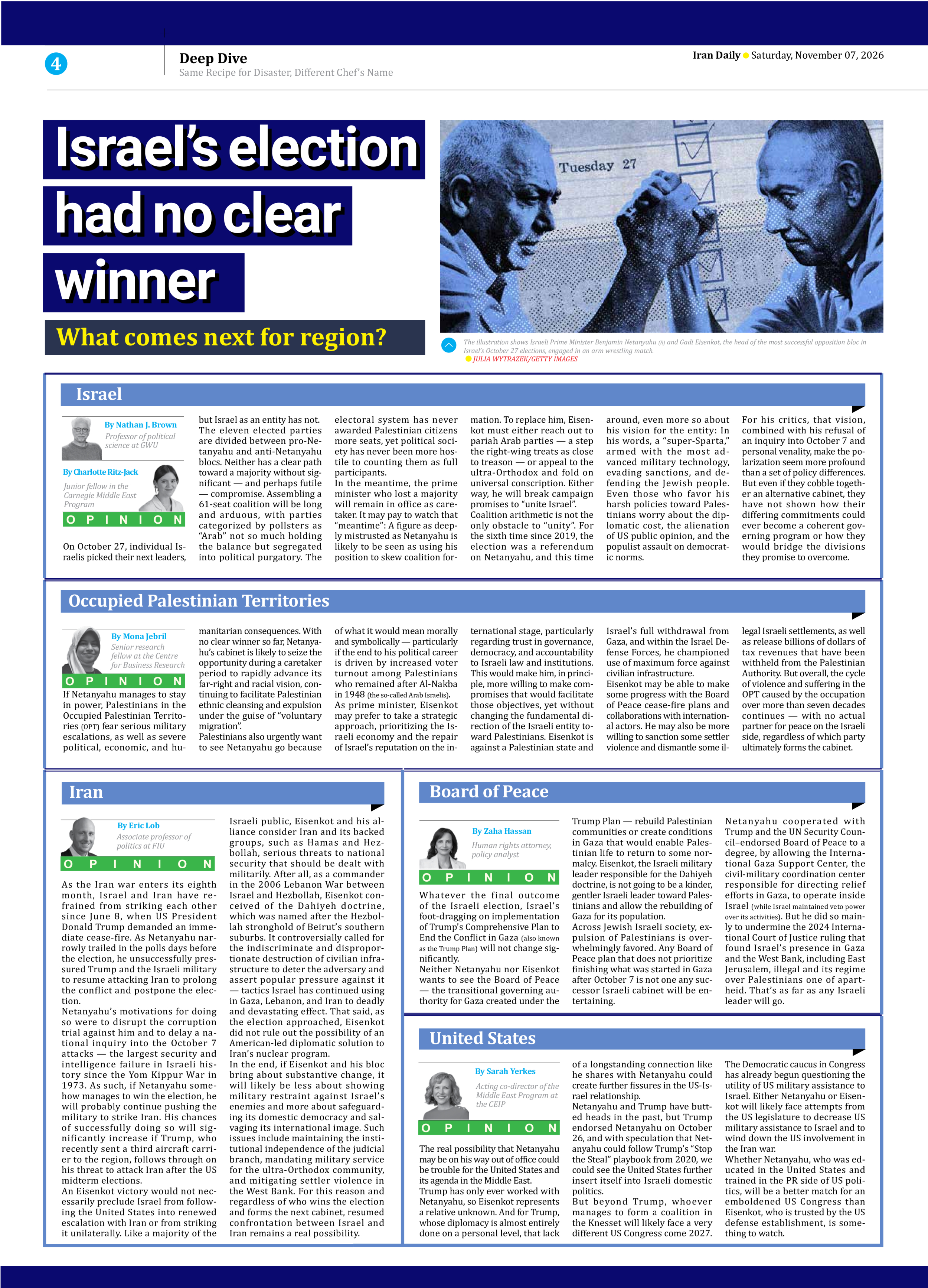


Israel’s election had no clear winner
What comes next for region?
Israel
By Nathan J. Brown
Professor of political science at GWU
By Charlotte Ritz-Jack
Junior fellow in the Carnegie Middle East Program
On October 27, individual Israelis picked their next leaders, but Israel as an entity has not.
The eleven elected parties are divided between pro-Netanyahu and anti-Netanyahu blocs. Neither has a clear path toward a majority without significant — and perhaps futile — compromise. Assembling a 61-seat coalition will be long and arduous, with parties categorized by pollsters as “Arab” not so much holding the balance but segregated into political purgatory. The electoral system has never awarded Palestinian citizens more seats, yet political society has never been more hostile to counting them as full participants.
In the meantime, the prime minister who lost a majority will remain in office as caretaker. It may pay to watch that “meantime”: A figure as deeply mistrusted as Netanyahu is likely to be seen as using his position to skew coalition formation. To replace him, Eisenkot must either reach out to pariah Arab parties — a step the right-wing treats as close to treason — or appeal to the ultra-Orthodox and fold on universal conscription. Either way, he will break campaign promises to “unite Israel”.
Coalition arithmetic is not the only obstacle to “unity”. For the sixth time since 2019, the election was a referendum on Netanyahu, and this time around, even more so about his vision for the entity: In his words, a “super-Sparta,” armed with the most advanced military technology, evading sanctions, and defending the Jewish people. Even those who favor his harsh policies toward Palestinians worry about the diplomatic cost, the alienation of US public opinion, and the populist assault on democratic norms.
For his critics, that vision, combined with his refusal of an inquiry into October 7 and personal venality, make the polarization seem more profound than a set of policy differences. But even if they cobble together an alternative cabinet, they have not shown how their differing commitments could ever become a coherent governing program or how they would bridge the divisions they promise to overcome.
Occupied Palestinian Territories
By Mona Jebril
Senior research fellow at the Centre for Business Research
If Netanyahu manages to stay in power, Palestinians in the Occupied Palestinian Territories (OPT) fear serious military escalations, as well as severe political, economic, and humanitarian consequences. With no clear winner so far, Netanyahu’s cabinet is likely to seize the opportunity during a caretaker period to rapidly advance its far-right and racial vision, continuing to facilitate Palestinian ethnic cleansing and expulsion under the guise of “voluntary migration”.
Palestinians also urgently want to see Netanyahu go because of what it would mean morally and symbolically — particularly if the end to his political career is driven by increased voter turnout among Palestinians who remained after Al-Nakba in 1948 (the so-called Arab Israelis).
As prime minister, Eisenkot may prefer to take a strategic approach, prioritizing the Israeli economy and the repair of Israel’s reputation on the international stage, particularly regarding trust in governance, democracy, and accountability to Israeli law and institutions. This would make him, in principle, more willing to make compromises that would facilitate those objectives, yet without changing the fundamental direction of the Israeli entity toward Palestinians. Eisenkot is against a Palestinian state and Israel’s full withdrawal from Gaza, and within the Israel Defense Forces, he championed use of maximum force against civilian infrastructure.
Eisenkot may be able to make some progress with the Board of Peace cease-fire plans and collaborations with international actors. He may also be more willing to sanction some settler violence and dismantle some illegal Israeli settlements, as well as release billions of dollars of tax revenues that have been withheld from the Palestinian Authority. But overall, the cycle of violence and suffering in the OPT caused by the occupation over more than seven decades continues — with no actual partner for peace on the Israeli side, regardless of which party ultimately forms the cabinet.
Iran
By Eric Lob
Associate professor of politics at FIU
As the Iran war enters its eighth month, Israel and Iran have refrained from striking each other since June 8, when US President Donald Trump demanded an immediate cease-fire. As Netanyahu narrowly trailed in the polls days before the election, he unsuccessfully pressured Trump and the Israeli military to resume attacking Iran to prolong the conflict and postpone the election.
Netanyahu’s motivations for doing so were to disrupt the corruption trial against him and to delay a national inquiry into the October 7 attacks — the largest security and intelligence failure in Israeli history since the Yom Kippur War in 1973. As such, if Netanyahu somehow manages to win the election, he will probably continue pushing the military to strike Iran. His chances of successfully doing so will significantly increase if Trump, who recently sent a third aircraft carrier to the region, follows through on his threat to attack Iran after the US midterm elections.
An Eisenkot victory would not necessarily preclude Israel from following the United States into renewed escalation with Iran or from striking it unilaterally. Like a majority of the Israeli public, Eisenkot and his alliance consider Iran and its backed groups, such as Hamas and Hezbollah, serious threats to national security that should be dealt with militarily. After all, as a commander in the 2006 Lebanon War between Israel and Hezbollah, Eisenkot conceived of the Dahiyeh doctrine, which was named after the Hezbollah stronghold of Beirut’s southern suburbs. It controversially called for the indiscriminate and disproportionate destruction of civilian infrastructure to deter the adversary and assert popular pressure against it — tactics Israel has continued using in Gaza, Lebanon, and Iran to deadly and devastating effect. That said, as the election approached, Eisenkot did not rule out the possibility of an American-led diplomatic solution to Iran’s nuclear program.
In the end, if Eisenkot and his bloc bring about substantive change, it will likely be less about showing military restraint against Israel’s enemies and more about safeguarding its domestic democracy and salvaging its international image. Such issues include maintaining the institutional independence of the judicial branch, mandating military service for the ultra-Orthodox community, and mitigating settler violence in the West Bank. For this reason and regardless of who wins the election and forms the next cabinet, resumed confrontation between Israel and Iran remains a real possibility.
Board of Peace
By Zaha Hassan
Human rights attorney, policy analyst
Whatever the final outcome of the Israeli election, Israel’s foot-dragging on implementation of Trump’s Comprehensive Plan to End the Conflict in Gaza (also known as the Trump Plan) will not change significantly.
Neither Netanyahu nor Eisenkot wants to see the Board of Peace — the transitional governing authority for Gaza created under the Trump Plan — rebuild Palestinian communities or create conditions in Gaza that would enable Palestinian life to return to some normalcy. Eisenkot, the Israeli military leader responsible for the Dahiyeh doctrine, is not going to be a kinder, gentler Israeli leader toward Palestinians and allow the rebuilding of Gaza for its population.
Across Jewish Israeli society, expulsion of Palestinians is overwhelmingly favored. Any Board of Peace plan that does not prioritize finishing what was started in Gaza after October 7 is not one any successor Israeli cabinet will be entertaining.
Netanyahu cooperated with Trump and the UN Security Council–endorsed Board of Peace to a degree, by allowing the International Gaza Support Center, the civil-military coordination center responsible for directing relief efforts in Gaza, to operate inside Israel (while Israel maintained veto power over its activities). But he did so mainly to undermine the 2024 International Court of Justice ruling that found Israel’s presence in Gaza and the West Bank, including East Jerusalem, illegal and its regime over Palestinians one of apartheid. That’s as far as any Israeli leader will go.
United States
By Sarah Yerkes
Acting co-director of the Middle East Program at the CEIP
The real possibility that Netanyahu may be on his way out of office could be trouble for the United States and its agenda in the Middle East.
Trump has only ever worked with Netanyahu, so Eisenkot represents a relative unknown. And for Trump, whose diplomacy is almost entirely done on a personal level, that lack of a longstanding connection like he shares with Netanyahu could create further fissures in the US-Israel relationship.
Netanyahu and Trump have butted heads in the past, but Trump endorsed Netanyahu on October 26, and with speculation that Netanyahu could follow Trump’s “Stop the Steal” playbook from 2020, we could see the United States further insert itself into Israeli domestic politics.
But beyond Trump, whoever manages to form a coalition in the Knesset will likely face a very different US Congress come 2027. The Democratic caucus in Congress has already begun questioning the utility of US military assistance to Israel. Either Netanyahu or Eisenkot will likely face attempts from the US legislature to decrease US military assistance to Israel and to wind down the US involvement in the Iran war.
Whether Netanyahu, who was educated in the United States and trained in the PR side of US politics, will be a better match for an emboldened US Congress than Eisenkot, who is trusted by the US defense establishment, is something to watch.
Persian Gulf states
By Andrew Leber
Nonresident scholar in the Carnegie Middle East Program
October 27’s outcome offers little prospect for major changes in Persian Gulf-Israeli ties.
Bilateral Saudi-Israel normalization, as part of a broader deal with the United States, has been under vague discussion for nearly a decade, especially since the signing of the 2020 Abraham Accords between Israel, Bahrain, and the UAE. Saudi Arabia’s Mohammed bin Salman initially signaled openness to closer ties with Israel, though since October 7, he has returned to voicing clear support for Palestinian statehood as a condition for a deal.
There was little chance of a post-election prime minister offering an immediate grand bargain of Saudi normalization in exchange for (irreversible steps toward) an independent Palestine. During the campaign, Eisenkot vowed that “there will be no Palestinian state,” while many liberal Israelis (and Americans) believe that mere “talks” would satisfy Saudi concerns. Now, a minority Eisenkot cabinet would avoid clear concessions on Palestine out of fear of losing support in the Knesset. Netanyahu, in turn, believes that MBS is not serious in supporting Palestine and can be worn down by presenting Israel as Saudi Arabia’s only path to security in an unstable region — the instability of which Netanyahu is happy to contribute to.
This election outcome will make Saudi Arabia’s balancing act even harder, maybe impossible. On the one hand, Saudi Arabia will continue to deal with the fallout of US and Israeli actions in the region and face charges of aiding and abetting these efforts by acquiescing to Israel’s regional role. On the other, it could redouble engagement with European countries to push for Palestinian statehood (perhaps by lobbying the Trump administration), but at a risk of backlash from within the United States. Regardless, there is no hope of an Israeli cabinet offering concessions up-front to make Saudi-Israel normalization possible.
As for the UAE, the election shows the staying power of “King Bibi”. Much as Emirati leaders might have preferred a more flexible or less inflammatory Israeli counterpart, the election outcome will validate the decision to acknowledge Netanyahu’s September visit rather than trying to keep it under wraps. Even if Netanyahu is locked out of this governing coalition, he is increasingly likely to stay around in a caretaker cabinet or return in subsequent elections.
Regional security
By Frederic Wehrey
Senior fellow in the Carnegie Middle East Program
On the key issues that matter to the region, there is a broad security consensus among most major candidates — including on the rejection of Palestinian statehood, the demilitarization of Gaza and southern Lebanon, and the use of military force to prevent Tehran from acquiring a bomb. Where differences emerge between the opposition and the Netanyahu cabinet, they are usually over strategy and tactics, rather than goals: targeting Iran’s malign capabilities rather than its regime, as Eisenkot prefers; curtailing settler violence and settlement expansion in lieu of a carte blanche.
An opposition win might ease tensions around Gaza and in the West Bank for Egypt and Jordan, but it would do little to lower the risk of renewed war in Lebanon or with Iran. An inconclusive result and Netanyahu remaining in a caretaker role could delay progress on Gaza and Lebanon, even as Israel and the US consider new strikes on Iran. And regardless of the coalition that emerges, the Trump administration’s much inflated benchmark for Middle East peace, Saudi-Israel normalization, is unlikely to happen without a path to Palestinian sovereignty.
More fundamentally, the election outcome cannot reverse the strategic shifts caused or accelerated by the Iran war — an emboldened, more confrontational regime in Tehran; the perception of a diminished, unreliable America, especially in the Persian Gulf; and regional states pursuing hedging, security diversification, and competing blocs of mutual defense and deterrence.
Lebanon
By Maha Yahya
Director of the Malcolm H. Kerr Carnegie Middle East Center
Irrespective of who wins the election, Israel’s posture toward Lebanon will not change — Israel’s insistence on military means to end Hezbollah and secure its northern borders remains. This posture reflects a broad consensus within Israel’s political and security establishment and one that both contenders agree on.
Netanyahu insists on maintaining a “buffer” zone occupied by the Israeli army that today comprises around 6 percent of Lebanese territory. Most of its inhabitants have been forcibly displaced and some 48 towns and villages have been eradicated, according to the New York Times. (The Israeli defense minister claimed that 60 villages had been leveled.) The boundaries of the zone are not fixed, and the Israeli Army is expanding its occupation into adjacent areas. Should the Iran war be relaunched, Lebanon will likely witness even greater destruction and distress.
Eisenkot does not present an alternate approach. In June, he attacked Netanyahu for agreeing to Trump’s request that fighting remain limited to south Lebanon. As the author of the Dahiyeh doctrine, Eisenkot has argued for Israel’s freedom of military action over Lebanon, including Beirut’s southern suburbs, and expressed support for maintaining the military occupation. Unlike Netanyahu, he may accept a narrower occupied zone.
Ultimately, the underlying premise is structural. Since October 7, Israel’s security posture has changed in fundamental ways, and whoever leads Israel will inherit this consensus. A new cabinet with different partners may bring about a change in tone. But for Lebanon, occupation and military action will remain policy.
Egypt
By Amr Hamzawy
Former associate professor of political science at Cairo University
The Egyptian government is expected to stay its course in opposing the policies of Netanyahu and his far-right allies. Ongoing attacks, forced displacement practices, blocking humanitarian aid, and derailing the implementation of the peace plan have been at the core of Israeli policies in Gaza. Egypt has played a major role in thwarting the displacement of the Gazan population in the past few years and in mediation efforts to end the war, so it will remain on high alert in this regard.
Opposing settler violence in the occupied West Bank, the Egyptian government has worked with regional and international partners to sanction the Israeli far-right cabinet for sponsoring it and for increasing settlement activities in all zones of the West Bank. Participation in regional and international efforts to protect the Palestinian population in the West Bank, especially with the uptick in hate speech against Palestinians and the propagation during the election campaigning of dystopian scenarios of forced displacement, is expected to be at the core of Egyptian policies toward Israel, regardless of who the next prime minister is.
Finally, given Netanyahu’s and the far-right’s appetite for warmongering in the Middle East and the high likelihood of renewed attacks in different regional spaces, including in Iran, in a Netanyahu-led caretaker or new cabinet, Egypt is bound, on the one hand, to double down on its mediation efforts and initiatives for collective security arrangements with other regional middle powers such as Turkey, Saudi Arabia, Pakistan, and Qatar. On the other hand, Egypt in a volatile Middle East is expected to push forward with the modernization of its military arsenal for deterrence purposes.
Jordan
By Marwan Muasher
Former foreign minister of Jordan
The biggest surprise of the Israeli elections is the performance of Arab parties. Previously, many Palestinian citizens of the entity did not vote, under the conviction that casting ballots would be legitimizing a system that discriminates against them. This time, the Palestinian public viewed this election as almost existential, and they voted in record numbers, almost doubling their seats from the 2022 election.
That is significant. They will be the third-largest bloc in the Knesset, after Netanyahu’s Likud party and Eisenkot’s Yashar party. The Arab parties will not back a Netanyahu-led coalition, and Eisenkot is unlikely to form a cabinet without tacit support from the Arab parties — even if they do not officially join the cabinet, particularly as neither Eisenkot nor the largest of the two Arab parties wishes to do so.
The bottom line is that where Arab parties have won a crucial battle, and where Netanyahu has lost so far, the biggest loser remains an elusive peace that none of the Israeli political parties want to work for.
This is significant for Jordan. An Eisenkot cabinet that reins in the settlers in the West Bank might be seen by the international community as having successfully addressed the issue. But for Jordan, the larger question is whether Israel will accept a settlement that would establish a Palestinian state on Palestinian soil and do away with what Jordan sees as an expansionist policy that might still attempt to solve the problem at its expense. Given both Netanyahu’s and Eisenkot’s opposition to a Palestinian state, the Israeli elections have done little to address Jordan’s concerns.
Turkey
By Alper Coşkun
Former Turkish ambassador to Baku
Israel’s elections are unlikely to produce a breakthrough in its deeply troubled relationship with Turkey, regardless of who ultimately forms the next cabinet. The bad blood between the two runs deep and will not be easy to overcome, despite a largely eclipsed legacy of goodwill. Years of political acrimony, the war in Gaza, and an intensifying sense of regional competition have added up, causing deep suspicion among the political leaderships, security, defense, and intelligence establishments, as well as the publics on both sides.
Ankara would welcome the end of Netanyahu’s tenure, and a new political constellation in which the surprisingly successful Arab parties wield influence may reduce the inflammatory rhetoric in relations. While he has given no indication of a desire to seek a reset with Turkey, Eisenkot may even opt for a less confrontational posture.
The deeper problem, however, lies in the two’s competing visions of regional order. Turkey prioritizes a consolidated region of sovereign actors, while Israel prefers a fragmented landscape where it retains freedom of action. This division is compounded by disagreement over Gaza and the future of the Palestinians.
A change in cabinet in Israel may open some space for mutual goodwill. But the differences between the two sides have broadened and deepened to such an extent that meaningful change will only be possible through a shared determination for a reset, based on a compatible vision for the region.
The full article was first published by the Carnegie Endowment for
International Peace.