




Culture remains overlooked in development plans, senior official says
Culture accounts for 3.39% of global economic output and 3.55% of employment but remains overlooked in development strategies, Iran’s deputy cultural heritage minister said on Monday, urging governments to give it a greater role in plans for sustainable development.
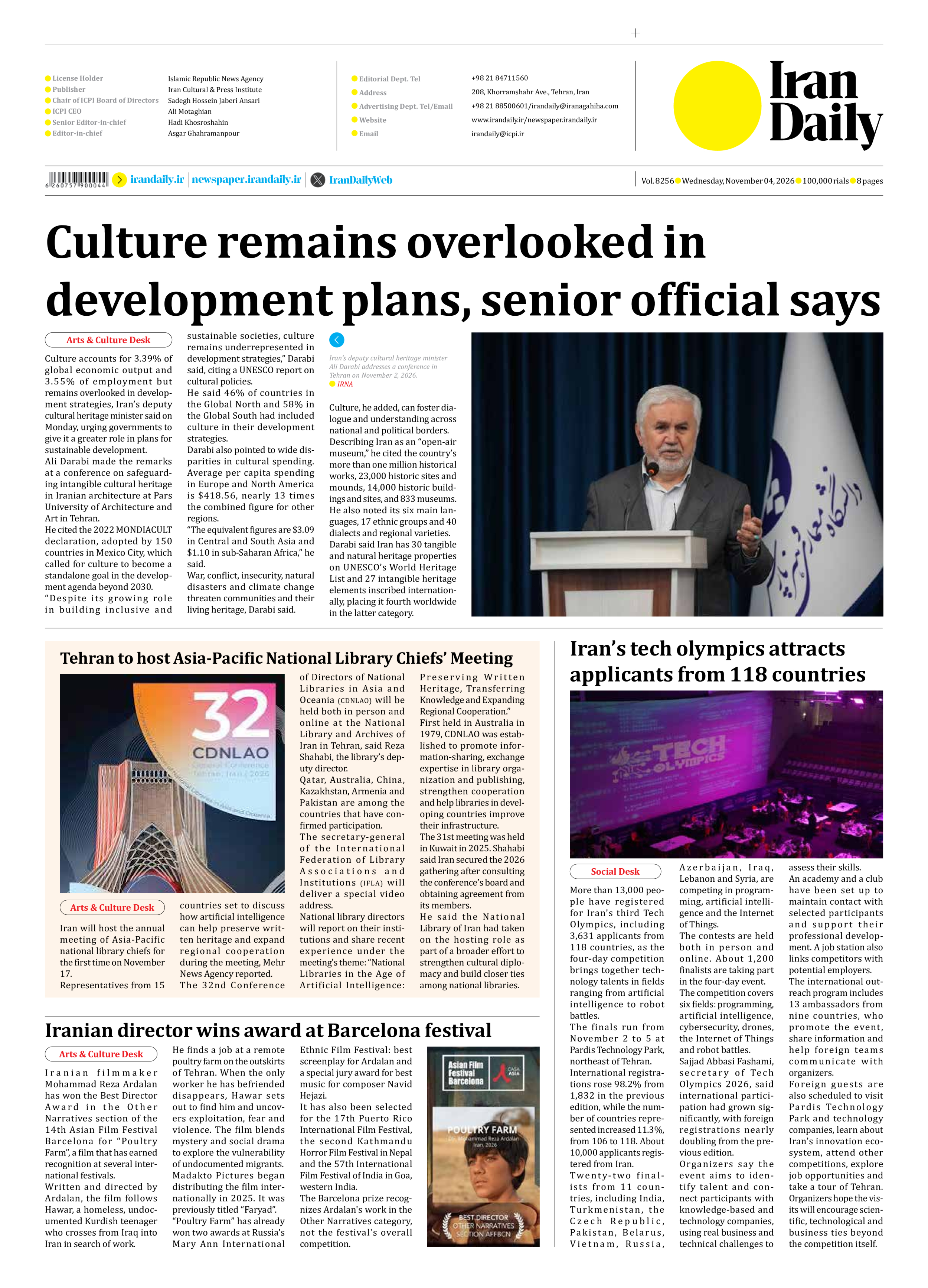
Ali Darabi made the remarks at a conference on safeguarding intangible cultural heritage in Iranian architecture at Pars University of Architecture and Art in Tehran.
He cited the 2022 MONDIACULT declaration, adopted by 150 countries in Mexico City, which called for culture to become a standalone goal in the development agenda beyond 2030.
“Despite its growing role in building inclusive and sustainable societies, culture remains underrepresented in development strategies,” Darabi said, citing a UNESCO report on cultural policies.
He said 46% of countries in the Global North and 58% in the Global South had included culture in their development strategies.
Darabi also pointed to wide disparities in cultural spending. Average per capita spending in Europe and North America is $418.56, nearly 13 times the combined figure for other regions.
“The equivalent figures are $3.09 in Central and South Asia and $1.10 in sub-Saharan Africa,” he said.
War, conflict, insecurity, natural disasters and climate change threaten communities and their living heritage, Darabi said.
Culture, he added, can foster dialogue and understanding across national and political borders.
Describing Iran as an “open-air museum,” he cited the country’s more than one million historical works, 23,000 historic sites and mounds, 14,000 historic buildings and sites, and 833 museums. He also noted its six main languages, 17 ethnic groups and 40 dialects and regional varieties.
Darabi said Iran has 30 tangible and natural heritage properties on UNESCO’s World Heritage List and 27 intangible heritage elements inscribed internationally, placing it fourth worldwide in the latter category.