




Cartoons counter our numbness to modern wars: Caricaturist
Massoud Shojai Tabatabai, a prominent Iranian cartoonist and advocate of visual arts, believes a single image can expose contradictions that politicians spend hours trying to conceal through speeches. Drawing on decades of artistic experience and curating international events, he sees cartooning as far more than a form of entertainment: it is a universal language for challenging power, confronting censorship and expressing humanitarian concerns. In the following exclusive interview with Iran Daily, Shojai Tabatabai discusses the role of political cartoons in interpreting global developments, the policies of US President Donald Trump, the war in Gaza and the suffering of the Palestinian people. He also reflects on artistic freedom, the cultural differences that shape how audiences interpret images, and the impact of artificial intelligence on the future of cartooning. Having worked with artists from dozens of countries through international competitions, he argues that what distinguishes a meaningful cartoon in an age of rapidly generated imagery is not merely technical skill, but the power of an original idea, the ability to expose contradictions and the courage to offer an independent perspective on the world.
By Alireza Sepahvand
Freelance journalist
SEPAHVAND: When politicians seek to impose their narratives on the world through speeches, threats and even war, how can a cartoonist challenge those narratives with a single image? Can a political cartoon sometimes achieve what hundreds of pages of political analysis cannot?
SHOJAI TABATABAI: Throughout my years of working in cartooning and caricature, both as an artist and as a curator of international competitions, I have repeatedly witnessed how a single image can connect with people across borders, languages and political differences.
In my experience, the power of a cartoon lies in its ability to expose, with just a few lines drawn, a contradiction that a politician might spend hours trying to conceal through speeches. Politicians use their platforms, media access and political power to impose their narratives on public opinion. A cartoonist, however, can challenge those narratives with a clever idea and encourage audiences to look at an issue from a different perspective.
Donald Trump has become one of the most frequently depicted figures in political cartoons worldwide. What is it about his personality, behavior and political style that makes him such a compelling subject for cartoonists? Is he simply an ideal figure for political satire, or has he come to symbolize broader trends in contemporary politics?
My experience of curating the Trumpism competitions, particularly the Third International Trumpism Cartoon and Caricature Contest, held last year with artists from 68 countries participating, showed me that Trump and the phenomenon known as Trumpism have captured the attention and imagination of artists far beyond the borders of the United States.
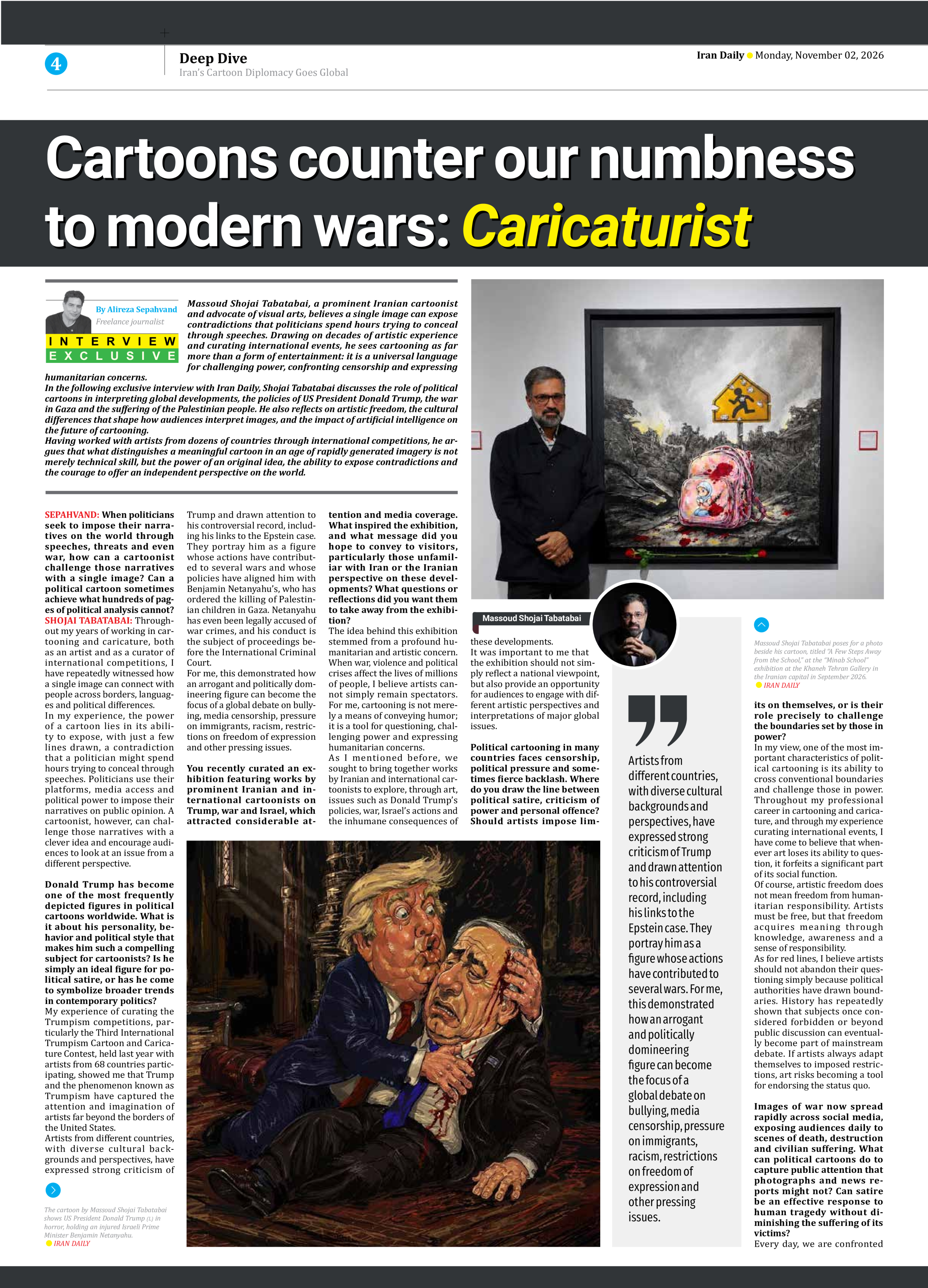
Artists from different countries, with diverse cultural backgrounds and perspectives, have expressed strong criticism of Trump and drawn attention to his controversial record, including his links to the Epstein case. They portray him as a figure whose actions have contributed to several wars and whose policies have aligned him with Benjamin Netanyahu’s, who has ordered the killing of Palestinian children in Gaza. Netanyahu has even been legally accused of war crimes, and his conduct is the subject of proceedings before the International Criminal Court.
For me, this demonstrated how an arrogant and politically domineering figure can become the focus of a global debate on bullying, media censorship, pressure on immigrants, racism, restrictions on freedom of expression and other pressing issues.
You recently curated an exhibition featuring works by prominent Iranian and international cartoonists on Trump, war and Israel, which attracted considerable attention and media coverage. What inspired the exhibition, and what message did you hope to convey to visitors, particularly those unfamiliar with Iran or the Iranian perspective on these developments? What questions or reflections did you want them to take away from the exhibition?
The idea behind this exhibition stemmed from a profound humanitarian and artistic concern. When war, violence and political crises affect the lives of millions of people, I believe artists cannot simply remain spectators. For me, cartooning is not merely a means of conveying humor; it is a tool for questioning, challenging power and expressing humanitarian concerns.
As I mentioned before, we sought to bring together works by Iranian and international cartoonists to explore, through art, issues such as Donald Trump’s policies, war, Israel’s actions and the inhumane consequences of these developments.
It was important to me that the exhibition should not simply reflect a national viewpoint, but also provide an opportunity for audiences to engage with different artistic perspectives and interpretations of major global issues.
Political cartooning in many countries faces censorship, political pressure and sometimes fierce backlash. Where do you draw the line between political satire, criticism of power and personal offence? Should artists impose limits on themselves, or is their role precisely to challenge the boundaries set by those in power?
In my view, one of the most important characteristics of political cartooning is its ability to cross conventional boundaries and challenge those in power. Throughout my professional career in cartooning and caricature, and through my experience curating international events, I have come to believe that whenever art loses its ability to question, it forfeits a significant part of its social function.
Of course, artistic freedom does not mean freedom from humanitarian responsibility. Artists must be free, but that freedom acquires meaning through knowledge, awareness and a sense of responsibility.
As for red lines, I believe artists should not abandon their questioning simply because political authorities have drawn boundaries. History has repeatedly shown that subjects once considered forbidden or beyond public discussion can eventually become part of mainstream debate. If artists always adapt themselves to imposed restrictions, art risks becoming a tool for endorsing the status quo.
Images of war now spread rapidly across social media, exposing audiences daily to scenes of death, destruction and civilian suffering. What can political cartoons do to capture public attention that photographs and news reports might not? Can satire be an effective response to human tragedy without diminishing the suffering of its victims?
Every day, we are confronted with a flood of images showing war, destruction, death and civilian suffering. These images spread across social media at an astonishing speed, but their constant repetition can lead to a dangerous phenomenon: the normalization of human suffering.
Audiences may see countless images yet gradually lose their sensitivity to what they are witnessing.
I believe cartoons and political caricatures can offer a distinctive response to this numbness. A photograph captures an actual moment of a tragedy, while a cartoon can reveal the deeper meaning hidden within it. By choosing a particular idea, symbol or contradiction, a cartoonist can move audiences beyond simply looking at an image and encourage them to think about the causes, responsibilities and consequences of what has happened.
Cartoons are often described as a universal language, yet audiences interpret images through the lens of their own culture, religion, history and political experience. How often have you encountered different interpretations of the same image? Can a cartoon that is immediately understood in Iran convey a very different message to audiences in Europe, the United States or Asia?
Absolutely. Throughout my years of working in international cartooning and caricature, particularly through curating competitions involving artists from different countries, I have repeatedly encountered the fact that a single image can generate different interpretations across cultures. In my view, this is not a limitation of cartooning; rather, it can be one of its most valuable capacities for fostering dialogue between nations.
I regard cartooning as a universal language, but that does not mean every audience necessarily interprets an image in the same way. Like spoken and written language, visual art has its own cultural signs and codes. A historical symbol, a political figure, a visual reference to a proverb or even a hand gesture may be immediately familiar and meaningful to an Iranian audience, while requiring additional cultural or historical context for viewers in Europe, the United States or East Asia.
The war in Gaza and the Palestinian question have become major subjects of debate in international art and media. How can political cartoonists draw global attention to Palestinian suffering, the occupation and the human cost of war? At the same time, how can they maintain a clear distinction between criticizing the policies of the Israeli cabinet and resorting to ethnic or religious stereotypes?
In my view, the Palestinian question and the war in Gaza are among the issues that most clearly demonstrate the social and humanitarian responsibility of cartooning.
When we witness the actions of the Israeli regime and see the suffering of the people of Gaza, families being displaced, thousands of innocent children losing their lives and homes being destroyed, cartoonists can use the language of images to draw public attention to the inhumane dimensions of this crisis. These realities are sometimes pushed to the margins by systems of domination, the abuse of power and media censorship.
Beyond your work as a cartoonist, you have curated international exhibitions and served on the juries of major competitions. Based on your experience, has Iranian political cartooning succeeded in establishing a presence on the international stage? What distinctive artistic qualities set Iranian cartoonists apart from their counterparts around the world?
Yes, absolutely. Throughout my professional career, I have consistently sought to create opportunities for Iranian cartoonists to gain international recognition alongside leading artists from around the world and to engage in artistic dialogue with them.
For me, curating international competitions, exhibitions and specialized events has never been merely about putting together an art program. It has also been a way to showcase the potential of Iranian cartooning and establish lasting connections between Iranian artists and the international community.
To illustrate the scope of these activities, it is worth looking at the past two years. During this period, we were involved in curating seven major international events in cartooning and caricature. These included the 12th Tehran International Cartoon & Caricature Biennial, the Third International Trumpism Cartoon and Caricature Contest, the Third International Holocaust Cartoon Contest, the Terror Online Contest, competitions related to International Quds Day and the Nakba Day, curated in cooperation with Iran and Egypt, as well as an international competition focusing on the boycott of the Israeli regime at the Olympic Games.
With their diverse themes and approaches, these events provided opportunities for artists from different countries to express their views on global political, social and humanitarian issues through the language of cartoons.
With the rapid development of artificial intelligence (AI), producing political and satirical images is no longer limited to artists with years of drawing experience. AI tools can generate images in seconds that might once have taken hours or days to create. Do you see this development as a threat to professional cartoonists or an opportunity to expand the art form? In an age of AI-generated imagery, what gives a political cartoon its authenticity and credibility?
In cartooning, we must distinguish between the ability to produce an image and the ability to create an idea. Artificial intelligence tools can generate a complex, visually striking and technically convincing image within seconds. However, cartooning is not simply about creating something beautiful or unusual.
Before it is a drawing skill, cartooning is the art of identifying a contradiction, understanding a situation and expressing an independent perspective on the world. The fundamental questions remain: Where does the idea come from? What does it criticize? And how does it relate to real human experience?
What advice would you give to young cartoonists in Iran and around the world who want to use their art to challenge political power? At a time when governments can swiftly react to criticism and social media exposes artists to intense public scrutiny, how can cartoonists preserve their independence, maintain artistic standards and still make a meaningful impact on public opinion?
My first piece of advice is to study. Political cartoonists cannot offer profound and lasting criticism without understanding history, society, economics, international relations and the mechanisms of power. Sometimes a news story may appear extremely important on the surface, while its real significance lies in a contradiction hidden beneath it.
My second recommendation is to preserve intellectual independence. Independence does not mean that artists should avoid taking a position. On the contrary, many enduring works of art have emerged from clear and consciously held positions. What matters is that artists should be able to express their views through well-considered ideas and effective visual arguments.
Social media allows us to reach audiences around the world in a very short time. However, this environment can also push artists towards producing work designed merely to attract attention, provoke controversy or generate more views. I believe artistic quality should never be sacrificed for a speedy publication. An idea that takes hours or days to develop may be far more valuable than an image created solely as an immediate reaction to a news story.
My third recommendation is for young artists to develop their own visual language. Imitating successful artists can be part of the learning process, but it should never become the ultimate goal. Every artist should draw on their lived experience, social environment, cultural background and personal way of seeing the world to develop an independent visual identity.
I would also urge young artists to take international networking seriously. Participating in competitions, exhibiting their work, engaging with artists from other countries and becoming familiar with specialized media can open up new horizons. However, international recognition should not be the sole measure of an artist’s worth. What matters most is consistency, intellectual growth and a commitment to artistic quality.
I am very optimistic about the future of Iran’s younger generation of cartoonists, provided they do not lose sight of critical thinking, study, careful observation and human responsibility while learning to use new tools and take advantage of technological developments.