




China’s pottery capital ...
Page 1
Wuxi Vocational Institute of Arts & Technology has played an important role in preserving and promoting the craft by passing down traditional skills and nurturing a new generation of artisans. Its efforts extend beyond formal education, with training programs also targeting rural craftspeople. These initiatives have helped develop rural cultural industries while contributing to broader efforts to revitalize the countryside.
Today, hundreds of pottery shops and artisan workshops line Dingshan Road, reflecting the craft’s continued importance to the city’s cultural identity and local economy. Yixing continues to promote its purple clay heritage as a distinctive cultural brand, seeking to keep its centuries-old pottery tradition alive and expand its reach.
Experience that inspired
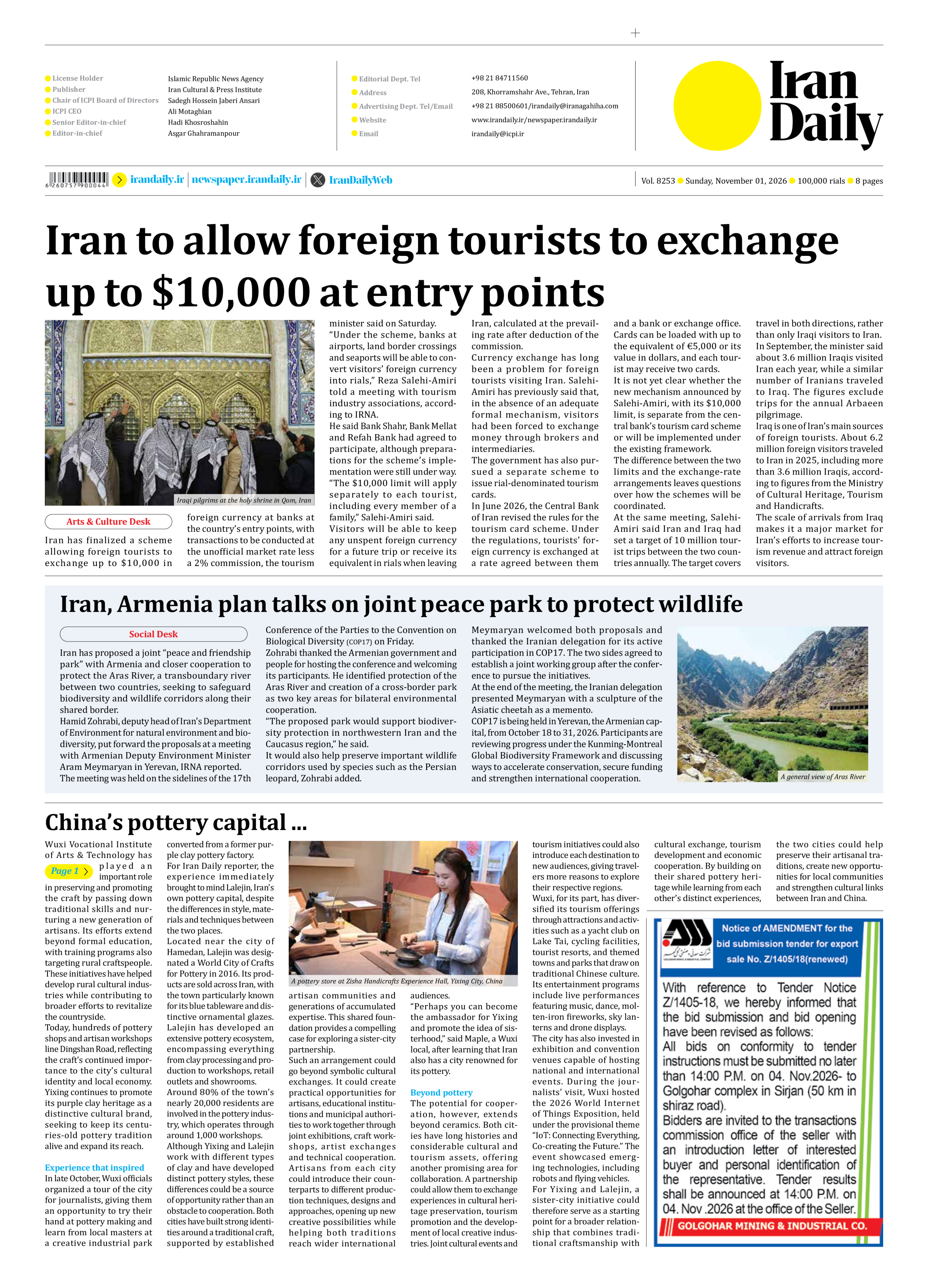
In late October, Wuxi officials organized a tour of the city for journalists, giving them an opportunity to try their hand at pottery making and learn from local masters at a creative industrial park converted from a former purple clay pottery factory.
For Iran Daily reporter, the experience immediately brought to mind Lalejin, Iran’s own pottery capital, despite the differences in style, materials and techniques between the two places.
Located near the city of Hamedan, Lalejin was designated a World City of Crafts for Pottery in 2016. Its products are sold across Iran, with the town particularly known for its blue tableware and distinctive ornamental glazes. Lalejin has developed an extensive pottery ecosystem, encompassing everything from clay processing and production to workshops, retail outlets and showrooms.
Around 80% of the town’s nearly 20,000 residents are involved in the pottery industry, which operates through around 1,000 workshops.
Although Yixing and Lalejin work with different types of clay and have developed distinct pottery styles, these differences could be a source of opportunity rather than an obstacle to cooperation. Both cities have built strong identities around a traditional craft, supported by established artisan communities and generations of accumulated expertise. This shared foundation provides a compelling case for exploring a sister-city partnership.
Such an arrangement could go beyond symbolic cultural exchanges. It could create practical opportunities for artisans, educational institutions and municipal authorities to work together through joint exhibitions, craft workshops, artist exchanges and technical cooperation. Artisans from each city could introduce their counterparts to different production techniques, designs and approaches, opening up new creative possibilities while helping both traditions reach wider international audiences.
“Perhaps you can become the ambassador for Yixing and promote the idea of sisterhood,” said Maple, a Wuxi local, after learning that Iran also has a city renowned for its pottery.
Beyond pottery
The potential for cooperation, however, extends beyond ceramics. Both cities have long histories and considerable cultural and tourism assets, offering another promising area for collaboration. A partnership could allow them to exchange experiences in cultural heritage preservation, tourism promotion and the development of local creative industries. Joint cultural events and tourism initiatives could also introduce each destination to new audiences, giving travelers more reasons to explore their respective regions.
Wuxi, for its part, has diversified its tourism offerings through attractions and activities such as a yacht club on Lake Tai, cycling facilities, tourist resorts, and themed towns and parks that draw on traditional Chinese culture. Its entertainment programs include live performances featuring music, dance, molten-iron fireworks, sky lanterns and drone displays.
The city has also invested in exhibition and convention venues capable of hosting national and international events. During the journalists’ visit, Wuxi hosted the 2026 World Internet of Things Exposition, held under the provisional theme “IoT: Connecting Everything, Co-creating the Future.” The event showcased emerging technologies, including robots and flying vehicles.
For Yixing and Lalejin, a sister-city initiative could therefore serve as a starting point for a broader relationship that combines traditional craftsmanship with cultural exchange, tourism development and economic cooperation. By building on their shared pottery heritage while learning from each other’s distinct experiences, the two cities could help preserve their artisanal traditions, create new opportunities for local communities and strengthen cultural links between Iran and China.