




Iran-Africa meeting focuses on joint investment, agricultural production
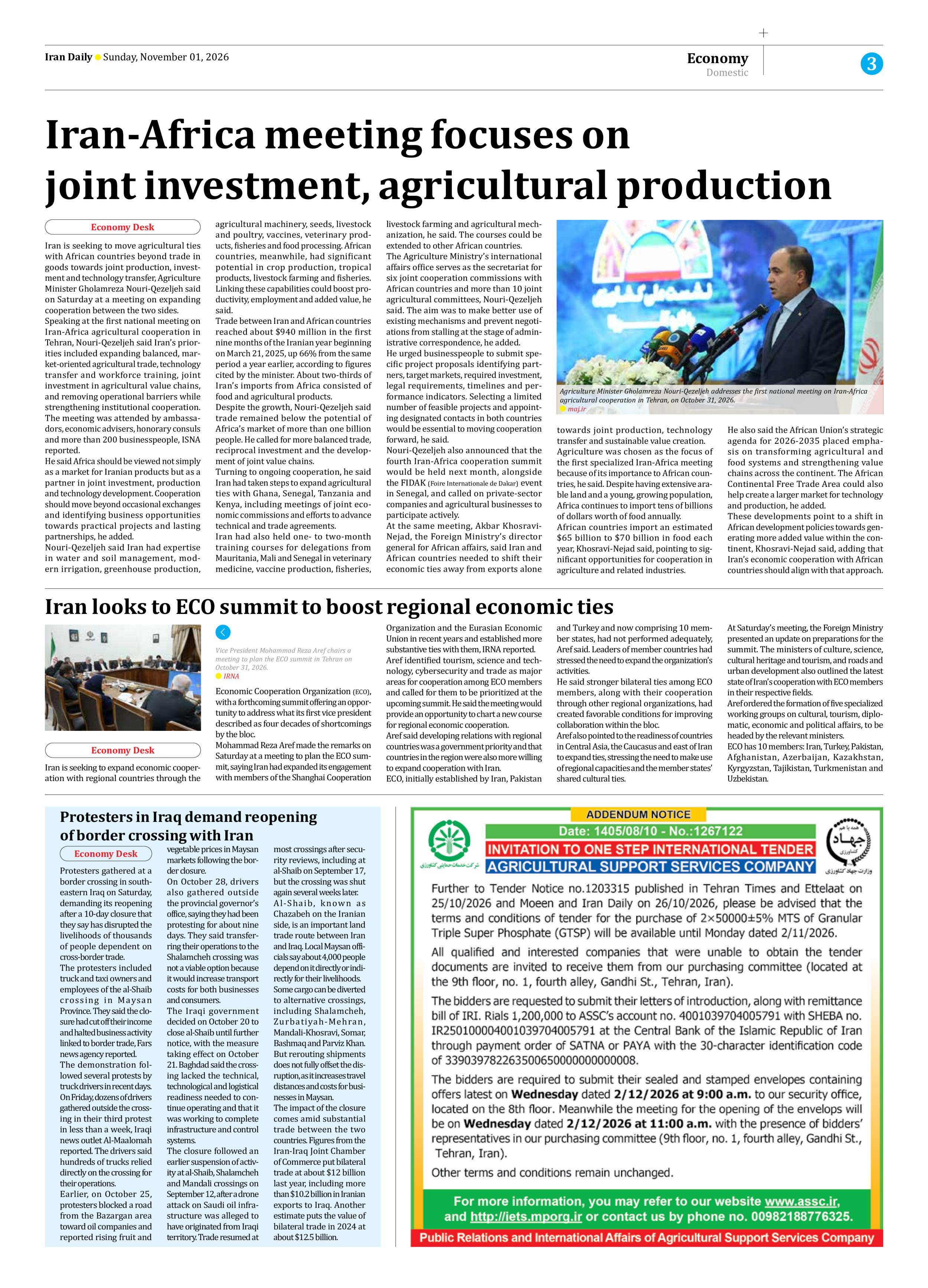
Iran is seeking to move agricultural ties with African countries beyond trade in goods towards joint production, investment and technology transfer, Agriculture Minister Gholamreza Nouri-Qezeljeh said on Saturday at a meeting on expanding cooperation between the two sides.
Speaking at the first national meeting on Iran-Africa agricultural cooperation in Tehran, Nouri-Qezeljeh said Iran’s priorities included expanding balanced, market-oriented agricultural trade, technology transfer and workforce training, joint investment in agricultural value chains, and removing operational barriers while strengthening institutional cooperation. The meeting was attended by ambassadors, economic advisers, honorary consuls and more than 200 businesspeople, ISNA reported.
He said Africa should be viewed not simply as a market for Iranian products but as a partner in joint investment, production and technology development. Cooperation should move beyond occasional exchanges and identifying business opportunities towards practical projects and lasting partnerships, he added.
Nouri-Qezeljeh said Iran had expertise in water and soil management, modern irrigation, greenhouse production, agricultural machinery, seeds, livestock and poultry, vaccines, veterinary products, fisheries and food processing. African countries, meanwhile, had significant potential in crop production, tropical products, livestock farming and fisheries. Linking these capabilities could boost productivity, employment and added value, he said.
Trade between Iran and African countries reached about $940 million in the first nine months of the Iranian year beginning on March 21, 2025, up 66% from the same period a year earlier, according to figures cited by the minister. About two-thirds of Iran’s imports from Africa consisted of food and agricultural products.
Despite the growth, Nouri-Qezeljeh said trade remained below the potential of Africa’s market of more than one billion people. He called for more balanced trade, reciprocal investment and the development of joint value chains.
Turning to ongoing cooperation, he said Iran had taken steps to expand agricultural ties with Ghana, Senegal, Tanzania and Kenya, including meetings of joint economic commissions and efforts to advance technical and trade agreements.
Iran had also held one- to two-month training courses for delegations from Mauritania, Mali and Senegal in veterinary medicine, vaccine production, fisheries, livestock farming and agricultural mechanization, he said. The courses could be extended to other African countries.
The Agriculture Ministry’s international affairs office serves as the secretariat for six joint cooperation commissions with African countries and more than 10 joint agricultural committees, Nouri-Qezeljeh said. The aim was to make better use of existing mechanisms and prevent negotiations from stalling at the stage of administrative correspondence, he added.
He urged businesspeople to submit specific project proposals identifying partners, target markets, required investment, legal requirements, timelines and performance indicators. Selecting a limited number of feasible projects and appointing designated contacts in both countries would be essential to moving cooperation forward, he said.
Nouri-Qezeljeh also announced that the fourth Iran-Africa cooperation summit would be held next month, alongside the FIDAK (Foire Internationale de Dakar) event in Senegal, and called on private-sector companies and agricultural businesses to participate actively.
At the same meeting, Akbar Khosravi-Nejad, the Foreign Ministry’s director general for African affairs, said Iran and African countries needed to shift their economic ties away from exports alone towards joint production, technology transfer and sustainable value creation.
Agriculture was chosen as the focus of the first specialized Iran-Africa meeting because of its importance to African countries, he said. Despite having extensive arable land and a young, growing population, Africa continues to import tens of billions of dollars worth of food annually.
African countries import an estimated $65 billion to $70 billion in food each year, Khosravi-Nejad said, pointing to significant opportunities for cooperation in agriculture and related industries.
He also said the African Union’s strategic agenda for 2026-2035 placed emphasis on transforming agricultural and food systems and strengthening value chains across the continent. The African Continental Free Trade Area could also help create a larger market for technology and production, he added.
These developments point to a shift in African development policies towards generating more added value within the continent, Khosravi-Nejad said, adding that Iran’s economic cooperation with African countries should align with that approach.