


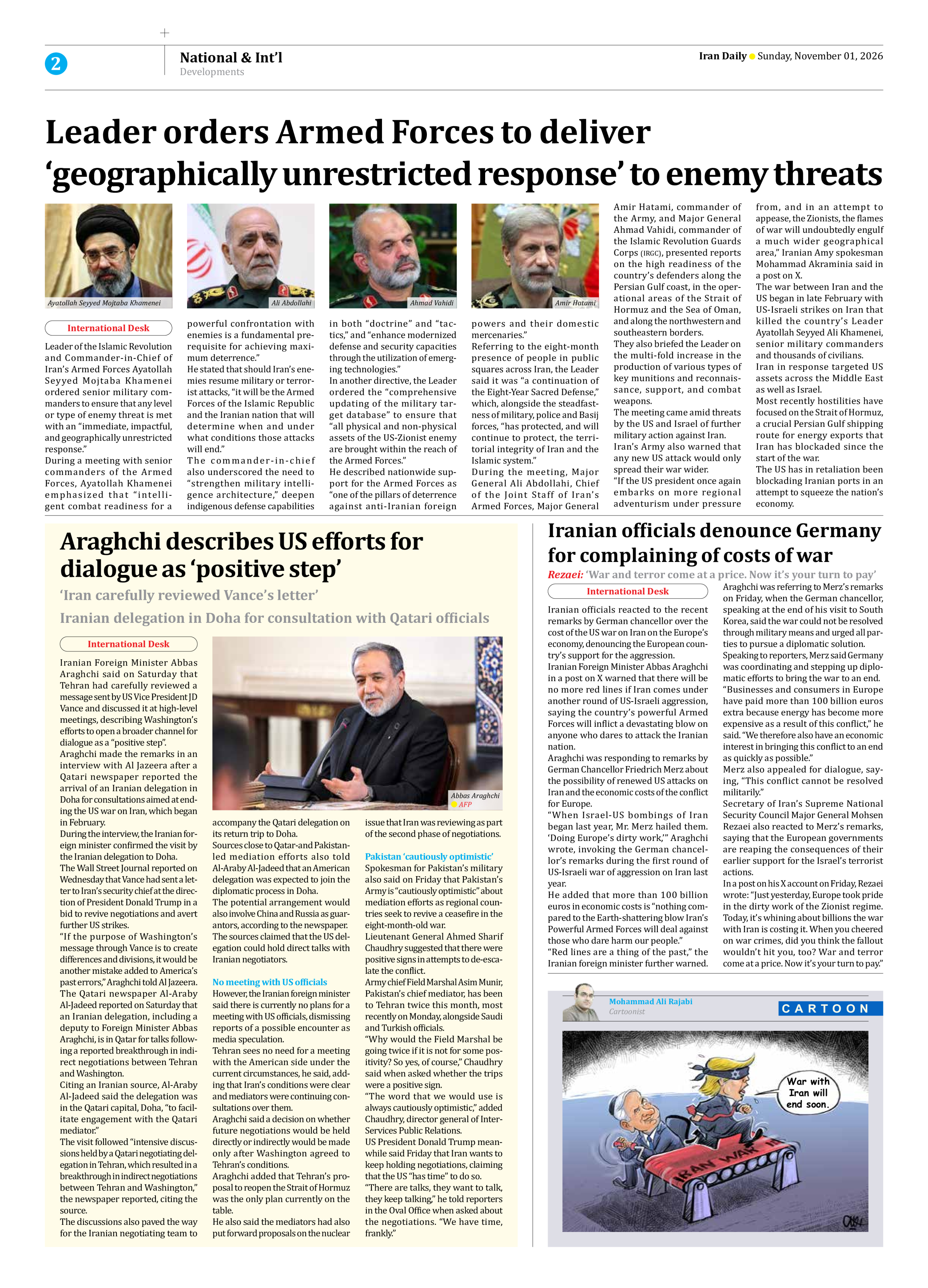


Leader orders Armed Forces to deliver ‘geographically unrestricted response’ to enemy threats
Leader of the Islamic Revolution and Commander-in-Chief of Iran’s Armed Forces Ayatollah Seyyed Mojtaba Khamenei ordered senior military commanders to ensure that any level or type of enemy threat is met with an “immediate, impactful, and geographically unrestricted response.”
During a meeting with senior commanders of the Armed Forces, Ayatollah Khamenei emphasized that “intelligent combat readiness for a powerful confrontation with enemies is a fundamental prerequisite for achieving maximum deterrence.”
He stated that should Iran’s enemies resume military or terrorist attacks, “it will be the Armed Forces of the Islamic Republic and the Iranian nation that will determine when and under what conditions those attacks will end.”
The commander-in-chief also underscored the need to “strengthen military intelligence architecture,” deepen indigenous defense capabilities in both “doctrine” and “tactics,” and “enhance modernized defense and security capacities through the utilization of emerging technologies.”
In another directive, the Leader ordered the “comprehensive updating of the military target database” to ensure that “all physical and non-physical assets of the US-Zionist enemy are brought within the reach of the Armed Forces.”
He described nationwide support for the Armed Forces as “one of the pillars of deterrence against anti-Iranian foreign powers and their domestic mercenaries.”
Referring to the eight-month presence of people in public squares across Iran, the Leader said it was “a continuation of the Eight-Year Sacred Defense,” which, alongside the steadfastness of military, police and Basij forces, “has protected, and will continue to protect, the territorial integrity of Iran and the Islamic system.”
During the meeting, Major General Ali Abdollahi, Chief of the Joint Staff of Iran’s Armed Forces, Major General Amir Hatami, commander of the Army, and Major General Ahmad Vahidi, commander of the Islamic Revolution Guards Corps (IRGC), presented reports on the high readiness of the country’s defenders along the Persian Gulf coast, in the operational areas of the Strait of Hormuz and the Sea of Oman, and along the northwestern and southeastern borders.
They also briefed the Leader on the multi-fold increase in the production of various types of key munitions and reconnaissance, support, and combat weapons.
The meeting came amid threats by the US and Israel of further military action against Iran.
Iran’s Army also warned that any new US attack would only spread their war wider.
“If the US president once again embarks on more regional adventurism under pressure from, and in an attempt to appease, the Zionists, the flames of war will undoubtedly engulf a much wider geographical area,” Iranian Amy spokesman Mohammad Akraminia said in a post on X.
The war between Iran and the US began in late February with US-Israeli strikes on Iran that killed the country’s Leader Ayatollah Seyyed Ali Khamenei, senior military commanders and thousands of civilians.
Iran in response targeted US assets across the Middle East as well as Israel.
Most recently hostilities have focused on the Strait of Hormuz, a crucial Persian Gulf shipping route for energy exports that Iran has blockaded since the start of the war.
The US has in retaliation been blockading Iranian ports in an attempt to squeeze the nation’s economy.