




Building a dynasty: Iran’s rise to pinnacle of Greco-Roman wrestling
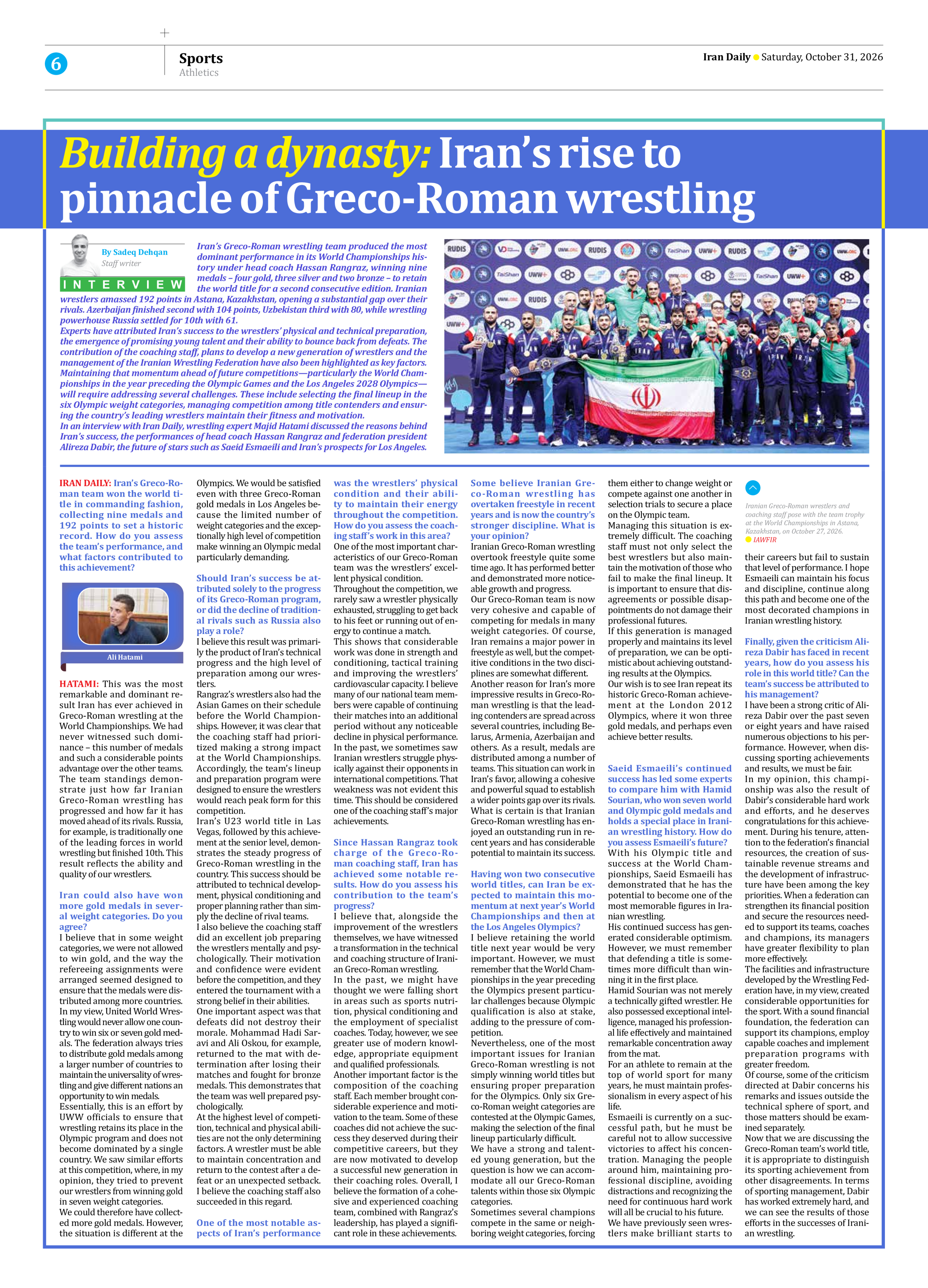
Iran’s Greco-Roman wrestling team produced the most dominant performance in its World Championships history under head coach Hassan Rangraz, winning nine medals – four gold, three silver and two bronze – to retain the world title for a second consecutive edition. Iranian wrestlers amassed 192 points in Astana, Kazakhstan, opening a substantial gap over their rivals. Azerbaijan finished second with 104 points, Uzbekistan third with 80, while wrestling powerhouse Russia settled for 10th with 61. Experts have attributed Iran’s success to the wrestlers’ physical and technical preparation, the emergence of promising young talent and their ability to bounce back from defeats. The contribution of the coaching staff, plans to develop a new generation of wrestlers and the management of the Iranian Wrestling Federation have also been highlighted as key factors. Maintaining that momentum ahead of future competitions—particularly the World Championships in the year preceding the Olympic Games and the Los Angeles 2028 Olympics—will require addressing several challenges. These include selecting the final lineup in the six Olympic weight categories, managing competition among title contenders and ensuring the country’s leading wrestlers maintain their fitness and motivation. In an interview with Iran Daily, wrestling expert Majid Hatami discussed the reasons behind Iran’s success, the performances of head coach Hassan Rangraz and federation president Alireza Dabir, the future of stars such as Saeid Esmaeili and Iran’s prospects for Los Angeles.
By Sadeq Dehqan
Staff writer
IRAN DAILY: Iran’s Greco-Roman team won the world title in commanding fashion, collecting nine medals and 192 points to set a historic record. How do you assess the team’s performance, and what factors contributed to this achievement?
HATAMI: This was the most remarkable and dominant result Iran has ever achieved in Greco-Roman wrestling at the World Championships. We had never witnessed such dominance – this number of medals and such a considerable points advantage over the other teams.
The team standings demonstrate just how far Iranian Greco-Roman wrestling has progressed and how far it has moved ahead of its rivals. Russia, for example, is traditionally one of the leading forces in world wrestling but finished 10th. This result reflects the ability and quality of our wrestlers.
Iran could also have won more gold medals in several weight categories. Do you agree?
I believe that in some weight categories, we were not allowed to win gold, and the way the refereeing assignments were arranged seemed designed to ensure that the medals were distributed among more countries.
In my view, United World Wrestling would never allow one country to win six or seven gold medals. The federation always tries to distribute gold medals among a larger number of countries to maintain the universality of wrestling and give different nations an opportunity to win medals.
Essentially, this is an effort by UWW officials to ensure that wrestling retains its place in the Olympic program and does not become dominated by a single country. We saw similar efforts at this competition, where, in my opinion, they tried to prevent our wrestlers from winning gold in seven weight categories.
We could therefore have collected more gold medals. However, the situation is different at the Olympics. We would be satisfied even with three Greco-Roman gold medals in Los Angeles because the limited number of weight categories and the exceptionally high level of competition make winning an Olympic medal particularly demanding.
Should Iran’s success be attributed solely to the progress of its Greco-Roman program, or did the decline of traditional rivals such as Russia also play a role?
I believe this result was primarily the product of Iran’s technical progress and the high level of preparation among our wrestlers.
Rangraz’s wrestlers also had the Asian Games on their schedule before the World Championships. However, it was clear that the coaching staff had prioritized making a strong impact at the World Championships. Accordingly, the team’s lineup and preparation program were designed to ensure the wrestlers would reach peak form for this competition.
Iran’s U23 world title in Las Vegas, followed by this achievement at the senior level, demonstrates the steady progress of Greco-Roman wrestling in the country. This success should be attributed to technical development, physical conditioning and proper planning rather than simply the decline of rival teams.
I also believe the coaching staff did an excellent job preparing the wrestlers mentally and psychologically. Their motivation and confidence were evident before the competition, and they entered the tournament with a strong belief in their abilities.
One important aspect was that defeats did not destroy their morale. Mohammad Hadi Saravi and Ali Oskou, for example, returned to the mat with determination after losing their matches and fought for bronze medals. This demonstrates that the team was well prepared psychologically.
At the highest level of competition, technical and physical abilities are not the only determining factors. A wrestler must be able to maintain concentration and return to the contest after a defeat or an unexpected setback. I believe the coaching staff also succeeded in this regard.
One of the most notable aspects of Iran’s performance was the wrestlers’ physical condition and their ability to maintain their energy throughout the competition. How do you assess the coaching staff’s work in this area?
One of the most important characteristics of our Greco-Roman team was the wrestlers’ excellent physical condition.
Throughout the competition, we rarely saw a wrestler physically exhausted, struggling to get back to his feet or running out of energy to continue a match.
This shows that considerable work was done in strength and conditioning, tactical training and improving the wrestlers’ cardiovascular capacity. I believe many of our national team members were capable of continuing their matches into an additional period without any noticeable decline in physical performance.
In the past, we sometimes saw Iranian wrestlers struggle physically against their opponents in international competitions. That weakness was not evident this time. This should be considered one of the coaching staff’s major achievements.
Since Hassan Rangraz took charge of the Greco-Roman coaching staff, Iran has achieved some notable results. How do you assess his contribution to the team’s progress?
I believe that, alongside the improvement of the wrestlers themselves, we have witnessed a transformation in the technical and coaching structure of Iranian Greco-Roman wrestling.
In the past, we might have thought we were falling short in areas such as sports nutrition, physical conditioning and the employment of specialist coaches. Today, however, we see greater use of modern knowledge, appropriate equipment and qualified professionals.
Another important factor is the composition of the coaching staff. Each member brought considerable experience and motivation to the team. Some of these coaches did not achieve the success they deserved during their competitive careers, but they are now motivated to develop a successful new generation in their coaching roles. Overall, I believe the formation of a cohesive and experienced coaching team, combined with Rangraz’s leadership, has played a significant role in these achievements.
Some believe Iranian Greco-Roman wrestling has overtaken freestyle in recent years and is now the country’s stronger discipline. What is your opinion?
Iranian Greco-Roman wrestling overtook freestyle quite some time ago. It has performed better and demonstrated more noticeable growth and progress.
Our Greco-Roman team is now very cohesive and capable of competing for medals in many weight categories. Of course, Iran remains a major power in freestyle as well, but the competitive conditions in the two disciplines are somewhat different.
Another reason for Iran’s more impressive results in Greco-Roman wrestling is that the leading contenders are spread across several countries, including Belarus, Armenia, Azerbaijan and others. As a result, medals are distributed among a number of teams. This situation can work in Iran’s favor, allowing a cohesive and powerful squad to establish a wider points gap over its rivals.
What is certain is that Iranian Greco-Roman wrestling has enjoyed an outstanding run in recent years and has considerable potential to maintain its success.
Having won two consecutive world titles, can Iran be expected to maintain this momentum at next year’s World Championships and then at the Los Angeles Olympics?
I believe retaining the world title next year would be very important. However, we must remember that the World Championships in the year preceding the Olympics present particular challenges because Olympic qualification is also at stake, adding to the pressure of competition.
Nevertheless, one of the most important issues for Iranian Greco-Roman wrestling is not simply winning world titles but ensuring proper preparation for the Olympics. Only six Greco-Roman weight categories are contested at the Olympic Games, making the selection of the final lineup particularly difficult.
We have a strong and talented young generation, but the question is how we can accommodate all our Greco-Roman talents within those six Olympic categories.
Sometimes several champions compete in the same or neighboring weight categories, forcing them either to change weight or compete against one another in selection trials to secure a place on the Olympic team.
Managing this situation is extremely difficult. The coaching staff must not only select the best wrestlers but also maintain the motivation of those who fail to make the final lineup. It is important to ensure that disagreements or possible disappointments do not damage their professional futures.
If this generation is managed properly and maintains its level of preparation, we can be optimistic about achieving outstanding results at the Olympics.
Our wish is to see Iran repeat its historic Greco-Roman achievement at the London 2012 Olympics, where it won three gold medals, and perhaps even achieve better results.
Saeid Esmaeili’s continued success has led some experts to compare him with Hamid Sourian, who won seven world and Olympic gold medals and holds a special place in Iranian wrestling history. How do you assess Esmaeili’s future?
With his Olympic title and success at the World Championships, Saeid Esmaeili has demonstrated that he has the potential to become one of the most memorable figures in Iranian wrestling.
His continued success has generated considerable optimism. However, we must remember that defending a title is sometimes more difficult than winning it in the first place.
Hamid Sourian was not merely a technically gifted wrestler. He also possessed exceptional intelligence, managed his professional life effectively and maintained remarkable concentration away from the mat.
For an athlete to remain at the top of world sport for many years, he must maintain professionalism in every aspect of his life.
Esmaeili is currently on a successful path, but he must be careful not to allow successive victories to affect his concentration. Managing the people around him, maintaining professional discipline, avoiding distractions and recognizing the need for continuous hard work will all be crucial to his future.
We have previously seen wrestlers make brilliant starts to their careers but fail to sustain that level of performance. I hope Esmaeili can maintain his focus and discipline, continue along this path and become one of the most decorated champions in Iranian wrestling history.
Finally, given the criticism Alireza Dabir has faced in recent years, how do you assess his role in this world title? Can the team’s success be attributed to his management?
I have been a strong critic of Alireza Dabir over the past seven or eight years and have raised numerous objections to his performance. However, when discussing sporting achievements and results, we must be fair.
In my opinion, this championship was also the result of Dabir’s considerable hard work and efforts, and he deserves congratulations for this achievement. During his tenure, attention to the federation’s financial resources, the creation of sustainable revenue streams and the development of infrastructure have been among the key priorities. When a federation can strengthen its financial position and secure the resources needed to support its teams, coaches and champions, its managers have greater flexibility to plan more effectively.
The facilities and infrastructure developed by the Wrestling Federation have, in my view, created considerable opportunities for the sport. With a sound financial foundation, the federation can support its champions, employ capable coaches and implement preparation programs with greater freedom.
Of course, some of the criticism directed at Dabir concerns his remarks and issues outside the technical sphere of sport, and those matters should be examined separately.
Now that we are discussing the Greco-Roman team’s world title, it is appropriate to distinguish its sporting achievement from other disagreements. In terms of sporting management, Dabir has worked extremely hard, and we can see the results of those efforts in the successes of Iranian wrestling.