




Iran constructive player in emerging regional order
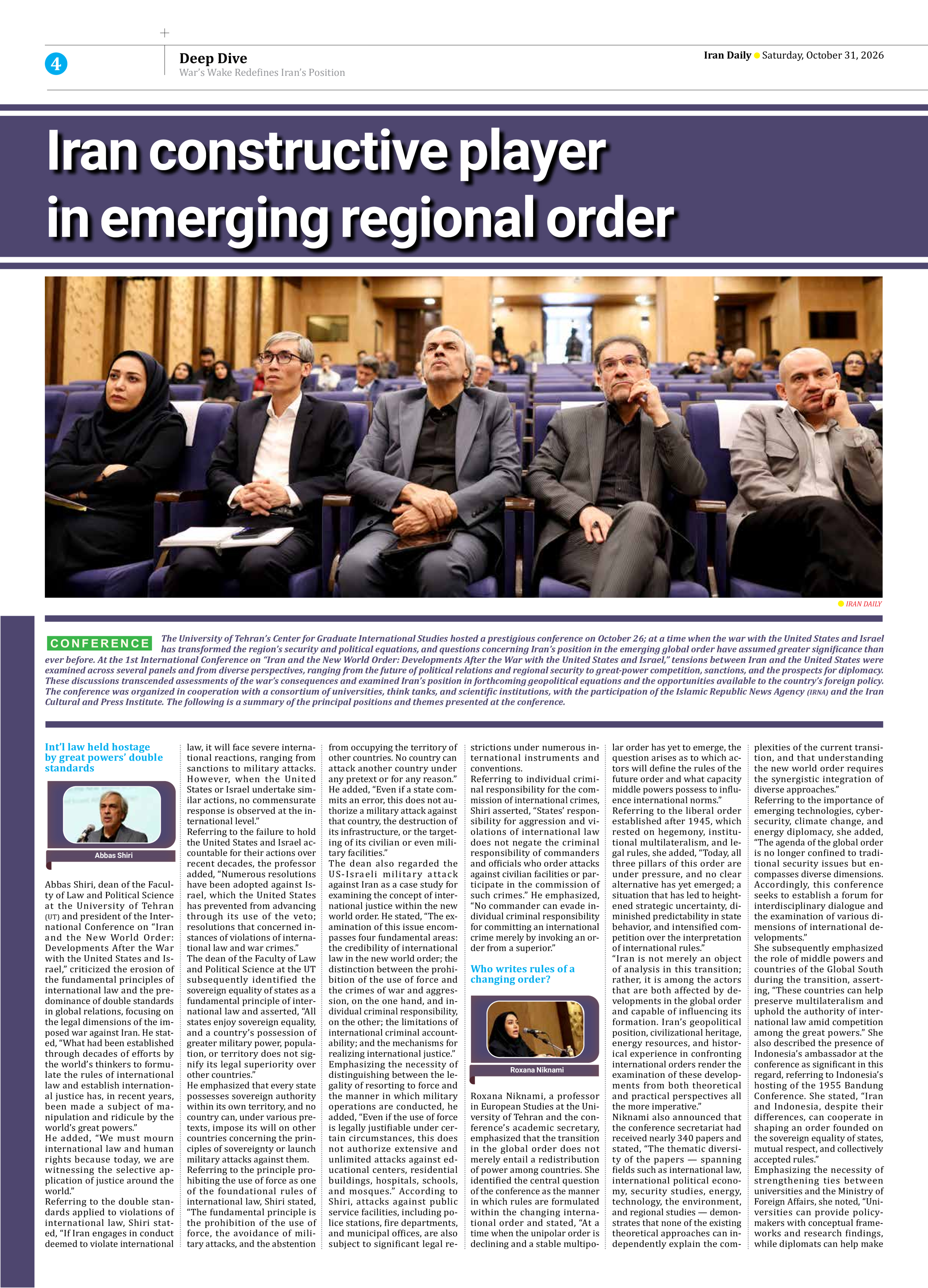
The University of Tehran’s Center for Graduate International Studies hosted a prestigious conference on October 26; at a time when the war with the United States and Israel has transformed the region’s security and political equations, and questions concerning Iran’s position in the emerging global order have assumed greater significance than ever before. At the 1st International Conference on “Iran and the New World Order: Developments After the War with the United States and Israel,” tensions between Iran and the United States were examined across several panels and from diverse perspectives, ranging from the future of political relations and regional security to great-power competition, sanctions, and the prospects for diplomacy. These discussions transcended assessments of the war’s consequences and examined Iran’s position in forthcoming geopolitical equations and the opportunities available to the country’s foreign policy. The conference was organized in cooperation with a consortium of universities, think tanks, and scientific institutions, with the participation of the Islamic Republic News Agency (IRNA) and the Iran Cultural and Press Institute. The following is a summary of the principal positions and themes presented at the conference.
Int’l law held hostage by great powers’ double standards
Abbas Shiri, dean of the Faculty of Law and Political Science at the University of Tehran (UT) and president of the International Conference on “Iran and the New World Order: Developments After the War with the United States and Israel,” criticized the erosion of the fundamental principles of international law and the predominance of double standards in global relations, focusing on the legal dimensions of the imposed war against Iran. He stated, “What had been established through decades of efforts by the world’s thinkers to formulate the rules of international law and establish international justice has, in recent years, been made a subject of manipulation and ridicule by the world’s great powers.”
He added, “We must mourn international law and human rights because today, we are witnessing the selective application of justice around the world.”
Referring to the double standards applied to violations of international law, Shiri stated, “If Iran engages in conduct deemed to violate international law, it will face severe international reactions, ranging from sanctions to military attacks. However, when the United States or Israel undertake similar actions, no commensurate response is observed at the international level.”
Referring to the failure to hold the United States and Israel accountable for their actions over recent decades, the professor added, “Numerous resolutions have been adopted against Israel, which the United States has prevented from advancing through its use of the veto; resolutions that concerned instances of violations of international law and war crimes.”
The dean of the Faculty of Law and Political Science at the UT subsequently identified the sovereign equality of states as a fundamental principle of international law and asserted, “All states enjoy sovereign equality, and a country’s possession of greater military power, population, or territory does not signify its legal superiority over other countries.”
He emphasized that every state possesses sovereign authority within its own territory, and no country can, under various pretexts, impose its will on other countries concerning the principles of sovereignty or launch military attacks against them.
Referring to the principle prohibiting the use of force as one of the foundational rules of international law, Shiri stated, “The fundamental principle is the prohibition of the use of force, the avoidance of military attacks, and the abstention from occupying the territory of other countries. No country can attack another country under any pretext or for any reason.” He added, “Even if a state commits an error, this does not authorize a military attack against that country, the destruction of its infrastructure, or the targeting of its civilian or even military facilities.”
The dean also regarded the US-Israeli military attack against Iran as a case study for examining the concept of international justice within the new world order. He stated, “The examination of this issue encompasses four fundamental areas: the credibility of international law in the new world order; the distinction between the prohibition of the use of force and the crimes of war and aggression, on the one hand, and individual criminal responsibility, on the other; the limitations of international criminal accountability; and the mechanisms for realizing international justice.”
Emphasizing the necessity of distinguishing between the legality of resorting to force and the manner in which military operations are conducted, he added, “Even if the use of force is legally justifiable under certain circumstances, this does not authorize extensive and unlimited attacks against educational centers, residential buildings, hospitals, schools, and mosques.” According to Shiri, attacks against public service facilities, including police stations, fire departments, and municipal offices, are also subject to significant legal restrictions under numerous international instruments and conventions.
Referring to individual criminal responsibility for the commission of international crimes, Shiri asserted, “States’ responsibility for aggression and violations of international law does not negate the criminal responsibility of commanders and officials who order attacks against civilian facilities or participate in the commission of such crimes.” He emphasized, “No commander can evade individual criminal responsibility for committing an international crime merely by invoking an order from a superior.”
Who writes rules of a changing order?
Roxana Niknami, a professor in European Studies at the University of Tehran and the conference’s academic secretary, emphasized that the transition in the global order does not merely entail a redistribution of power among countries. She identified the central question of the conference as the manner in which rules are formulated within the changing international order and stated, “At a time when the unipolar order is declining and a stable multipolar order has yet to emerge, the question arises as to which actors will define the rules of the future order and what capacity middle powers possess to influence international norms.”
Referring to the liberal order established after 1945, which rested on hegemony, institutional multilateralism, and legal rules, she added, “Today, all three pillars of this order are under pressure, and no clear alternative has yet emerged; a situation that has led to heightened strategic uncertainty, diminished predictability in state behavior, and intensified competition over the interpretation of international rules.”
“Iran is not merely an object of analysis in this transition; rather, it is among the actors that are both affected by developments in the global order and capable of influencing its formation. Iran’s geopolitical position, civilizational heritage, energy resources, and historical experience in confronting international orders render the examination of these developments from both theoretical and practical perspectives all the more imperative.”
Niknami also announced that the conference secretariat had received nearly 340 papers and stated, “The thematic diversity of the papers — spanning fields such as international law, international political economy, security studies, energy, technology, the environment, and regional studies — demonstrates that none of the existing theoretical approaches can independently explain the complexities of the current transition, and that understanding the new world order requires the synergistic integration of diverse approaches.”
Referring to the importance of emerging technologies, cybersecurity, climate change, and energy diplomacy, she added, “The agenda of the global order is no longer confined to traditional security issues but encompasses diverse dimensions. Accordingly, this conference seeks to establish a forum for interdisciplinary dialogue and the examination of various dimensions of international developments.”
She subsequently emphasized the role of middle powers and countries of the Global South during the transition, asserting, “These countries can help preserve multilateralism and uphold the authority of international law amid competition among the great powers.” She also described the presence of Indonesia’s ambassador at the conference as significant in this regard, referring to Indonesia’s hosting of the 1955 Bandung Conference. She stated, “Iran and Indonesia, despite their differences, can cooperate in shaping an order founded on the sovereign equality of states, mutual respect, and collectively accepted rules.”
Emphasizing the necessity of strengthening ties between universities and the Ministry of Foreign Affairs, she noted, “Universities can provide policymakers with conceptual frameworks and research findings, while diplomats can help make analyses and decision-making more realistic by conveying their practical experience and the operational constraints encountered in the field.”
The professor concluded by expressing hope that the conference would not remain an isolated event but would become a permanent platform for knowledge production, the expansion of academic diplomacy, and the development of scientific cooperation with universities and research centers in other countries, particularly Indonesia. She also announced plans to publish a collection of papers and compile policy briefs to convey the conference’s scientific findings to policymakers.
Impossible to speak of end of previous order
Mohammad Kazem Sajjadpour, former head of the Ministry of Foreign Affairs’ Institute for Political and International Studies and a professor of international relations at the ministry’s School of International Relations, addressed the international conference at the University of Tehran.
Emphasizing the complexity of developments in the international system, he stated that the previous global order continues to exist while the competition among the great powers to shape the future global architecture has intensified. According to him, under current circumstances, neither can we talk about the establishment of a clearly defined new order nor can the complete collapse of the previous order be accepted since international law and the United Nations continue to play a role in global relations.
Referring to Washington’s efforts to preserve its global hegemony, Sajjadpour stated that, while pursuing a preeminent international position, the United States was simultaneously weakening institutions and frameworks that had emerged after World War II with its own participation. China, by contrast, simultaneously operates within existing institutions and seeks to enhance its role in decision-making structures while establishing new economic and international institutions. He emphasized that understanding the strategies of the great powers requires attention to their competition over hegemony and the determination of the rules governing the future order.
Referring to Iran’s experience in the two most recent imposed wars, he identified reliance on domestic capabilities as a major factor in preserving the country and stated that Iran secures its security through its own capabilities. In his view, Iran’s strategy should rest on comprehensive national power, encompassing military, social, and scientific capabilities. Sajjadpour also emphasized the need to avoid either underestimating or exaggerating Iran’s capabilities and called for a scientific and realistic assessment of international conditions.
Rejecting the substitution of aspirations for scientific analysis, the professor of international relations referred to the complex relations between the United States and China. He stated that, despite their competition and tensions, both countries sought to prevent an escalation of confrontation. Consequently, the perception that a war between them would constitute a definite opportunity for other countries was an analysis based on wishful thinking.
In his concluding remarks, Sajjadpour emphasized that Iran stood at a complex juncture in the history of the international system and should draw on its several-thousand-year historical experience to formulate an effective strategy. According to him, developing a more scientific understanding of global developments, balancing objectives with instruments, and strengthening comprehensive national power are among the fundamental requirements of Iran’s strategic policymaking.
Iran in paradigmatic struggle between China, Russia and US
Mohammadreza Majidi, a professor of regional studies at the University of Tehran, examined tensions between Iran and the United States through the prism of the structural confrontation between China and Russia, on the one hand, and the United States, on the other. Emphasizing the necessity of analyzing developments from a geopolitical perspective, he maintained that the crises in the Middle East are not merely a conflict involving Iran, the United States, and Israel; rather, they are part of a paradigmatic competition to organize global power. “The United States seeks to preserve its maritime hegemony and control strategic routes, while the China–Russia–Iran coalition seeks to strengthen the continental axis and counter American maritime supremacy through the development of land corridors,” he added.
“Strait of Hormuz is the energy artery, and Bab el-Mandeb is the artery of global trade. In addition to its strategic position in the energy heartland, Iran plays a decisive role in the competition between the maritime-oriented and land-oriented axes.”
He noted that both axes need Iran to shape their preferred order. Accordingly, Iran constitutes the connecting point between these two axes, and the outcome of the Iran–United States conflict would influence the future of the global order, an order unlikely to remain uncontested.
Requirements for defense pact among Saudi Arabia, Turkey, and Pakistan
At another panel of the conference, the trilateral pact among Turkey, Saudi Arabia, and Pakistan was examined. The pact’s signatories had traveled to Tehran on the day of the conference to discuss major regional security issues with Iranian officials.
Attending the meeting remotely, Flavius Caba-Maria, president of the Romanian think tank Middle East Political and Economic Institute, stated that regional countries were seeking to diversify their security cooperation to reduce exclusive dependence on a single foreign power.
“Saudi Arabia continues to rely on American military capabilities but is expanding its relations with China, Turkey, and Pakistan. Turkey seeks greater strategic autonomy, while Pakistan faces constraints because of its rivalry with India and its sensitive relations with Iran.”
Therefore, he maintained, the objective of the joint defense pact is not to replace one alliance with another but to diversify security partnerships; the pact’s immediate significance lies in its political message, deterrence, and the expansion of its members’ strategic options. Its long-term credibility also depends on mechanisms for consultation, joint planning, information exchange, and clear rules for crisis management.
He added, “The success of the joint defense pact depends on translating political commitments into practical cooperation. The members must establish specific mechanisms for consultation, crisis communication, the assessment of responsibility for attacks, and decision-making concerning assistance to one another. Maintaining diplomatic channels with Iran and other regional countries is also essential. Ultimately, lasting security in the Middle East depends on the establishment of a broader partnership that also includes Iran.”
Complementing this discussion via video conference, Henrietta Toivanen, a researcher at the Martti Ahtisaari Peace Foundation in Finland, examined the experience of regional cooperation in Europe and the possibility of applying its lessons in West Asia, emphasizing the formulation of common principles to reduce tensions.
She stated, “The European experience demonstrates that simple principles can provide a basis for security dialogues, and these dialogues do not necessarily require changes in security approaches or the termination of existing defense cooperation.”
“New mechanisms, including trilateral agreements, can complement existing regional arrangements. The initiation of security dialogues does not require complete trust among countries, and a degree of trust in mediators and the dialogue process can be sufficient to advance regional cooperation,” Toivanen added.
War’s impact on world’s data infrastructure
Behzad Ahmadi, a professor at the University of Tehran’s Faculty of World Studies, addressed the importance of submarine cables in global communications, Iran’s capacity to become a data transit route, and the war’s impact on investment in and the security of this infrastructure. He stated that, when the consequences of war are examined, data infrastructure and submarine cables, which play a significant role in information transmission, generally receive insufficient attention. He argued that the impact of the third war of aggression on Iran on calculations concerning east-to-west data transmission must be examined.
He added that the central paradox was that the war, on the one hand, disrupted data transmission and increased the need to identify alternative routes, given that approximately 90% of the world’s data travels through maritime routes. On the other hand, the passage of land routes near Iran under wartime conditions presented a contradiction since war increases financing risks and sanctions-related constraints while simultaneously potentially affecting the world’s data infrastructure. Nevertheless, a land route would constitute an effective alternative only if it possessed sufficient capacity, connectivity to international networks, and the ability to transmit data reliably. Land routes, however, are not immune to the dangers of war.
Emphasizing the requirements for establishing a data corridor, the professor said that such a corridor requires sufficient capacity, operational viability, and appropriate routes. The war has strengthened Iran’s fiber-optic capacity, but the realization of this potential also depends on the availability of other necessary conditions. He further noted that, under peacetime conditions, Iran possesses connectivity-based power and that it is necessary to examine whether bypassing Iran in data transmission is feasible.
End of Europe’s era of preaching
Ali Sabbaghian, a professor of regional studies at the University of Tehran, examined the European Union’s position in the reconfiguration of the global order. He stated that the order established in Europe had been founded on multilateralism and that the European Union was itself a product of, and one of the principal pillars of, this order. However, developments in recent years had demonstrated that this structure no longer functioned as it once had.
He added that one of the factors contributing to this transformation is the changing relationship among the great powers. Europe has been grappling with the consequences of the war in Ukraine for approximately five years, while Iran’s war with the United States and Israel has further complicated geopolitical developments. Alongside these factors, the unilateralist approaches of US President Donald Trump have also contributed to the weakening of the previous order by disregarding certain characteristics of its structure.
Sabbaghian identified the rise of China and the gradual disruption of the existing order’s structure, alongside the ineffectiveness of international institutions, as other contributing factors. He asserted that the European Union now finds itself confronting a geopolitical transformation and is adjusting its actions in accordance with this reality.
Referring to the concept of European strategic autonomy, the professor stated that this autonomy is no longer confined to defense and security but also encompasses technology and trade. Nevertheless, the European Union faces difficulties because of its collective nature and could not act cohesively on every issue.
He continued that Europe’s efforts to reform the international order are being pursued through support for global initiatives and expanded engagement with countries of the Global South. The “Global Europe” approach also emphasizes cooperation with these countries and a departure from a preachy stance since Europe could no longer define global norms single-handedly.
Understanding war within framework of Trumpism
Mohammad Jamshidi, a professor of regional studies at the University of Tehran, raised the question of whether diplomacy and power are in opposition to one another or could reinforce one another. He stated that understanding the current circumstances first requires answering the question of what had caused the war. Today’s developments, he argued, are the outcome of a decade-long process and the international system’s movement toward realist approaches, a trajectory that has now culminated in the war against Iran.
He added that the situation does not involve two separate incidents of attack but rather a state of war in which both the political will to attack and the corresponding military posture are present. According to him, the adversary’s objective is regime change, and the requirements of such a situation, as well as the function of diplomacy within it, need to be properly understood.
Referring to the origins of the war, Jamshidi asserted that the conflict should be examined within the framework of Trumpism and a broader intellectual and social movement, a phenomenon that is not merely attributable to the advent of a single individual but reflects a deeper transformation. Furthermore, damage to Iran’s deterrence, particularly in the Levant, following regional developments and the collapse of the pillars of resistance, have been among the factors contributing to the current circumstances.
Emphasizing that Iran’s previous policy had been rational and deterrence-based, the professor stated that the country is now in a state of war and that this situation would not end after two rounds of confrontation. At the same time, he noted that, although Iran is the initial target of this war, a larger objective also exists, with China constituting the United States’ principal and more consequential target.
He subsequently identified diplomacy as one of the instruments of national power and added that its most important function is to understand the international environment, although its responsibilities are not confined to this domain. Securing the support of other countries and accurately explaining the country’s policies should also feature on the diplomatic agenda, enabling this instrument to play a role alongside other components of national power.
Expecting unconditional support from allies unrealistic
Akbar Valizadeh, a professor of regional studies at the University of Tehran, referred to Russia’s approach toward Iran and stated that Russia has neither acted entirely alongside Iran nor maintained complete distance from the country. Rather, it has consistently pursued a form of calibrated support.
He added that preserving Iran as a partner, avoiding substantial costs, and consolidating Russia’s position as a mediating actor have been among the considerations shaping Moscow’s conduct toward Iran.
Emphasizing that strategic alliances in the international system are invariably subject to the test of competing interests, he stated that understanding these limitations is an essential prerequisite for managing relations between countries. According to him, Russia’s approach toward Iran reflected a pattern also observable in the behavior of other actors in the international system and could not be attributed exclusively to relations between Moscow and Tehran.
Valizadeh asserted that expecting unconditional support from allies is unrealistic since every country pursues its own interests and particular considerations in its foreign policy. He added that, accordingly, managing foreign relations requires not only a precise understanding of the limitations of cooperation with other powers but also domestic capacity-building and the diversification of foreign relations. According to him, simultaneous attention to these two factors could facilitate better management of international relations and reduce dependence on any single actor.
The article first appeared in the Persian-language newspaper Iran.