




US ‘carrot-and-stick’ approach will not work against Iran: Speaker
Qatari delegation makes second visit to Tehran in a week
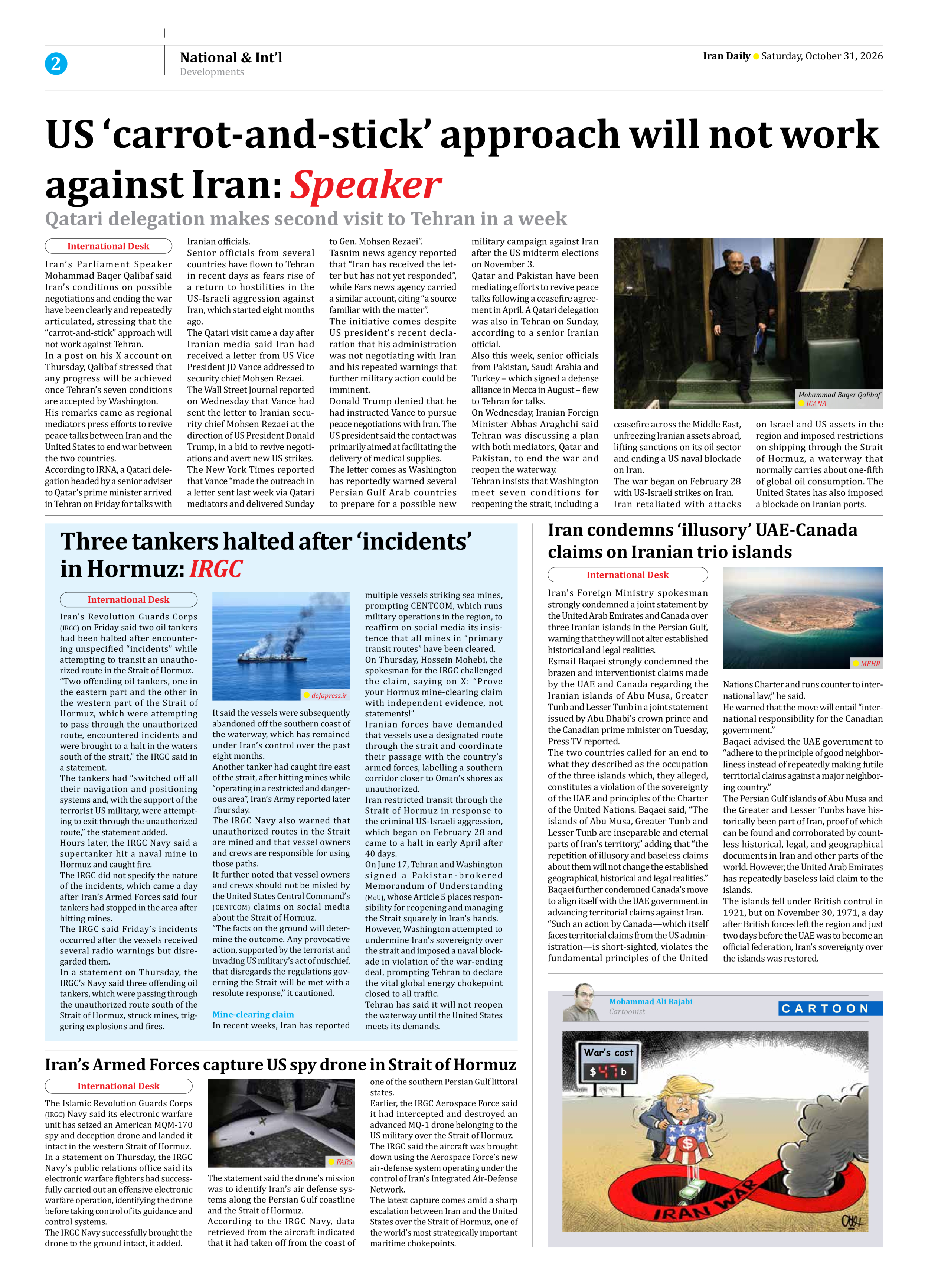
Iran’s Parliament Speaker Mohammad Baqer Qalibaf said Iran’s conditions on possible negotiations and ending the war have been clearly and repeatedly articulated, stressing that the “carrot-and-stick” approach will not work against Tehran.
In a post on his X account on Thursday, Qalibaf stressed that any progress will be achieved once Tehran’s seven conditions are accepted by Washington.
His remarks came as regional mediators press efforts to revive peace talks between Iran and the United States to end war between the two countries.
According to IRNA, a Qatari delegation headed by a senior adviser to Qatar’s prime minister arrived in Tehran on Friday for talks with Iranian officials.
Senior officials from several countries have flown to Tehran in recent days as fears rise of a return to hostilities in the US-Israeli aggression against Iran, which started eight months ago.
The Qatari visit came a day after Iranian media said Iran had received a letter from US Vice President JD Vance addressed to security chief Mohsen Rezaei.
The Wall Street Journal reported on Wednesday that Vance had sent the letter to Iranian security chief Mohsen Rezaei at the direction of US President Donald Trump, in a bid to revive negotiations and avert new US strikes.
The New York Times reported that Vance “made the outreach in a letter sent last week via Qatari mediators and delivered Sunday to Gen. Mohsen Rezaei”.
Tasnim news agency reported that “Iran has received the letter but has not yet responded”, while Fars news agency carried a similar account, citing “a source familiar with the matter”.
The initiative comes despite US president’s recent declaration that his administration was not negotiating with Iran and his repeated warnings that further military action could be imminent.
Donald Trump denied that he had instructed Vance to pursue peace negotiations with Iran. The US president said the contact was primarily aimed at facilitating the delivery of medical supplies.
The letter comes as Washington has reportedly warned several Persian Gulf Arab countries to prepare for a possible new military campaign against Iran after the US midterm elections on November 3.
Qatar and Pakistan have been mediating efforts to revive peace talks following a ceasefire agreement in April. A Qatari delegation was also in Tehran on Sunday, according to a senior Iranian official.
Also this week, senior officials from Pakistan, Saudi Arabia and Turkey – which signed a defense alliance in Mecca in August – flew to Tehran for talks.
On Wednesday, Iranian Foreign Minister Abbas Araghchi said Tehran was discussing a plan with both mediators, Qatar and Pakistan, to end the war and reopen the waterway.
Tehran insists that Washington meet seven conditions for reopening the strait, including a ceasefire across the Middle East, unfreezing Iranian assets abroad, lifting sanctions on its oil sector and ending a US naval blockade on Iran.
The war began on February 28 with US-Israeli strikes on Iran.
Iran retaliated with attacks on Israel and US assets in the region and imposed restrictions on shipping through the Strait of Hormuz, a waterway that normally carries about one-fifth of global oil consumption. The United States has also imposed a blockade on Iranian ports.