


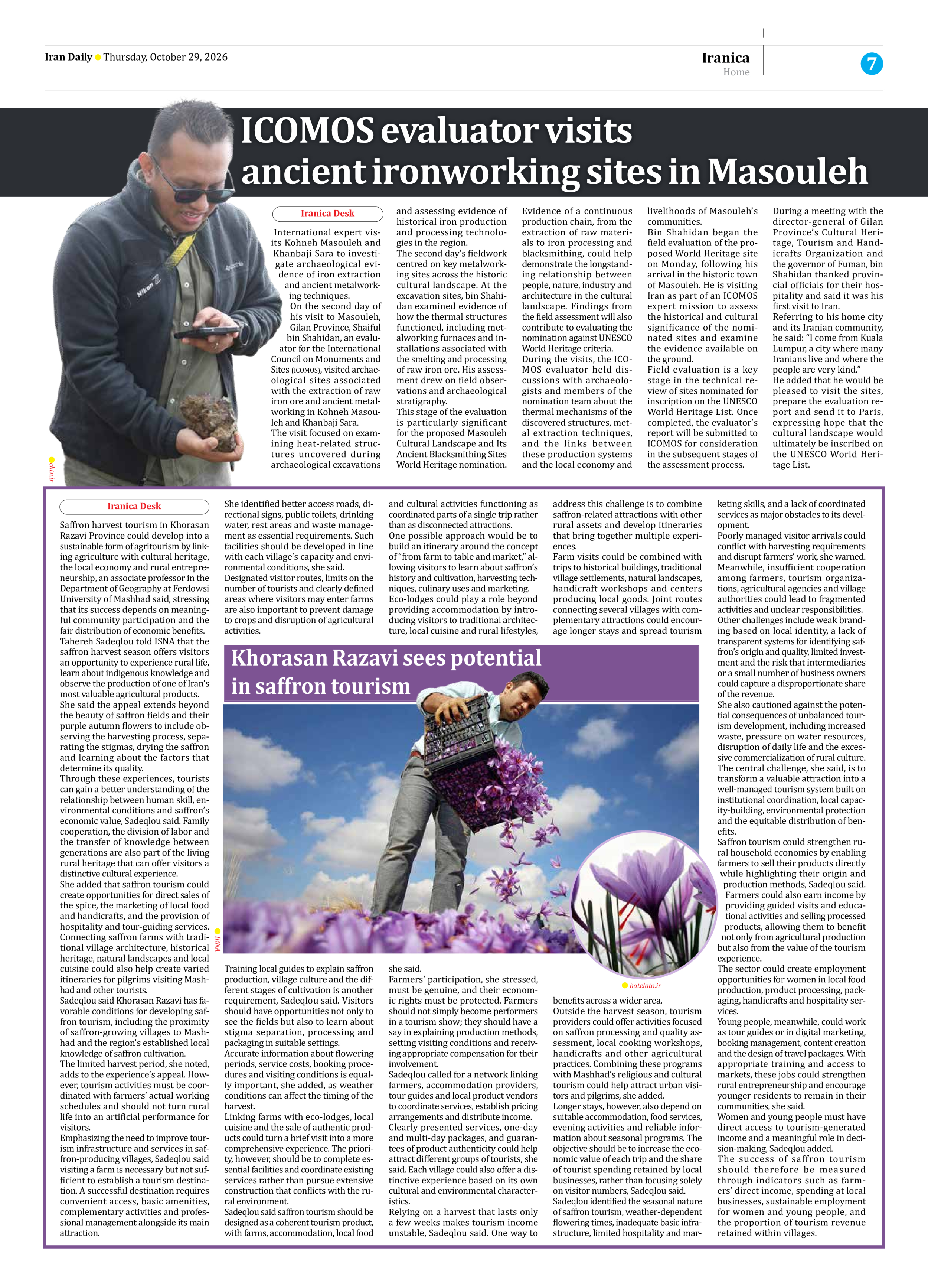


Khorasan Razavi sees potential in saffron tourism
Saffron harvest tourism in Khorasan Razavi Province could develop into a sustainable form of agritourism by linking agriculture with cultural heritage, the local economy and rural entrepreneurship, an associate professor in the Department of Geography at Ferdowsi University of Mashhad said, stressing that its success depends on meaningful community participation and the fair distribution of economic benefits.
Tahereh Sadeqlou told ISNA that the saffron harvest season offers visitors an opportunity to experience rural life, learn about indigenous knowledge and observe the production of one of Iran’s most valuable agricultural products.
She said the appeal extends beyond the beauty of saffron fields and their purple autumn flowers to include observing the harvesting process, separating the stigmas, drying the saffron and learning about the factors that determine its quality.
Through these experiences, tourists can gain a better understanding of the relationship between human skill, environmental conditions and saffron’s economic value, Sadeqlou said. Family cooperation, the division of labor and the transfer of knowledge between generations are also part of the living rural heritage that can offer visitors a distinctive cultural experience.
She added that saffron tourism could create opportunities for direct sales of the spice, the marketing of local food and handicrafts, and the provision of hospitality and tour-guiding services. Connecting saffron farms with traditional village architecture, historical heritage, natural landscapes and local cuisine could also help create varied itineraries for pilgrims visiting Mashhad and other tourists.
Sadeqlou said Khorasan Razavi has favorable conditions for developing saffron tourism, including the proximity of saffron-growing villages to Mashhad and the region’s established local knowledge of saffron cultivation.
The limited harvest period, she noted, adds to the experience’s appeal. However, tourism activities must be coordinated with farmers’ actual working schedules and should not turn rural life into an artificial performance for visitors.
Emphasizing the need to improve tourism infrastructure and services in saffron-producing villages, Sadeqlou said visiting a farm is necessary but not sufficient to establish a tourism destination. A successful destination requires convenient access, basic amenities, complementary activities and professional management alongside its main attraction.
She identified better access roads, directional signs, public toilets, drinking water, rest areas and waste management as essential requirements. Such facilities should be developed in line with each village’s capacity and environmental conditions, she said.
Designated visitor routes, limits on the number of tourists and clearly defined areas where visitors may enter farms are also important to prevent damage to crops and disruption of agricultural activities.
Training local guides to explain saffron production, village culture and the different stages of cultivation is another requirement, Sadeqlou said. Visitors should have opportunities not only to see the fields but also to learn about stigma separation, processing and packaging in suitable settings.
Accurate information about flowering periods, service costs, booking procedures and visiting conditions is equally important, she added, as weather conditions can affect the timing of the harvest.
Linking farms with eco-lodges, local cuisine and the sale of authentic products could turn a brief visit into a more comprehensive experience. The priority, however, should be to complete essential facilities and coordinate existing services rather than pursue extensive construction that conflicts with the rural environment.
Sadeqlou said saffron tourism should be designed as a coherent tourism product, with farms, accommodation, local food and cultural activities functioning as coordinated parts of a single trip rather than as disconnected attractions.
One possible approach would be to build an itinerary around the concept of “from farm to table and market,” allowing visitors to learn about saffron’s history and cultivation, harvesting techniques, culinary uses and marketing.
Eco-lodges could play a role beyond providing accommodation by introducing visitors to traditional architecture, local cuisine and rural lifestyles, she said.
Farmers’ participation, she stressed, must be genuine, and their economic rights must be protected. Farmers should not simply become performers in a tourism show; they should have a say in explaining production methods, setting visiting conditions and receiving appropriate compensation for their involvement.
Sadeqlou called for a network linking farmers, accommodation providers, tour guides and local product vendors to coordinate services, establish pricing arrangements and distribute income.
Clearly presented services, one-day and multi-day packages, and guarantees of product authenticity could help attract different groups of tourists, she said. Each village could also offer a distinctive experience based on its own cultural and environmental characteristics.
Relying on a harvest that lasts only a few weeks makes tourism income unstable, Sadeqlou said. One way to address this challenge is to combine saffron-related attractions with other rural assets and develop itineraries that bring together multiple experiences.
Farm visits could be combined with trips to historical buildings, traditional village settlements, natural landscapes, handicraft workshops and centers producing local goods. Joint routes connecting several villages with complementary attractions could encourage longer stays and spread tourism benefits across a wider area.
Outside the harvest season, tourism providers could offer activities focused on saffron processing and quality assessment, local cooking workshops, handicrafts and other agricultural practices. Combining these programs with Mashhad’s religious and cultural tourism could help attract urban visitors and pilgrims, she added.
Longer stays, however, also depend on suitable accommodation, food services, evening activities and reliable information about seasonal programs. The objective should be to increase the economic value of each trip and the share of tourist spending retained by local businesses, rather than focusing solely on visitor numbers, Sadeqlou said.
Sadeqlou identified the seasonal nature of saffron tourism, weather-dependent flowering times, inadequate basic infrastructure, limited hospitality and marketing skills, and a lack of coordinated services as major obstacles to its development.
Poorly managed visitor arrivals could conflict with harvesting requirements and disrupt farmers’ work, she warned. Meanwhile, insufficient cooperation among farmers, tourism organizations, agricultural agencies and village authorities could lead to fragmented activities and unclear responsibilities.
Other challenges include weak branding based on local identity, a lack of transparent systems for identifying saffron’s origin and quality, limited investment and the risk that intermediaries or a small number of business owners could capture a disproportionate share of the revenue.
She also cautioned against the potential consequences of unbalanced tourism development, including increased waste, pressure on water resources, disruption of daily life and the excessive commercialization of rural culture.
The central challenge, she said, is to transform a valuable attraction into a well-managed tourism system built on institutional coordination, local capacity-building, environmental protection and the equitable distribution of benefits.
Saffron tourism could strengthen rural household economies by enabling farmers to sell their products directly while highlighting their origin and production methods, Sadeqlou said. Farmers could also earn income by providing guided visits and educational activities and selling processed products, allowing them to benefit not only from agricultural production but also from the value of the tourism experience.
The sector could create employment opportunities for women in local food production, product processing, packaging, handicrafts and hospitality services.
Young people, meanwhile, could work as tour guides or in digital marketing, booking management, content creation and the design of travel packages. With appropriate training and access to markets, these jobs could strengthen rural entrepreneurship and encourage younger residents to remain in their communities, she said.
Women and young people must have direct access to tourism-generated income and a meaningful role in decision-making, Sadeqlou added.
The success of saffron tourism should therefore be measured through indicators such as farmers’ direct income, spending at local businesses, sustainable employment for women and young people, and the proportion of tourism revenue retained within villages.