




Gas exporters reject unilateral sanctions in Moscow summit statement
GECF warns tariffs, Mideast tensions threaten gas market stability
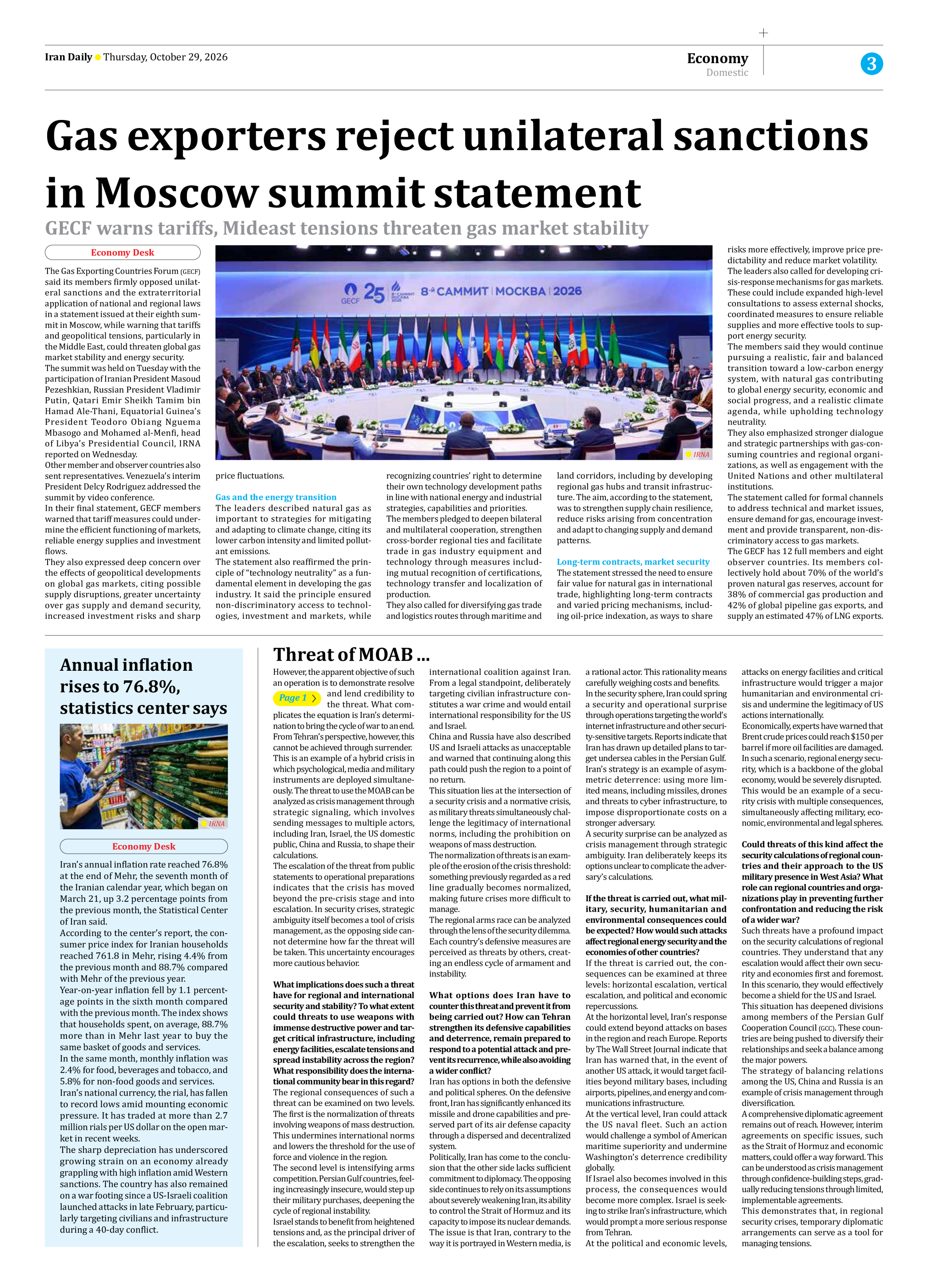
The Gas Exporting Countries Forum (GECF) said its members firmly opposed unilateral sanctions and the extraterritorial application of national and regional laws in a statement issued at their eighth summit in Moscow, while warning that tariffs and geopolitical tensions, particularly in the Middle East, could threaten global gas market stability and energy security.
The summit was held on Tuesday with the participation of Iranian President Masoud Pezeshkian, Russian President Vladimir Putin, Qatari Emir Sheikh Tamim bin Hamad Ale-Thani, Equatorial Guinea’s President Teodoro Obiang Nguema Mbasogo and Mohamed al-Menfi, head of Libya’s Presidential Council, IRNA reported on Wednesday.
Other member and observer countries also sent representatives. Venezuela’s interim President Delcy Rodriguez addressed the summit by video conference.
In their final statement, GECF members warned that tariff measures could undermine the efficient functioning of markets, reliable energy supplies and investment flows.
They also expressed deep concern over the effects of geopolitical developments on global gas markets, citing possible supply disruptions, greater uncertainty over gas supply and demand security, increased investment risks and sharp price fluctuations.
Gas and the energy transition
The leaders described natural gas as important to strategies for mitigating and adapting to climate change, citing its lower carbon intensity and limited pollutant emissions.
The statement also reaffirmed the principle of “technology neutrality” as a fundamental element in developing the gas industry. It said the principle ensured non-discriminatory access to technologies, investment and markets, while recognizing countries’ right to determine their own technology development paths in line with national energy and industrial strategies, capabilities and priorities.
The members pledged to deepen bilateral and multilateral cooperation, strengthen cross-border regional ties and facilitate trade in gas industry equipment and technology through measures including mutual recognition of certifications, technology transfer and localization of production.
They also called for diversifying gas trade and logistics routes through maritime and land corridors, including by developing regional gas hubs and transit infrastructure. The aim, according to the statement, was to strengthen supply chain resilience, reduce risks arising from concentration and adapt to changing supply and demand patterns.
Long-term contracts, market security
The statement stressed the need to ensure fair value for natural gas in international trade, highlighting long-term contracts and varied pricing mechanisms, including oil-price indexation, as ways to share risks more effectively, improve price predictability and reduce market volatility.
The leaders also called for developing crisis-response mechanisms for gas markets. These could include expanded high-level consultations to assess external shocks, coordinated measures to ensure reliable supplies and more effective tools to support energy security.
The members said they would continue pursuing a realistic, fair and balanced transition toward a low-carbon energy system, with natural gas contributing to global energy security, economic and social progress, and a realistic climate agenda, while upholding technology neutrality.
They also emphasized stronger dialogue and strategic partnerships with gas-consuming countries and regional organizations, as well as engagement with the United Nations and other multilateral institutions.
The statement called for formal channels to address technical and market issues, ensure demand for gas, encourage investment and provide transparent, non-discriminatory access to gas markets.
The GECF has 12 full members and eight observer countries. Its members collectively hold about 70% of the world’s proven natural gas reserves, account for 38% of commercial gas production and 42% of global pipeline gas exports, and supply an estimated 47% of LNG exports.