




Culture can bridge political divides, says ECO institute chief
By Sadeq Dehqan
Staff writer
In a region whose peoples share deep historical, cultural and civilizational ties, culture can transcend political borders and provide a foundation for dialogue, mutual understanding and lasting cooperation. The Economic Cooperation Organization (ECO), established to promote economic cooperation and regional development, also seeks to strengthen the historical and cultural bonds among its member states.
Based in Tehran, the ECO Cultural Institute works to build on this shared heritage by promoting literary and artistic exchanges, cooperation among universities and cultural institutions, and greater awareness of member countries’ cultures.
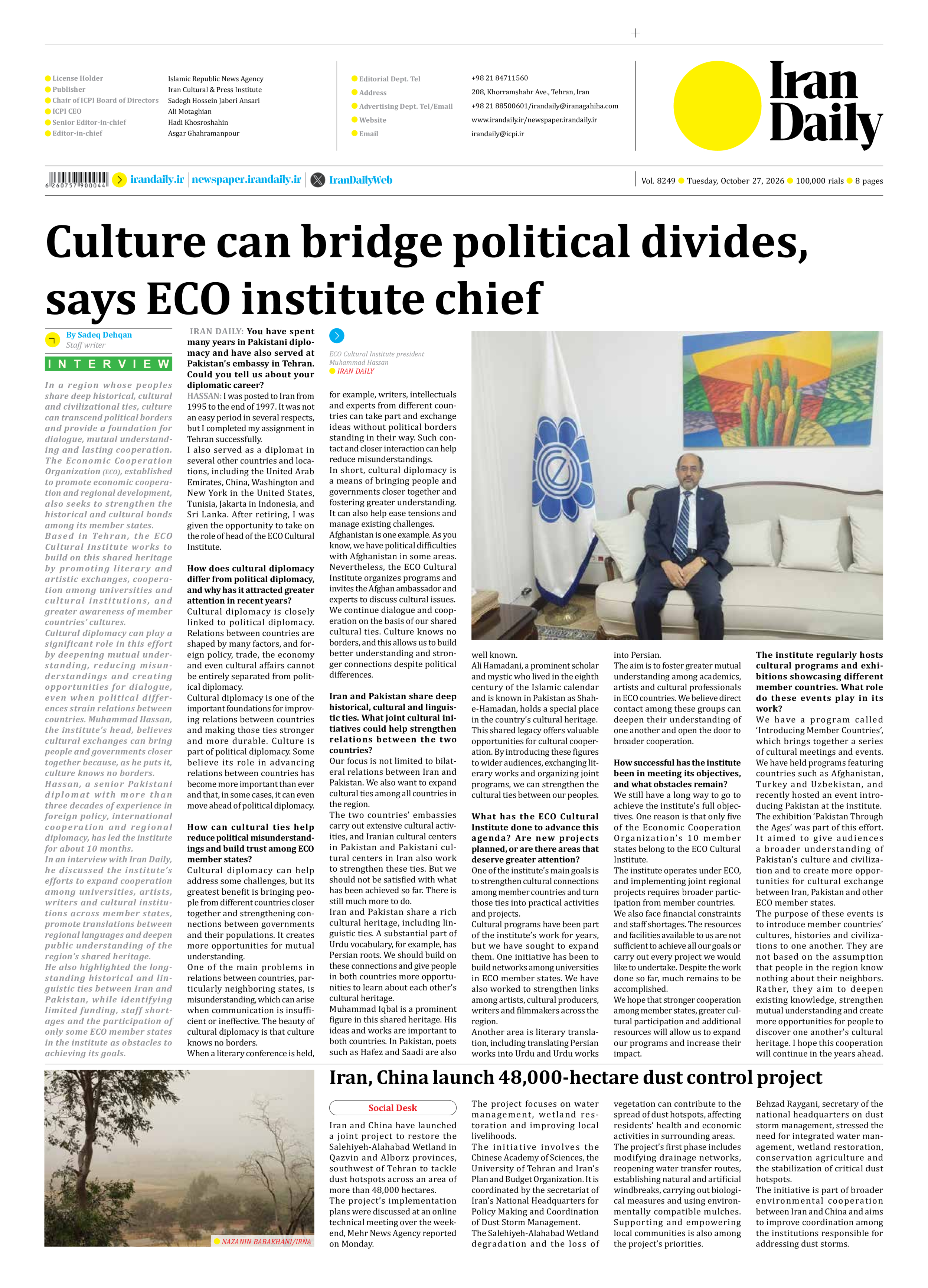
Cultural diplomacy can play a significant role in this effort by deepening mutual understanding, reducing misunderstandings and creating opportunities for dialogue, even when political differences strain relations between countries. Muhammad Hassan, the institute’s head, believes cultural exchanges can bring people and governments closer together because, as he puts it, culture knows no borders.
Hassan, a senior Pakistani diplomat with more than three decades of experience in foreign policy, international cooperation and regional diplomacy, has led the institute for about 10 months.
In an interview with Iran Daily, he discussed the institute’s efforts to expand cooperation among universities, artists, writers and cultural institutions across member states, promote translations between regional languages and deepen public understanding of the region’s shared heritage.
He also highlighted the longstanding historical and linguistic ties between Iran and Pakistan, while identifying limited funding, staff shortages and the participation of only some ECO member states in the institute as obstacles to achieving its goals.
IRAN DAILY: You have spent many years in Pakistani diplomacy and have also served at Pakistan’s embassy in Tehran. Could you tell us about your diplomatic career?
HASSAN: I was posted to Iran from 1995 to the end of 1997. It was not an easy period in several respects, but I completed my assignment in Tehran successfully.
I also served as a diplomat in several other countries and locations, including the United Arab Emirates, China, Washington and New York in the United States, Tunisia, Jakarta in Indonesia, and Sri Lanka. After retiring, I was given the opportunity to take on the role of head of the ECO Cultural Institute.
How does cultural diplomacy differ from political diplomacy, and why has it attracted greater attention in recent years?
Cultural diplomacy is closely linked to political diplomacy. Relations between countries are shaped by many factors, and foreign policy, trade, the economy and even cultural affairs cannot be entirely separated from political diplomacy.
Cultural diplomacy is one of the important foundations for improving relations between countries and making those ties stronger and more durable. Culture is part of political diplomacy. Some believe its role in advancing relations between countries has become more important than ever and that, in some cases, it can even move ahead of political diplomacy.
How can cultural ties help reduce political misunderstandings and build trust among ECO member states?
Cultural diplomacy can help address some challenges, but its greatest benefit is bringing people from different countries closer together and strengthening connections between governments and their populations. It creates more opportunities for mutual understanding.
One of the main problems in relations between countries, particularly neighboring states, is misunderstanding, which can arise when communication is insufficient or ineffective. The beauty of cultural diplomacy is that culture knows no borders.
When a literary conference is held, for example, writers, intellectuals and experts from different countries can take part and exchange ideas without political borders standing in their way. Such contact and closer interaction can help reduce misunderstandings.
In short, cultural diplomacy is a means of bringing people and governments closer together and fostering greater understanding. It can also help ease tensions and manage existing challenges.
Afghanistan is one example. As you know, we have political difficulties with Afghanistan in some areas. Nevertheless, the ECO Cultural Institute organizes programs and invites the Afghan ambassador and experts to discuss cultural issues.
We continue dialogue and cooperation on the basis of our shared cultural ties. Culture knows no borders, and this allows us to build better understanding and stronger connections despite political differences.
Iran and Pakistan share deep historical, cultural and linguistic ties. What joint cultural initiatives could help strengthen relations between the two countries?
Our focus is not limited to bilateral relations between Iran and Pakistan. We also want to expand cultural ties among all countries in the region.
The two countries’ embassies carry out extensive cultural activities, and Iranian cultural centers in Pakistan and Pakistani cultural centers in Iran also work to strengthen these ties. But we should not be satisfied with what has been achieved so far. There is still much more to do.
Iran and Pakistan share a rich cultural heritage, including linguistic ties. A substantial part of Urdu vocabulary, for example, has Persian roots. We should build on these connections and give people in both countries more opportunities to learn about each other’s cultural heritage.
Muhammad Iqbal is a prominent figure in this shared heritage. His ideas and works are important to both countries. In Pakistan, poets such as Hafez and Saadi are also well known.
Ali Hamadani, a prominent scholar and mystic who lived in the eighth century of the Islamic calendar and is known in Pakistan as Shah-e-Hamadan, holds a special place in the country’s cultural heritage.
This shared legacy offers valuable opportunities for cultural cooperation. By introducing these figures to wider audiences, exchanging literary works and organizing joint programs, we can strengthen the cultural ties between our peoples.
What has the ECO Cultural Institute done to advance this agenda? Are new projects planned, or are there areas that deserve greater attention?
One of the institute’s main goals is to strengthen cultural connections among member countries and turn those ties into practical activities and projects.
Cultural programs have been part of the institute’s work for years, but we have sought to expand them. One initiative has been to build networks among universities in ECO member states. We have also worked to strengthen links among artists, cultural producers, writers and filmmakers across the region.
Another area is literary translation, including translating Persian works into Urdu and Urdu works into Persian.
The aim is to foster greater mutual understanding among academics, artists and cultural professionals in ECO countries. We believe direct contact among these groups can deepen their understanding of one another and open the door to broader cooperation.
How successful has the institute been in meeting its objectives, and what obstacles remain?
We still have a long way to go to achieve the institute’s full objectives. One reason is that only five of the Economic Cooperation Organization’s 10 member states belong to the ECO Cultural Institute.
The institute operates under ECO, and implementing joint regional projects requires broader participation from member countries.
We also face financial constraints and staff shortages. The resources and facilities available to us are not sufficient to achieve all our goals or carry out every project we would like to undertake. Despite the work done so far, much remains to be accomplished.
We hope that stronger cooperation among member states, greater cultural participation and additional resources will allow us to expand our programs and increase their impact.
The institute regularly hosts cultural programs and exhibitions showcasing different member countries. What role do these events play in its work?
We have a program called ‘Introducing Member Countries’, which brings together a series of cultural meetings and events. We have held programs featuring countries such as Afghanistan, Turkey and Uzbekistan, and recently hosted an event introducing Pakistan at the institute.
The exhibition ‘Pakistan Through the Ages’ was part of this effort. It aimed to give audiences a broader understanding of Pakistan’s culture and civilization and to create more opportunities for cultural exchange between Iran, Pakistan and other ECO member states.
The purpose of these events is to introduce member countries’ cultures, histories and civilizations to one another. They are not based on the assumption that people in the region know nothing about their neighbors. Rather, they aim to deepen existing knowledge, strengthen mutual understanding and create more opportunities for people to discover one another’s cultural heritage. I hope this cooperation will continue in the years ahead.