




Tabriz’s historic mansion preserves legacy of Iran’s Constitutional Revolution
Walking through the old streets and historic quarters of Tabriz can feel like stepping back into the past. Among the city’s historic buildings are landmarks that preserve more than stone and brick; they bear witness to pivotal moments in Iran’s history. The Constitution House of Tabriz is one such landmark, keeping alive the memory of a defining period in the country’s modern history.
Located near Tabriz’s historic bazaar, the Constitution House, also known as the Kuzeh Kanani House, is a Qajar-era mansion closely associated with Iran’s Constitutional Revolution. During the movement, it became a gathering place for several prominent constitutionalists. Today, the building serves as a museum dedicated to the revolution and Tabriz’s role in the struggle for constitutional government, according to IRNA.
The house stands in an area that has long been one of the city’s principal economic and social centers. Its proximity to the historic bazaar and the Jaame Mosque of Tabriz places it within a wider network of landmarks reflecting the city’s commercial, religious and political life. Visitors can explore the house while also experiencing the historic urban fabric surrounding it.
The mansion was built around 1868, during the second half of the Qajar period, and belonged to Haji Mehdi Kuzeh Kanani, a prominent merchant in Tabriz. Its historical significance grew during the Constitutional Revolution, when Kuzeh Kanani made the house available to constitutionalists. It subsequently became a venue for meetings and discussions about the political changes sweeping the country.
In Tabriz, the Constitutional Revolution was more than a political movement; it also transformed social life across the city. The bazaar, civic associations, mosques and the homes of influential merchants all became important spaces for political activity. The Kuzeh Kanani House was part of this environment, hosting gatherings where supporters of the movement exchanged views, consulted one another and discussed developments.
Following the bombardment of Iran’s parliament by order of Mohammad Ali Shah Qajar in 1908, the country entered a new phase of political turmoil. Tabriz emerged as a major center of resistance by constitutionalists. During this period, Kuzeh Kanani’s house was used for meetings and other activities associated with the movement.
The building’s historical importance led to its registration on Iran’s National Heritage List in 1975. It was subsequently protected and restored, and in 1996, it was converted into the Constitution Museum. Documents, photographs and other historical objects relating to the Constitutional Revolution are now displayed there. A private residence that once hosted political activists has thus become a public space where later generations can learn about a pivotal chapter in Iran’s history.
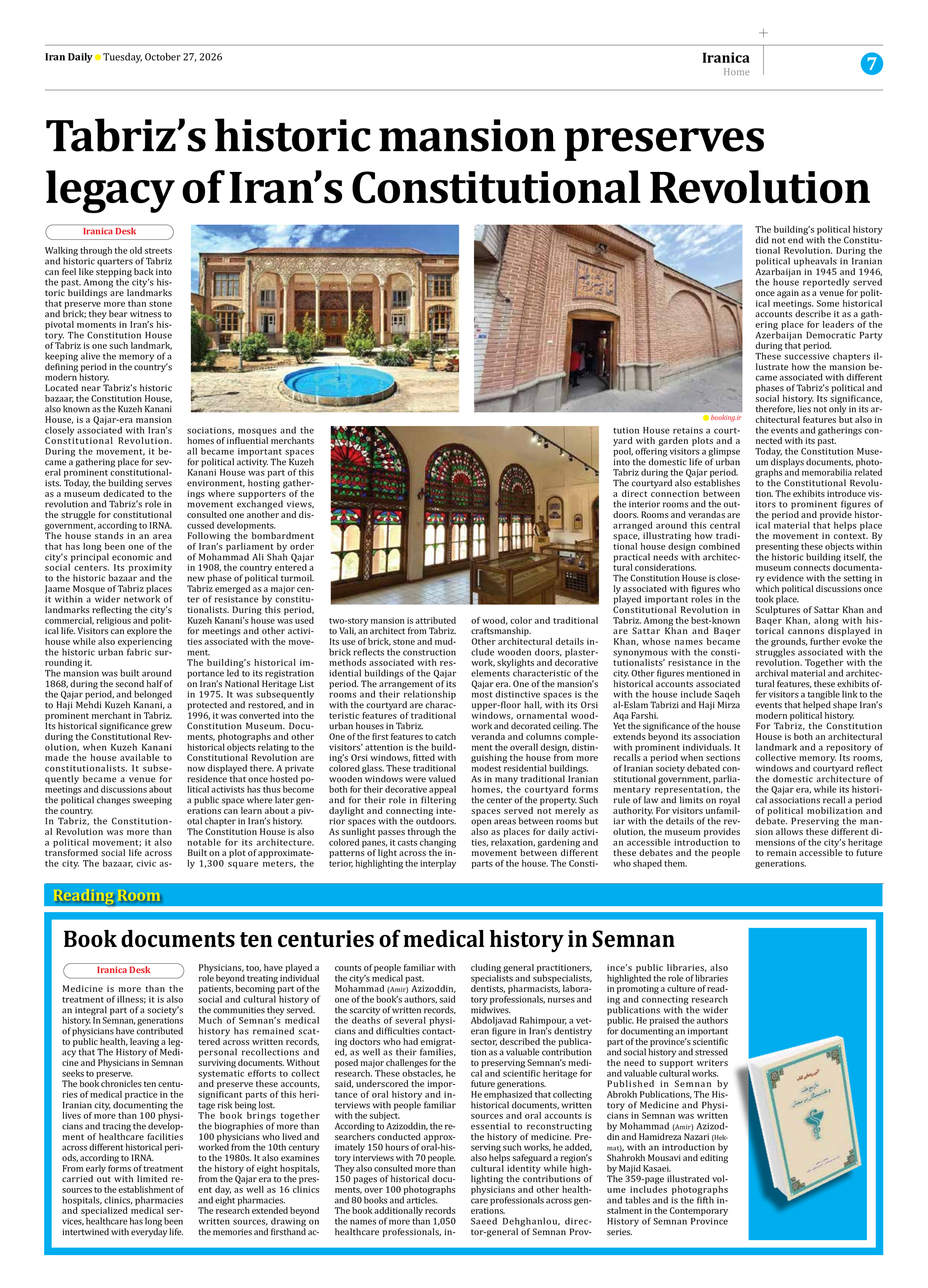
The Constitution House is also notable for its architecture. Built on a plot of approximately 1,300 square meters, the two-story mansion is attributed to Vali, an architect from Tabriz. Its use of brick, stone and mudbrick reflects the construction methods associated with residential buildings of the Qajar period. The arrangement of its rooms and their relationship with the courtyard are characteristic features of traditional urban houses in Tabriz.
One of the first features to catch visitors’ attention is the building’s Orsi windows, fitted with colored glass. These traditional wooden windows were valued both for their decorative appeal and for their role in filtering daylight and connecting interior spaces with the outdoors. As sunlight passes through the colored panes, it casts changing patterns of light across the interior, highlighting the interplay of wood, color and traditional craftsmanship.
Other architectural details include wooden doors, plasterwork, skylights and decorative elements characteristic of the Qajar era. One of the mansion’s most distinctive spaces is the upper-floor hall, with its Orsi windows, ornamental woodwork and decorated ceiling. The veranda and columns complement the overall design, distinguishing the house from more modest residential buildings.
As in many traditional Iranian homes, the courtyard forms the center of the property. Such spaces served not merely as open areas between rooms but also as places for daily activities, relaxation, gardening and movement between different parts of the house. The Constitution House retains a courtyard with garden plots and a pool, offering visitors a glimpse into the domestic life of urban Tabriz during the Qajar period.
The courtyard also establishes a direct connection between the interior rooms and the outdoors. Rooms and verandas are arranged around this central space, illustrating how traditional house design combined practical needs with architectural considerations.
The Constitution House is closely associated with figures who played important roles in the Constitutional Revolution in Tabriz. Among the best-known are Sattar Khan and Baqer Khan, whose names became synonymous with the constitutionalists’ resistance in the city. Other figures mentioned in historical accounts associated with the house include Saqeh al-Eslam Tabrizi and Haji Mirza Aqa Farshi.
Yet the significance of the house extends beyond its association with prominent individuals. It recalls a period when sections of Iranian society debated constitutional government, parliamentary representation, the rule of law and limits on royal authority. For visitors unfamiliar with the details of the revolution, the museum provides an accessible introduction to these debates and the people who shaped them.
The building’s political history did not end with the Constitutional Revolution. During the political upheavals in Iranian Azarbaijan in 1945 and 1946, the house reportedly served once again as a venue for political meetings. Some historical accounts describe it as a gathering place for leaders of the Azerbaijan Democratic Party during that period.
These successive chapters illustrate how the mansion became associated with different phases of Tabriz’s political and social history. Its significance, therefore, lies not only in its architectural features but also in the events and gatherings connected with its past.
Today, the Constitution Museum displays documents, photographs and memorabilia related to the Constitutional Revolution. The exhibits introduce visitors to prominent figures of the period and provide historical material that helps place the movement in context. By presenting these objects within the historic building itself, the museum connects documentary evidence with the setting in which political discussions once took place.
Sculptures of Sattar Khan and Baqer Khan, along with historical cannons displayed in the grounds, further evoke the struggles associated with the revolution. Together with the archival material and architectural features, these exhibits offer visitors a tangible link to the events that helped shape Iran’s modern political history.
For Tabriz, the Constitution House is both an architectural landmark and a repository of collective memory. Its rooms, windows and courtyard reflect the domestic architecture of the Qajar era, while its historical associations recall a period of political mobilization and debate. Preserving the mansion allows these different dimensions of the city’s heritage to remain accessible to future generations.