




Iran calls on GECF states to increase gas share in global energy mix
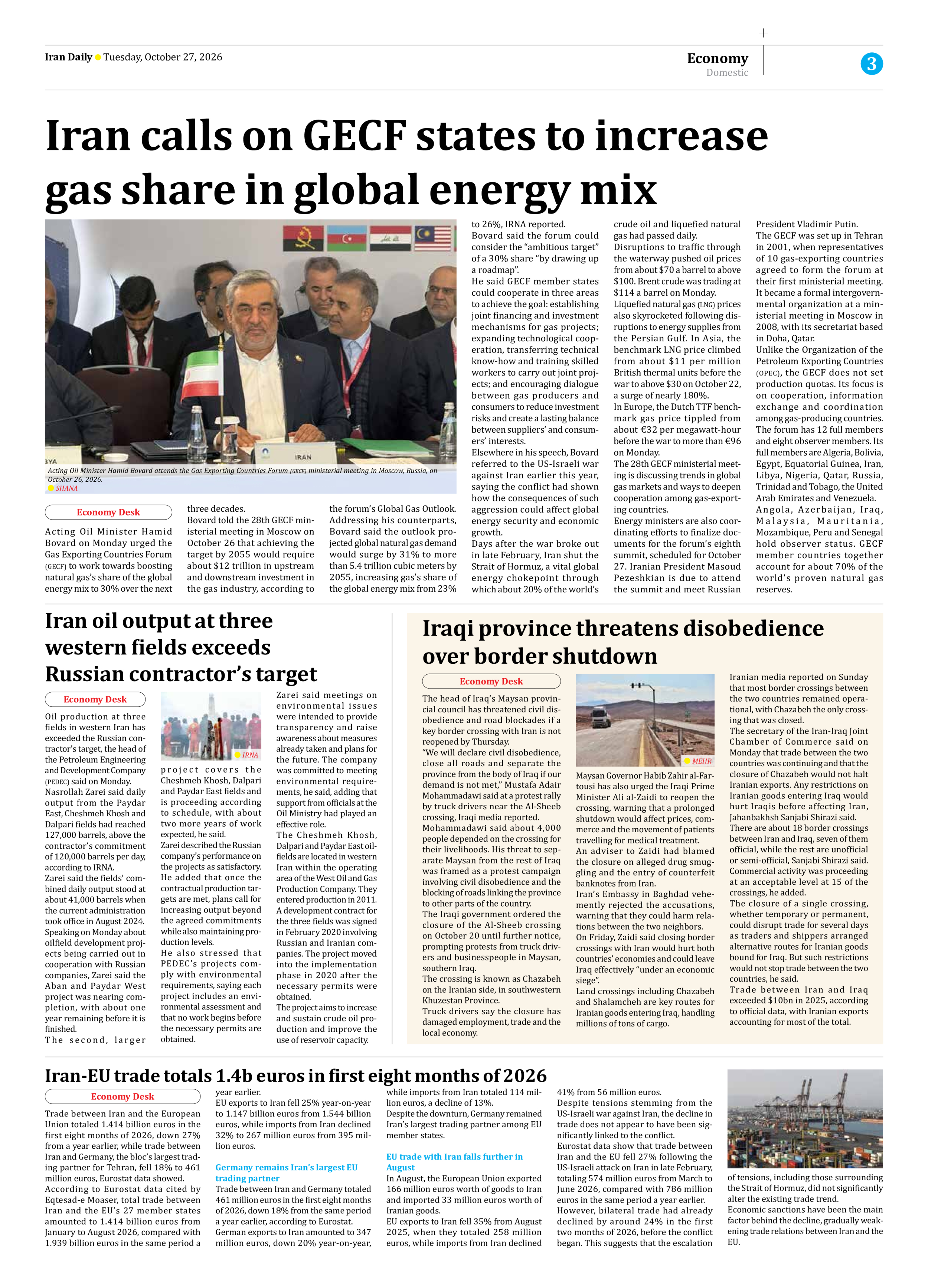
Acting Oil Minister Hamid Bovard on Monday urged the Gas Exporting Countries Forum (GECF) to work towards boosting natural gas’s share of the global energy mix to 30% over the next three decades.
Bovard told the 28th GECF ministerial meeting in Moscow on October 26 that achieving the target by 2055 would require about $12 trillion in upstream and downstream investment in the gas industry, according to the forum’s Global Gas Outlook.
Addressing his counterparts, Bovard said the outlook projected global natural gas demand would surge by 31% to more than 5.4 trillion cubic meters by 2055, increasing gas’s share of the global energy mix from 23% to 26%, IRNA reported.
Bovard said the forum could consider the “ambitious target” of a 30% share “by drawing up a roadmap”.
He said GECF member states could cooperate in three areas to achieve the goal: establishing joint financing and investment mechanisms for gas projects; expanding technological cooperation, transferring technical know-how and training skilled workers to carry out joint projects; and encouraging dialogue between gas producers and consumers to reduce investment risks and create a lasting balance between suppliers’ and consumers’ interests.
Elsewhere in his speech, Bovard referred to the US-Israeli war against Iran earlier this year, saying the conflict had shown how the consequences of such aggression could affect global energy security and economic growth.
Days after the war broke out in late February, Iran shut the Strait of Hormuz, a vital global energy chokepoint through which about 20% of the world’s crude oil and liquefied natural gas had passed daily.
Disruptions to traffic through the waterway pushed oil prices from about $70 a barrel to above $100. Brent crude was trading at $114 a barrel on Monday.
Liquefied natural gas (LNG) prices also skyrocketed following disruptions to energy supplies from the Persian Gulf. In Asia, the benchmark LNG price climbed from about $11 per million British thermal units before the war to above $30 on October 22, a surge of nearly 180%.
In Europe, the Dutch TTF benchmark gas price tippled from about €32 per megawatt-hour before the war to more than €96 on Monday.
The 28th GECF ministerial meeting is discussing trends in global gas markets and ways to deepen cooperation among gas-exporting countries.
Energy ministers are also coordinating efforts to finalize documents for the forum’s eighth summit, scheduled for October 27. Iranian President Masoud Pezeshkian is due to attend the summit and meet Russian President Vladimir Putin.
The GECF was set up in Tehran in 2001, when representatives of 10 gas-exporting countries agreed to form the forum at their first ministerial meeting. It became a formal intergovernmental organization at a ministerial meeting in Moscow in 2008, with its secretariat based in Doha, Qatar.
Unlike the Organization of the Petroleum Exporting Countries (OPEC), the GECF does not set production quotas. Its focus is on cooperation, information exchange and coordination among gas-producing countries.
The forum has 12 full members and eight observer members. Its full members are Algeria, Bolivia, Egypt, Equatorial Guinea, Iran, Libya, Nigeria, Qatar, Russia, Trinidad and Tobago, the United Arab Emirates and Venezuela.
Angola, Azerbaijan, Iraq, Malaysia, Mauritania, Mozambique, Peru and Senegal hold observer status. GECF member countries together account for about 70% of the world’s proven natural gas reserves.