


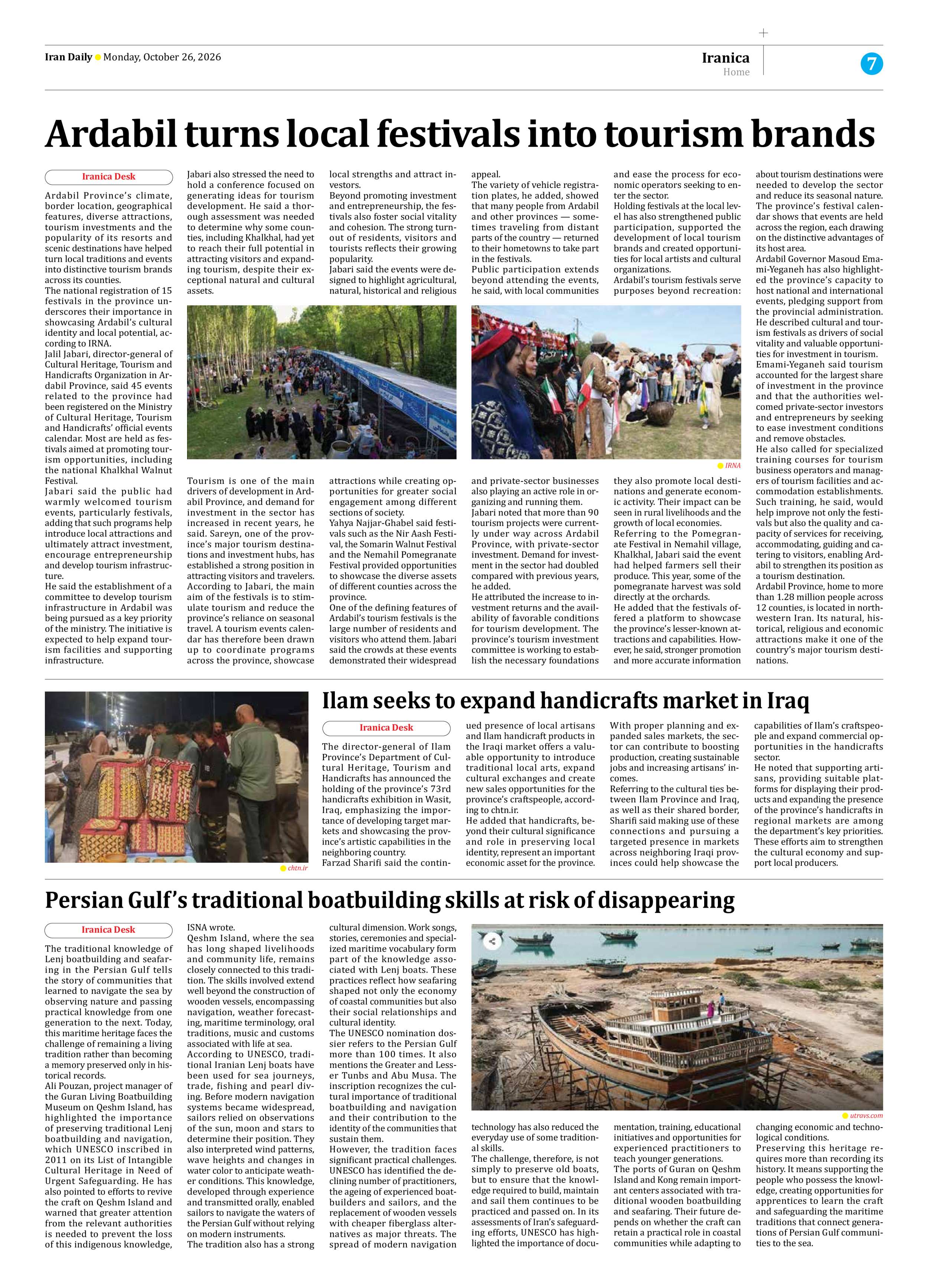


Persian Gulf’s traditional boatbuilding skills at risk of disappearing
The traditional knowledge of Lenj boatbuilding and seafaring in the Persian Gulf tells the story of communities that learned to navigate the sea by observing nature and passing practical knowledge from one generation to the next. Today, this maritime heritage faces the challenge of remaining a living tradition rather than becoming a memory preserved only in historical records.
Ali Pouzan, project manager of the Guran Living Boatbuilding Museum on Qeshm Island, has highlighted the importance of preserving traditional Lenj boatbuilding and navigation, which UNESCO inscribed in 2011 on its List of Intangible Cultural Heritage in Need of Urgent Safeguarding. He has also pointed to efforts to revive the craft on Qeshm Island and warned that greater attention from the relevant authorities is needed to prevent the loss of this indigenous knowledge, ISNA wrote.
Qeshm Island, where the sea has long shaped livelihoods and community life, remains closely connected to this tradition. The skills involved extend well beyond the construction of wooden vessels, encompassing navigation, weather forecasting, maritime terminology, oral traditions, music and customs associated with life at sea.
According to UNESCO, traditional Iranian Lenj boats have been used for sea journeys, trade, fishing and pearl diving. Before modern navigation systems became widespread, sailors relied on observations of the sun, moon and stars to determine their position. They also interpreted wind patterns, wave heights and changes in water color to anticipate weather conditions. This knowledge, developed through experience and transmitted orally, enabled sailors to navigate the waters of the Persian Gulf without relying on modern instruments.
The tradition also has a strong cultural dimension. Work songs, stories, ceremonies and specialized maritime vocabulary form part of the knowledge associated with Lenj boats. These practices reflect how seafaring shaped not only the economy of coastal communities but also their social relationships and cultural identity.
The UNESCO nomination dossier refers to the Persian Gulf more than 100 times. It also mentions the Greater and Lesser Tunbs and Abu Musa. The inscription recognizes the cultural importance of traditional boatbuilding and navigation and their contribution to the identity of the communities that sustain them.
However, the tradition faces significant practical challenges. UNESCO has identified the declining number of practitioners, the ageing of experienced boatbuilders and sailors, and the replacement of wooden vessels with cheaper fiberglass alternatives as major threats. The spread of modern navigation technology has also reduced the everyday use of some traditional skills.
The challenge, therefore, is not simply to preserve old boats, but to ensure that the knowledge required to build, maintain and sail them continues to be practiced and passed on. In its assessments of Iran’s safeguarding efforts, UNESCO has highlighted the importance of documentation, training, educational initiatives and opportunities for experienced practitioners to teach younger generations.
The ports of Guran on Qeshm Island and Kong remain important centers associated with traditional wooden boatbuilding and seafaring. Their future depends on whether the craft can retain a practical role in coastal communities while adapting to changing economic and technological conditions.
Preserving this heritage requires more than recording its history. It means supporting the people who possess the knowledge, creating opportunities for apprentices to learn the craft and safeguarding the maritime traditions that connect generations of Persian Gulf communities to the sea.