




Nothing will be same as before aggression against Iran: Araghchi
‘US military bases failed to bring security to their host countries’
Foreign Minister Abbas Araghchi said on Sunday that “nothing will be the same” as before the US-Israeli aggression against Iran, stressing that fundamental and strategic changes have taken place in West Asia since then.
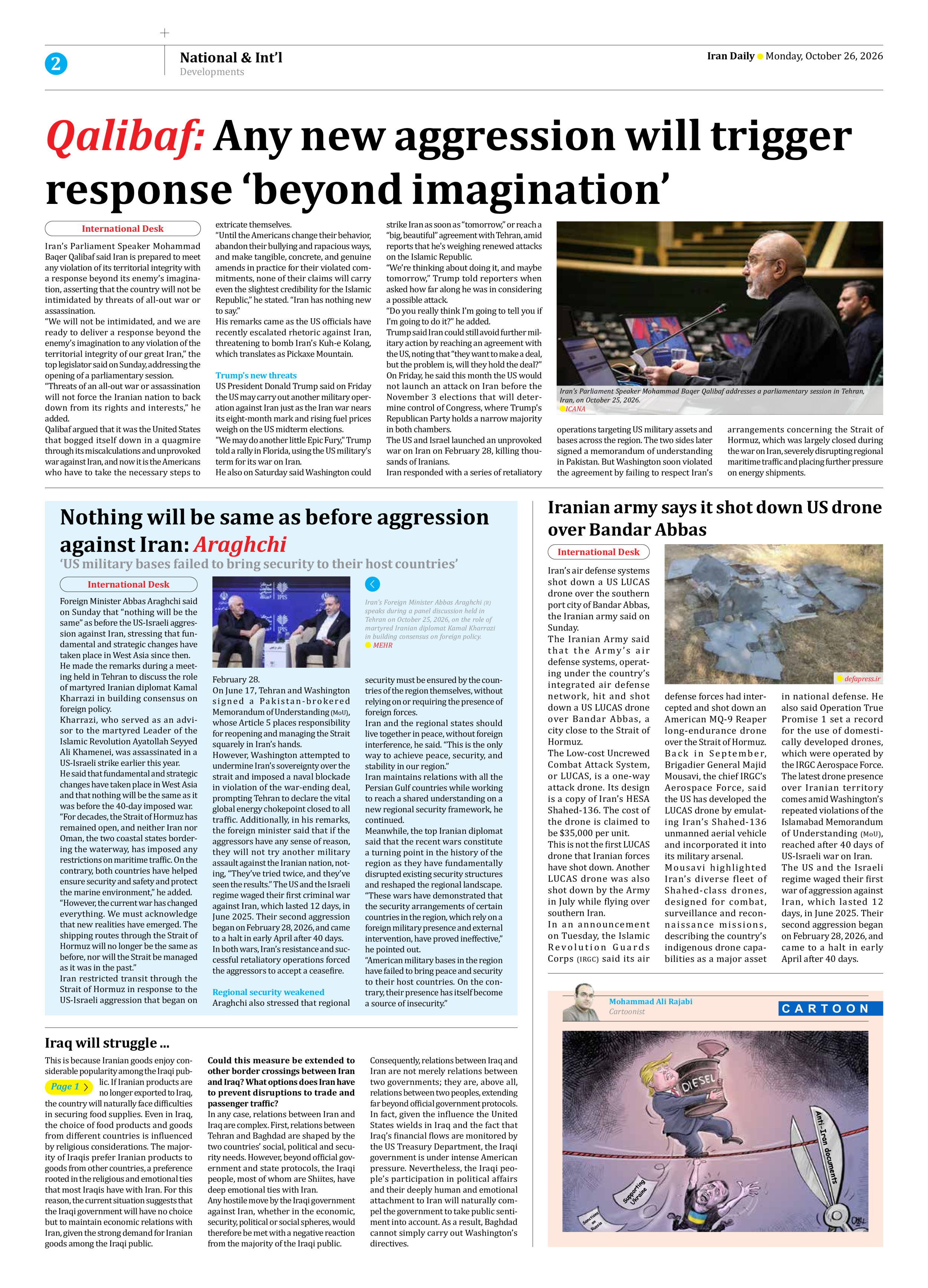
He made the remarks during a meeting held in Tehran to discuss the role of martyred Iranian diplomat Kamal Kharrazi in building consensus on foreign policy.
Kharrazi, who served as an advisor to the martyred Leader of the Islamic Revolution Ayatollah Seyyed Ali Khamenei, was assassinated in a US-Israeli strike earlier this year.
He said that fundamental and strategic changes have taken place in West Asia and that nothing will be the same as it was before the 40-day imposed war.
“For decades, the Strait of Hormuz has remained open, and neither Iran nor Oman, the two coastal states bordering the waterway, has imposed any restrictions on maritime traffic. On the contrary, both countries have helped ensure security and safety and protect the marine environment,” he added.
“However, the current war has changed everything. We must acknowledge that new realities have emerged. The shipping routes through the Strait of Hormuz will no longer be the same as before, nor will the Strait be managed as it was in the past.”
Iran restricted transit through the Strait of Hormuz in response to the US-Israeli aggression that began on February 28.
On June 17, Tehran and Washington signed a Pakistan-brokered Memorandum of Understanding (MoU), whose Article 5 places responsibility for reopening and managing the Strait squarely in Iran’s hands.
However, Washington attempted to undermine Iran’s sovereignty over the strait and imposed a naval blockade in violation of the war-ending deal, prompting Tehran to declare the vital global energy chokepoint closed to all traffic. Additionally, in his remarks, the foreign minister said that if the aggressors have any sense of reason, they will not try another military assault against the Iranian nation, noting, “They’ve tried twice, and they’ve seen the results.” The US and the Israeli regime waged their first criminal war against Iran, which lasted 12 days, in June 2025. Their second aggression began on February 28, 2026, and came to a halt in early April after 40 days.
In both wars, Iran’s resistance and successful retaliatory operations forced the aggressors to accept a ceasefire.
Regional security weakened
Araghchi also stressed that regional security must be ensured by the countries of the region themselves, without relying on or requiring the presence of foreign forces.
Iran and the regional states should live together in peace, without foreign interference, he said. “This is the only way to achieve peace, security, and stability in our region.”
Iran maintains relations with all the Persian Gulf countries while working to reach a shared understanding on a new regional security framework, he continued.
Meanwhile, the top Iranian diplomat said that the recent wars constitute a turning point in the history of the region as they have fundamentally disrupted existing security structures and reshaped the regional landscape.
“These wars have demonstrated that the security arrangements of certain countries in the region, which rely on a foreign military presence and external intervention, have proved ineffective,” he pointed out.
“American military bases in the region have failed to bring peace and security to their host countries. On the contrary, their presence has itself become a source of insecurity.”