




Gov’t seeks to remove export barriers to Iraq, Pakistan, Afghanistan
Baghdad warns against border closures
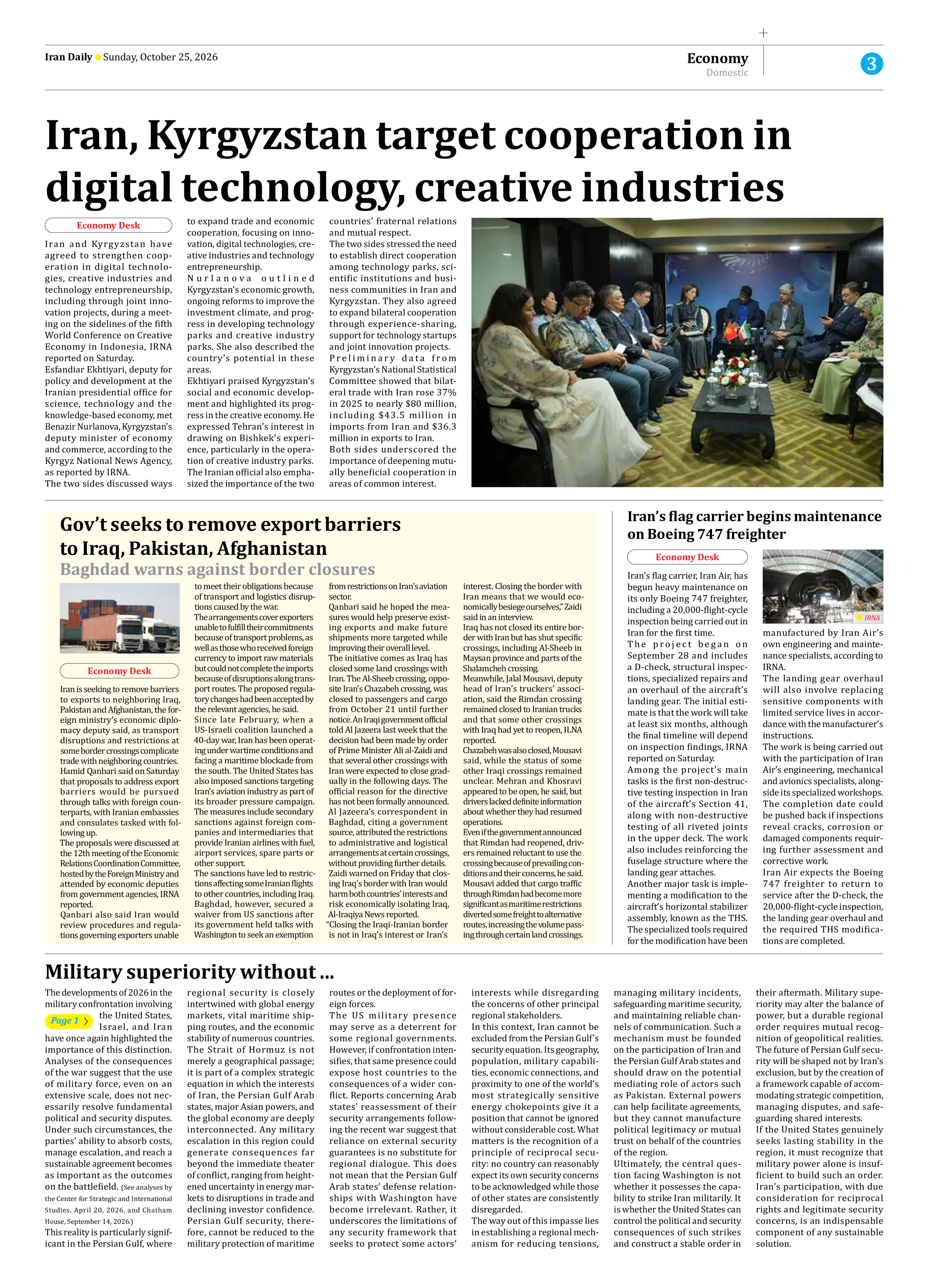
Iran is seeking to remove barriers to exports to neighboring Iraq, Pakistan and Afghanistan, the foreign ministry’s economic diplomacy deputy said, as transport disruptions and restrictions at some border crossings complicate trade with neighboring countries.
Hamid Qanbari said on Saturday that proposals to address export barriers would be pursued through talks with foreign counterparts, with Iranian embassies and consulates tasked with following up.
The proposals were discussed at the 12th meeting of the Economic Relations Coordination Committee, hosted by the Foreign Ministry and attended by economic deputies from government agencies, IRNA reported.
Qanbari also said Iran would review procedures and regulations governing exporters unable to meet their obligations because of transport and logistics disruptions caused by the war.
The arrangements cover exporters unable to fulfill their commitments because of transport problems, as well as those who received foreign currency to import raw materials but could not complete the imports because of disruptions along transport routes. The proposed regulatory changes had been accepted by the relevant agencies, he said.
Since late February, when a US-Israeli coalition launched a 40-day war, Iran has been operating under wartime conditions and facing a maritime blockade from the south. The United States has also imposed sanctions targeting Iran’s aviation industry as part of its broader pressure campaign. The measures include secondary sanctions against foreign companies and intermediaries that provide Iranian airlines with fuel, airport services, spare parts or other support.
The sanctions have led to restrictions affecting some Iranian flights to other countries, including Iraq. Baghdad, however, secured a waiver from US sanctions after its government held talks with Washington to seek an exemption from restrictions on Iran’s aviation sector.
Qanbari said he hoped the measures would help preserve existing exports and make future shipments more targeted while improving their overall level.
The initiative comes as Iraq has closed some land crossings with Iran. The Al-Sheeb crossing, opposite Iran’s Chazabeh crossing, was closed to passengers and cargo from October 21 until further notice. An Iraqi government official told Al Jazeera last week that the decision had been made by order of Prime Minister Ali al-Zaidi and that several other crossings with Iran were expected to close gradually in the following days. The official reason for the directive has not been formally announced. Al Jazeera’s correspondent in Baghdad, citing a government source, attributed the restrictions to administrative and logistical arrangements at certain crossings, without providing further details.
Zaidi warned on Friday that closing Iraq’s border with Iran would harm both countries’ interests and risk economically isolating Iraq, Al-Iraqiya News reported.
“Closing the Iraqi-Iranian border is not in Iraq’s interest or Iran’s interest. Closing the border with Iran means that we would economically besiege ourselves,” Zaidi said in an interview.
Iraq has not closed its entire border with Iran but has shut specific crossings, including Al-Sheeb in Maysan province and parts of the Shalamcheh crossing.
Meanwhile, Jalal Mousavi, deputy head of Iran’s truckers’ association, said the Rimdan crossing remained closed to Iranian trucks and that some other crossings with Iraq had yet to reopen, ILNA reported.
Chazabeh was also closed, Mousavi said, while the status of some other Iraqi crossings remained unclear. Mehran and Khosravi appeared to be open, he said, but drivers lacked definite information about whether they had resumed operations.
Even if the government announced that Rimdan had reopened, drivers remained reluctant to use the crossing because of prevailing conditions and their concerns, he said.
Mousavi added that cargo traffic through Rimdan had become more significant as maritime restrictions diverted some freight to alternative routes, increasing the volume passing through certain land crossings.