


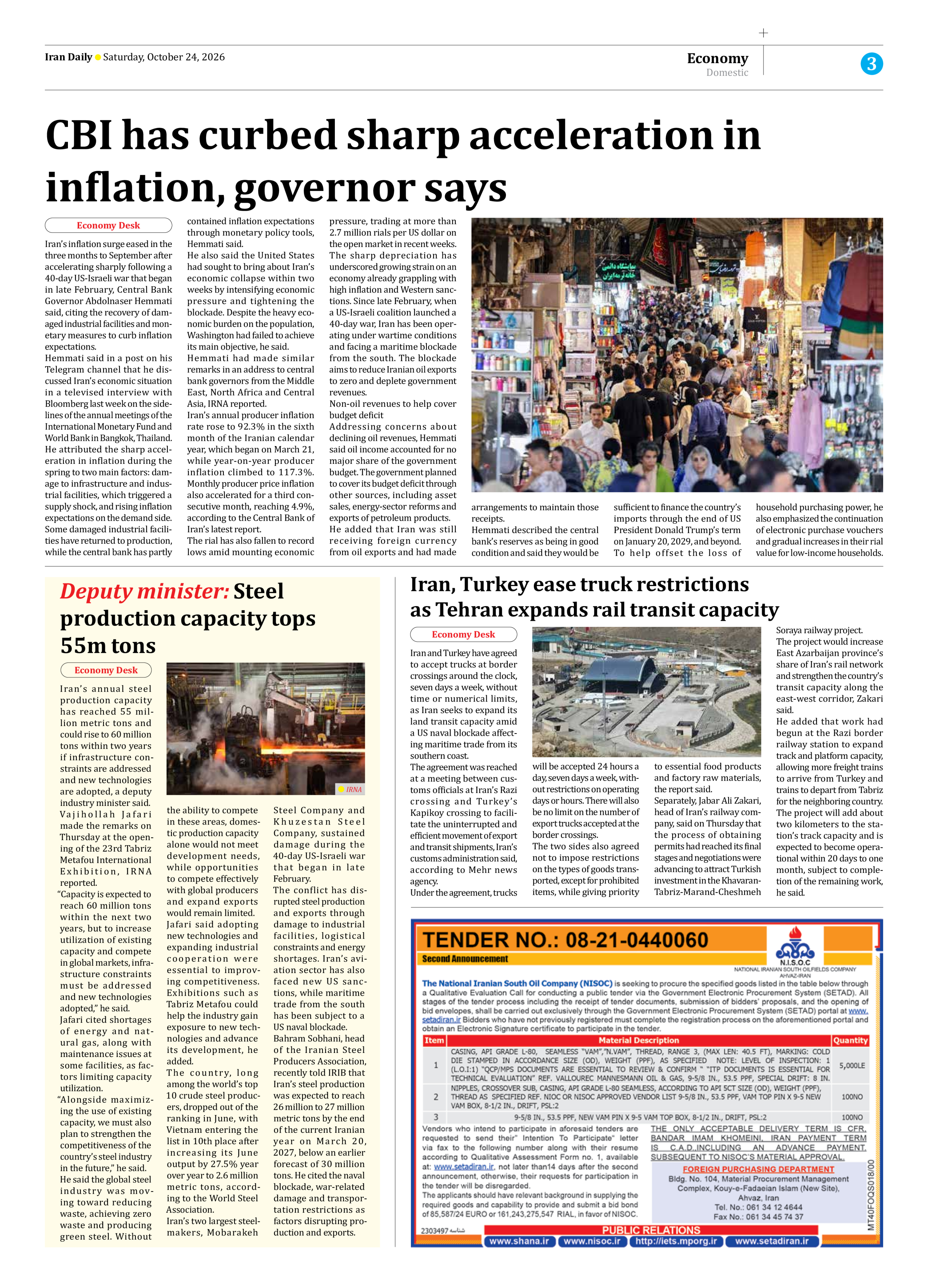


CBI has curbed sharp acceleration in inflation, governor says
Iran’s inflation surge eased in the three months to September after accelerating sharply following a 40-day US-Israeli war that began in late February, Central Bank Governor Abdolnaser Hemmati said, citing the recovery of damaged industrial facilities and monetary measures to curb inflation expectations.
Hemmati said in a post on his Telegram channel that he discussed Iran’s economic situation in a televised interview with Bloomberg last week on the sidelines of the annual meetings of the International Monetary Fund and World Bank in Bangkok, Thailand.
He attributed the sharp acceleration in inflation during the spring to two main factors: damage to infrastructure and industrial facilities, which triggered a supply shock, and rising inflation expectations on the demand side.
Some damaged industrial facilities have returned to production, while the central bank has partly contained inflation expectations through monetary policy tools, Hemmati said.
He also said the United States had sought to bring about Iran’s economic collapse within two weeks by intensifying economic pressure and tightening the blockade. Despite the heavy economic burden on the population, Washington had failed to achieve its main objective, he said.
Hemmati had made similar remarks in an address to central bank governors from the Middle East, North Africa and Central Asia, IRNA reported.
Iran’s annual producer inflation rate rose to 92.3% in the sixth month of the Iranian calendar year, which began on March 21, while year-on-year producer inflation climbed to 117.3%. Monthly producer price inflation also accelerated for a third consecutive month, reaching 4.9%, according to the Central Bank of Iran’s latest report.
The rial has also fallen to record lows amid mounting economic pressure, trading at more than 2.7 million rials per US dollar on the open market in recent weeks.
The sharp depreciation has underscored growing strain on an economy already grappling with high inflation and Western sanctions. Since late February, when a US-Israeli coalition launched a 40-day war, Iran has been operating under wartime conditions and facing a maritime blockade from the south. The blockade aims to reduce Iranian oil exports to zero and deplete government revenues.
Non-oil revenues to help cover budget deficit
Addressing concerns about declining oil revenues, Hemmati said oil income accounted for no major share of the government budget. The government planned to cover its budget deficit through other sources, including asset sales, energy-sector reforms and exports of petroleum products.
He added that Iran was still receiving foreign currency from oil exports and had made arrangements to maintain those receipts.
Hemmati described the central bank’s reserves as being in good condition and said they would be sufficient to finance the country’s imports through the end of US President Donald Trump’s term on January 20, 2029, and beyond.
To help offset the loss of household purchasing power, he also emphasized the continuation of electronic purchase vouchers and gradual increases in their rial value for low-income households.