




Official says deep cultural, religious ties underpin Iran-Pakistan relations
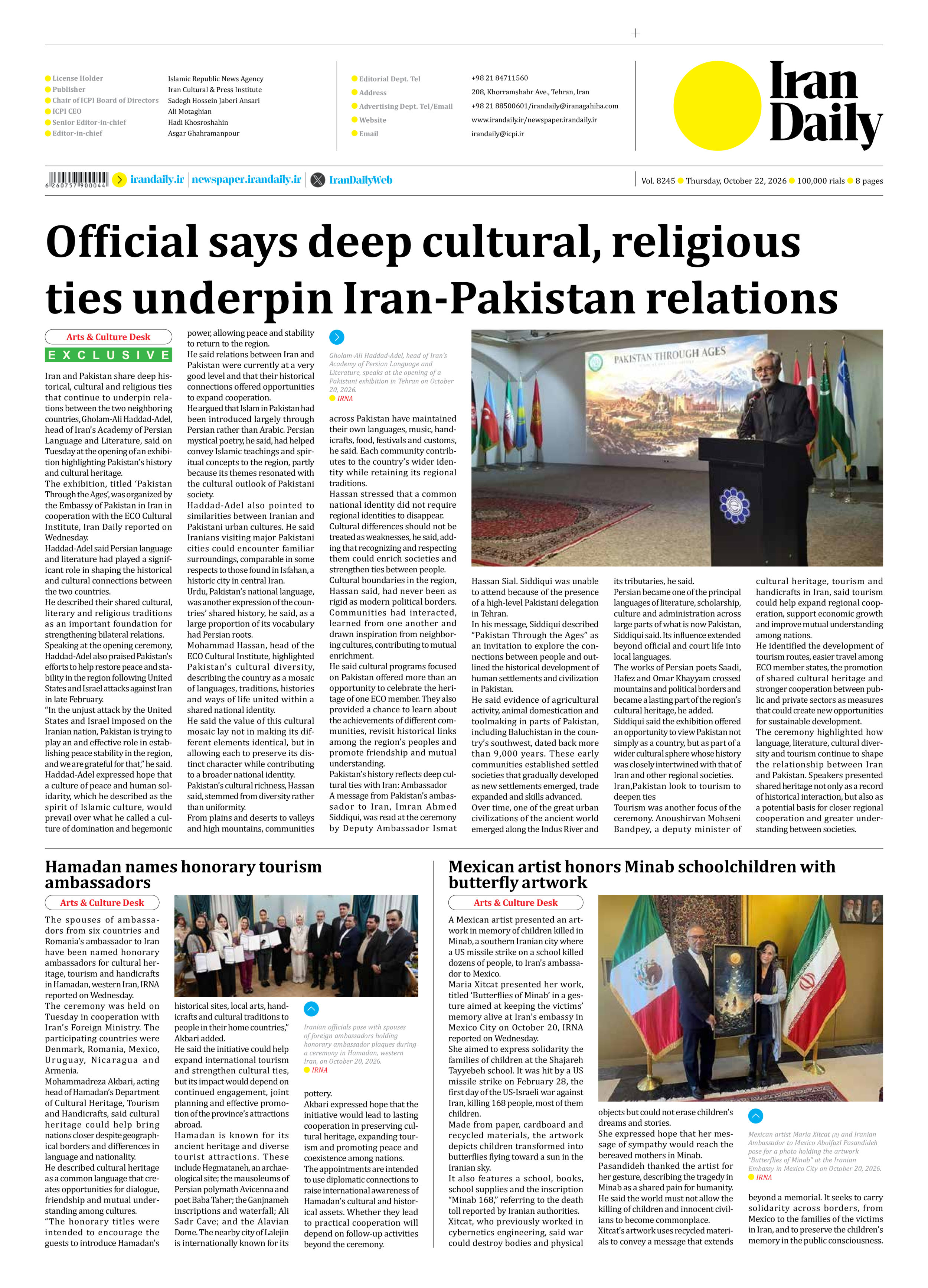
Iran and Pakistan share deep historical, cultural and religious ties that continue to underpin relations between the two neighboring countries, Gholam-Ali Haddad-Adel, head of Iran’s Academy of Persian Language and Literature, said on Tuesday at the opening of an exhibition highlighting Pakistan’s history and cultural heritage.
The exhibition, titled ‘Pakistan Through the Ages’, was organized by the Embassy of Pakistan in Iran in cooperation with the ECO Cultural Institute, Iran Daily reported on Wednesday.
Haddad-Adel said Persian language and literature had played a significant role in shaping the historical and cultural connections between the two countries.
He described their shared cultural, literary and religious traditions as an important foundation for strengthening bilateral relations.
Speaking at the opening ceremony, Haddad-Adel also praised Pakistan’s efforts to help restore peace and stability in the region following United States and Israel attacks against Iran in late February.
“In the unjust attack by the United States and Israel imposed on the Iranian nation, Pakistan is trying to play an and effective role in establishing peace stability in the region, and we are grateful for that,” he said.
Haddad-Adel expressed hope that a culture of peace and human solidarity, which he described as the spirit of Islamic culture, would prevail over what he called a culture of domination and hegemonic power, allowing peace and stability to return to the region.
He said relations between Iran and Pakistan were currently at a very good level and that their historical connections offered opportunities to expand cooperation.
He argued that Islam in Pakistan had been introduced largely through Persian rather than Arabic. Persian mystical poetry, he said, had helped convey Islamic teachings and spiritual concepts to the region, partly because its themes resonated with the cultural outlook of Pakistani society.
Haddad-Adel also pointed to similarities between Iranian and Pakistani urban cultures. He said Iranians visiting major Pakistani cities could encounter familiar surroundings, comparable in some respects to those found in Isfahan, a historic city in central Iran.
Urdu, Pakistan’s national language, was another expression of the countries’ shared history, he said, as a large proportion of its vocabulary had Persian roots.
Mohammad Hassan, head of the ECO Cultural Institute, highlighted Pakistan’s cultural diversity, describing the country as a mosaic of languages, traditions, histories and ways of life united within a shared national identity.
He said the value of this cultural mosaic lay not in making its different elements identical, but in allowing each to preserve its distinct character while contributing to a broader national identity.
Pakistan’s cultural richness, Hassan said, stemmed from diversity rather than uniformity.
From plains and deserts to valleys and high mountains, communities across Pakistan have maintained their own languages, music, handicrafts, food, festivals and customs, he said. Each community contributes to the country’s wider identity while retaining its regional traditions.
Hassan stressed that a common national identity did not require regional identities to disappear.
Cultural differences should not be treated as weaknesses, he said, adding that recognizing and respecting them could enrich societies and strengthen ties between people.
Cultural boundaries in the region, Hassan said, had never been as rigid as modern political borders. Communities had interacted, learned from one another and drawn inspiration from neighboring cultures, contributing to mutual enrichment.
He said cultural programs focused on Pakistan offered more than an opportunity to celebrate the heritage of one ECO member. They also provided a chance to learn about the achievements of different communities, revisit historical links among the region’s peoples and promote friendship and mutual understanding.
Pakistan’s history reflects deep cultural ties with Iran: Ambassador
A message from Pakistan’s ambassador to Iran, Imran Ahmed Siddiqui, was read at the ceremony by Deputy Ambassador Ismat Hassan Sial. Siddiqui was unable to attend because of the presence of a high-level Pakistani delegation in Tehran.
In his message, Siddiqui described “Pakistan Through the Ages” as an invitation to explore the connections between people and outlined the historical development of human settlements and civilization in Pakistan.
He said evidence of agricultural activity, animal domestication and toolmaking in parts of Pakistan, including Baluchistan in the country’s southwest, dated back more than 9,000 years. These early communities established settled societies that gradually developed as new settlements emerged, trade expanded and skills advanced.
Over time, one of the great urban civilizations of the ancient world emerged along the Indus River and its tributaries, he said.
Persian became one of the principal languages of literature, scholarship, culture and administration across large parts of what is now Pakistan, Siddiqui said. Its influence extended beyond official and court life into local languages.
The works of Persian poets Saadi, Hafez and Omar Khayyam crossed mountains and political borders and became a lasting part of the region’s cultural heritage, he added.
Siddiqui said the exhibition offered an opportunity to view Pakistan not simply as a country, but as part of a wider cultural sphere whose history was closely intertwined with that of Iran and other regional societies.
Iran,Pakistan look to tourism to deepen ties
Tourism was another focus of the ceremony. Anoushirvan Mohseni Bandpey, a deputy minister of cultural heritage, tourism and handicrafts in Iran, said tourism could help expand regional cooperation, support economic growth and improve mutual understanding among nations.
He identified the development of tourism routes, easier travel among ECO member states, the promotion of shared cultural heritage and stronger cooperation between public and private sectors as measures that could create new opportunities for sustainable development.
The ceremony highlighted how language, literature, cultural diversity and tourism continue to shape the relationship between Iran and Pakistan. Speakers presented shared heritage not only as a record of historical interaction, but also as a potential basis for closer regional cooperation and greater understanding between societies.