




Who holds off switch?
Starlink, dependence, and India’s satcom policy
By Ashwin Prasad Rao, Aditya Ramanathan & KPM Das
Researchers
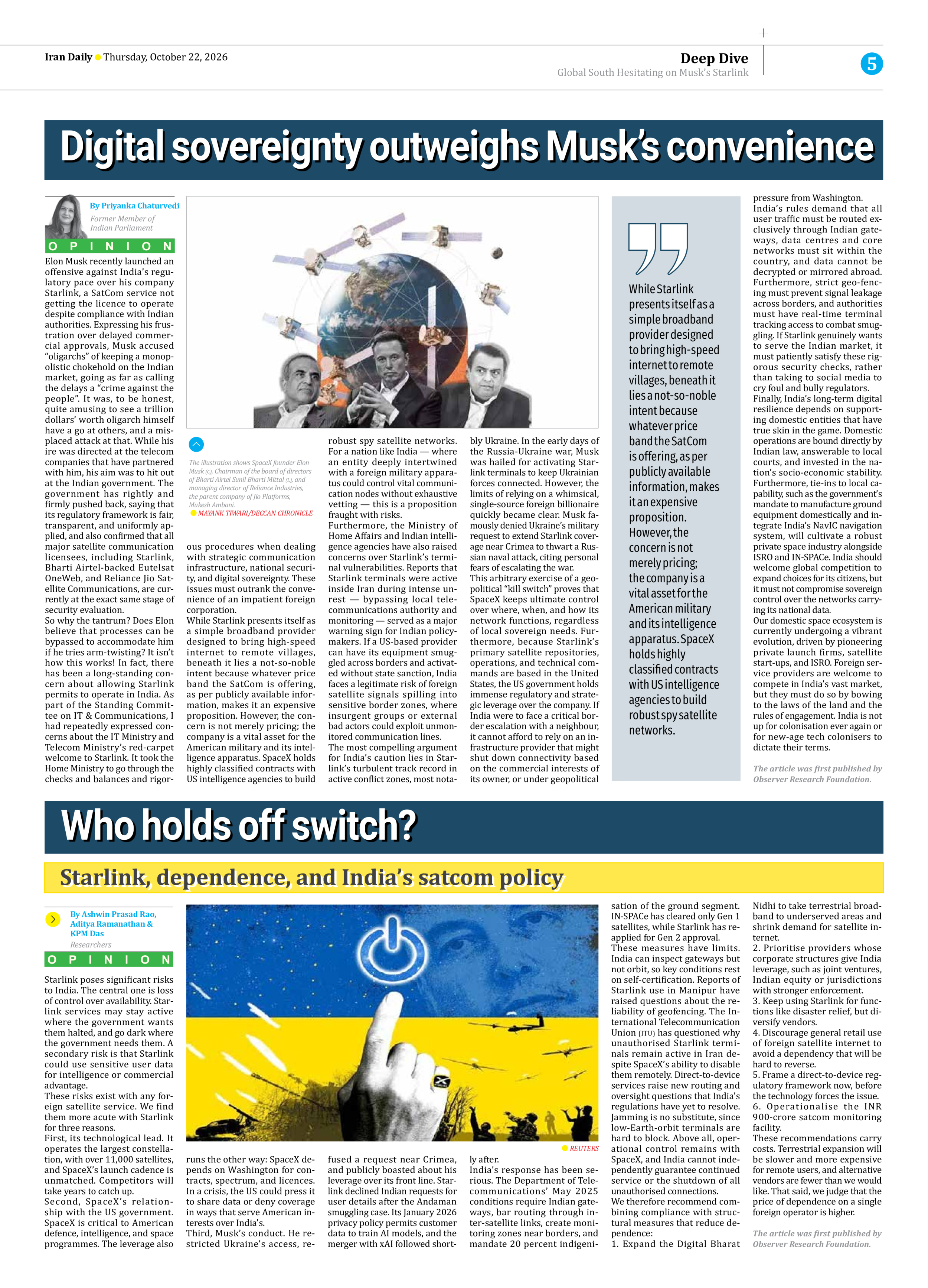
Starlink poses significant risks to India. The central one is loss of control over availability. Starlink services may stay active where the government wants them halted, and go dark where the government needs them. A secondary risk is that Starlink could use sensitive user data for intelligence or commercial advantage.
These risks exist with any foreign satellite service. We find them more acute with Starlink for three reasons.
First, its technological lead. It operates the largest constellation, with over 11,000 satellites, and SpaceX’s launch cadence is unmatched. Competitors will take years to catch up.
Second, SpaceX’s relationship with the US government. SpaceX is critical to American defence, intelligence, and space programmes. The leverage also runs the other way: SpaceX depends on Washington for contracts, spectrum, and licences. In a crisis, the US could press it to share data or deny coverage in ways that serve American interests over India’s.
Third, Musk’s conduct. He restricted Ukraine’s access, refused a request near Crimea, and publicly boasted about his leverage over its front line. Starlink declined Indian requests for user details after the Andaman smuggling case. Its January 2026 privacy policy permits customer data to train AI models, and the merger with xAI followed shortly after.
India’s response has been serious. The Department of Telecommunications’ May 2025 conditions require Indian gateways, bar routing through inter-satellite links, create monitoring zones near borders, and mandate 20 percent indigenisation of the ground segment. IN-SPACe has cleared only Gen 1 satellites, while Starlink has reapplied for Gen 2 approval.
These measures have limits. India can inspect gateways but not orbit, so key conditions rest on self-certification. Reports of Starlink use in Manipur have raised questions about the reliability of geofencing. The International Telecommunication Union (ITU) has questioned why unauthorised Starlink terminals remain active in Iran despite SpaceX’s ability to disable them remotely. Direct-to-device services raise new routing and oversight questions that India’s regulations have yet to resolve. Jamming is no substitute, since low-Earth-orbit terminals are hard to block. Above all, operational control remains with SpaceX, and India cannot independently guarantee continued service or the shutdown of all unauthorised connections.
We therefore recommend combining compliance with structural measures that reduce dependence:
1. Expand the Digital Bharat Nidhi to take terrestrial broadband to underserved areas and shrink demand for satellite internet.
2. Prioritise providers whose corporate structures give India leverage, such as joint ventures, Indian equity or jurisdictions with stronger enforcement.
3. Keep using Starlink for functions like disaster relief, but diversify vendors.
4. Discourage general retail use of foreign satellite internet to avoid a dependency that will be hard to reverse.
5. Frame a direct-to-device regulatory framework now, before the technology forces the issue.
6. Operationalise the INR 900-crore satcom monitoring facility.
These recommendations carry costs. Terrestrial expansion will be slower and more expensive for remote users, and alternative vendors are fewer than we would like. That said, we judge that the price of dependence on a single foreign operator is higher.
The article was first published by Observer Research Foundation.