




Sovereignty by design
What Starlink debate in India gets wrong
Assistant Professor of Economics at Mata Sundri College for Women
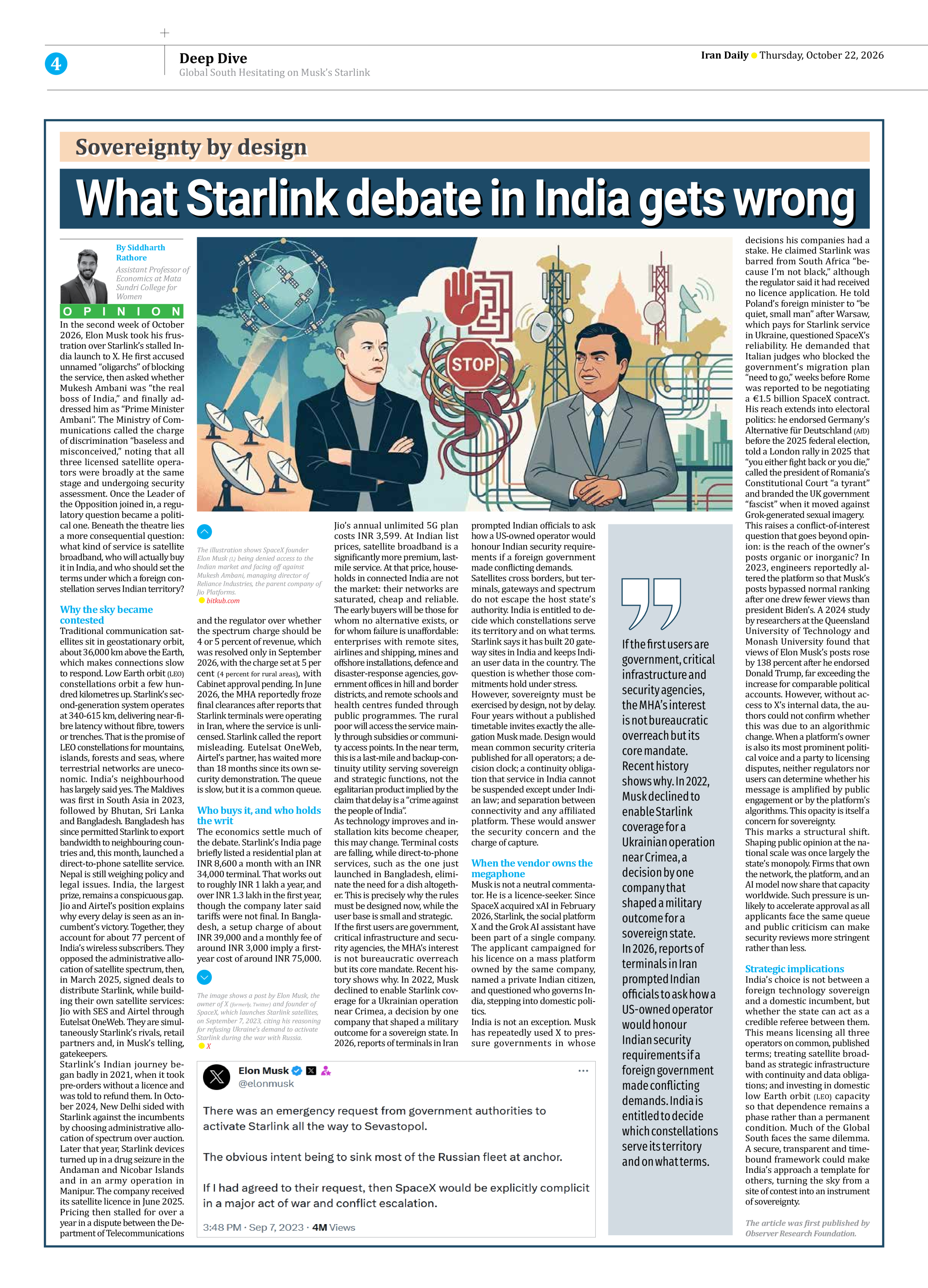
In the second week of October 2026, Elon Musk took his frustration over Starlink’s stalled India launch to X. He first accused unnamed “oligarchs” of blocking the service, then asked whether Mukesh Ambani was “the real boss of India,” and finally addressed him as “Prime Minister Ambani”. The Ministry of Communications called the charge of discrimination “baseless and misconceived,” noting that all three licensed satellite operators were broadly at the same stage and undergoing security assessment. Once the Leader of the Opposition joined in, a regulatory question became a political one. Beneath the theatre lies a more consequential question: what kind of service is satellite broadband, who will actually buy it in India, and who should set the terms under which a foreign constellation serves Indian territory?
Why the sky became contested
Traditional communication satellites sit in geostationary orbit, about 36,000 km above the Earth, which makes connections slow to respond. Low Earth orbit (LEO) constellations orbit a few hundred kilometres up. Starlink’s second-generation system operates at 340-615 km, delivering near-fibre latency without fibre, towers or trenches. That is the promise of LEO constellations for mountains, islands, forests and seas, where terrestrial networks are uneconomic. India’s neighbourhood has largely said yes. The Maldives was first in South Asia in 2023, followed by Bhutan, Sri Lanka and Bangladesh. Bangladesh has since permitted Starlink to export bandwidth to neighbouring countries and, this month, launched a direct-to-phone satellite service. Nepal is still weighing policy and legal issues. India, the largest prize, remains a conspicuous gap.
Jio and Airtel’s position explains why every delay is seen as an incumbent’s victory. Together, they account for about 77 percent of India’s wireless subscribers. They opposed the administrative allocation of satellite spectrum, then, in March 2025, signed deals to distribute Starlink, while building their own satellite services: Jio with SES and Airtel through Eutelsat OneWeb. They are simultaneously Starlink’s rivals, retail partners and, in Musk’s telling, gatekeepers.
Starlink’s Indian journey began badly in 2021, when it took pre-orders without a licence and was told to refund them. In October 2024, New Delhi sided with Starlink against the incumbents by choosing administrative allocation of spectrum over auction. Later that year, Starlink devices turned up in a drug seizure in the Andaman and Nicobar Islands and in an army operation in Manipur. The company received its satellite licence in June 2025. Pricing then stalled for over a year in a dispute between the Department of Telecommunications and the regulator over whether the spectrum charge should be 4 or 5 percent of revenue, which was resolved only in September 2026, with the charge set at 5 per cent (4 percent for rural areas), with Cabinet approval pending. In June 2026, the MHA reportedly froze final clearances after reports that Starlink terminals were operating in Iran, where the service is unlicensed. Starlink called the report misleading. Eutelsat OneWeb, Airtel’s partner, has waited more than 18 months since its own security demonstration. The queue is slow, but it is a common queue.
Who buys it, and who holds the writ
The economics settle much of the debate. Starlink’s India page briefly listed a residential plan at INR 8,600 a month with an INR 34,000 terminal. That works out to roughly INR 1 lakh a year, and over INR 1.3 lakh in the first year, though the company later said tariffs were not final. In Bangladesh, a setup charge of about INR 39,000 and a monthly fee of around INR 3,000 imply a first-year cost of around INR 75,000. Jio’s annual unlimited 5G plan costs INR 3,599. At Indian list prices, satellite broadband is a significantly more premium, last-mile service. At that price, households in connected India are not the market: their networks are saturated, cheap and reliable. The early buyers will be those for whom no alternative exists, or for whom failure is unaffordable: enterprises with remote sites, airlines and shipping, mines and offshore installations, defence and disaster-response agencies, government offices in hill and border districts, and remote schools and health centres funded through public programmes. The rural poor will access the service mainly through subsidies or community access points. In the near term, this is a last-mile and backup-continuity utility serving sovereign and strategic functions, not the egalitarian product implied by the claim that delay is a “crime against the people of India”.
As technology improves and installation kits become cheaper, this may change. Terminal costs are falling, while direct-to-phone services, such as the one just launched in Bangladesh, eliminate the need for a dish altogether. This is precisely why the rules must be designed now, while the user base is small and strategic.
If the first users are government, critical infrastructure and security agencies, the MHA’s interest is not bureaucratic overreach but its core mandate. Recent history shows why. In 2022, Musk declined to enable Starlink coverage for a Ukrainian operation near Crimea, a decision by one company that shaped a military outcome for a sovereign state. In 2026, reports of terminals in Iran prompted Indian officials to ask how a US-owned operator would honour Indian security requirements if a foreign government made conflicting demands.
Satellites cross borders, but terminals, gateways and spectrum do not escape the host state’s authority. India is entitled to decide which constellations serve its territory and on what terms. Starlink says it has built 20 gateway sites in India and keeps Indian user data in the country. The question is whether those commitments hold under stress.
However, sovereignty must be exercised by design, not by delay. Four years without a published timetable invites exactly the allegation Musk made. Design would mean common security criteria published for all operators; a decision clock; a continuity obligation that service in India cannot be suspended except under Indian law; and separation between connectivity and any affiliated platform. These would answer the security concern and the charge of capture.
When the vendor owns the megaphone
Musk is not a neutral commentator. He is a licence-seeker. Since SpaceX acquired xAI in February 2026, Starlink, the social platform X and the Grok AI assistant have been part of a single company. The applicant campaigned for his licence on a mass platform owned by the same company, named a private Indian citizen, and questioned who governs India, stepping into domestic politics.
India is not an exception. Musk has repeatedly used X to pressure governments in whose decisions his companies had a stake. He claimed Starlink was barred from South Africa “because I’m not black,” although the regulator said it had received no licence application. He told Poland’s foreign minister to “be quiet, small man” after Warsaw, which pays for Starlink service in Ukraine, questioned SpaceX’s reliability. He demanded that Italian judges who blocked the government’s migration plan “need to go,” weeks before Rome was reported to be negotiating a €1.5 billion SpaceX contract. His reach extends into electoral politics: he endorsed Germany’s Alternative für Deutschland (AfD) before the 2025 federal election, told a London rally in 2025 that “you either fight back or you die,” called the president of Romania’s Constitutional Court “a tyrant” and branded the UK government “fascist” when it moved against Grok-generated sexual imagery.
This raises a conflict-of-interest question that goes beyond opinion: is the reach of the owner’s posts organic or inorganic? In 2023, engineers reportedly altered the platform so that Musk’s posts bypassed normal ranking after one drew fewer views than president Biden’s. A 2024 study by researchers at the Queensland University of Technology and Monash University found that views of Elon Musk’s posts rose by 138 percent after he endorsed Donald Trump, far exceeding the increase for comparable political accounts. However, without access to X’s internal data, the authors could not confirm whether this was due to an algorithmic change. When a platform’s owner is also its most prominent political voice and a party to licensing disputes, neither regulators nor users can determine whether his message is amplified by public engagement or by the platform’s algorithms. This opacity is itself a concern for sovereignty.
This marks a structural shift. Shaping public opinion at the national scale was once largely the state’s monopoly. Firms that own the network, the platform, and an AI model now share that capacity worldwide. Such pressure is unlikely to accelerate approval as all applicants face the same queue and public criticism can make security reviews more stringent rather than less.
Strategic implications
India’s choice is not between a foreign technology sovereign and a domestic incumbent, but whether the state can act as a credible referee between them. This means licensing all three operators on common, published terms; treating satellite broadband as strategic infrastructure with continuity and data obligations; and investing in domestic low Earth orbit (LEO) capacity so that dependence remains a phase rather than a permanent condition. Much of the Global South faces the same dilemma. A secure, transparent and time-bound framework could make India’s approach a template for others, turning the sky from a site of contest into an instrument of sovereignty.
The article was first published by Observer Research Foundation.