




US accepted Iran’s seven-day proposal but sought to add more clauses: Araghchi
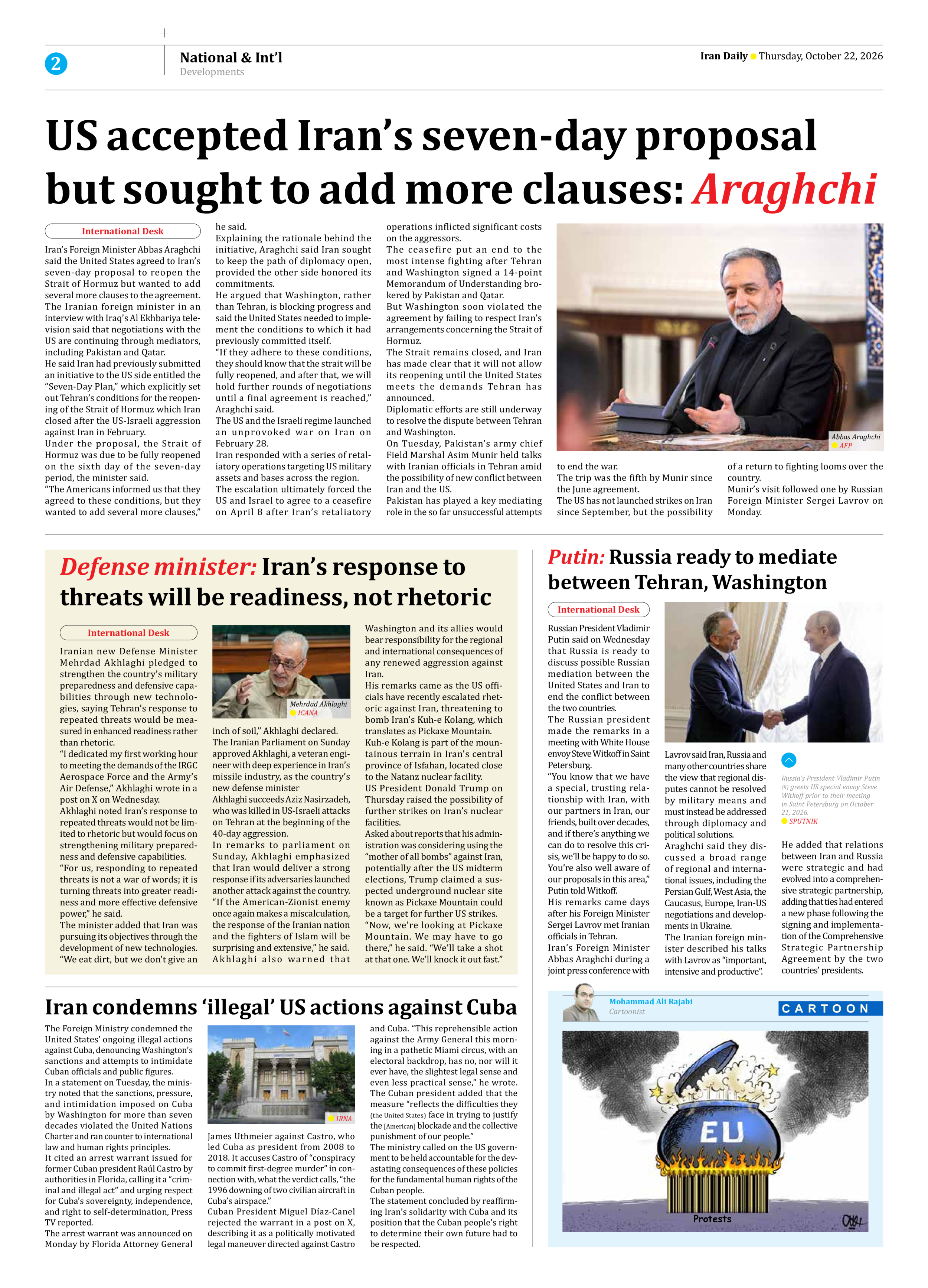
Iran’s Foreign Minister Abbas Araghchi said the United States agreed to Iran’s seven-day proposal to reopen the Strait of Hormuz but wanted to add several more clauses to the agreement.
The Iranian foreign minister in an interview with Iraq’s Al Ekhbariya television said that negotiations with the US are continuing through mediators, including Pakistan and Qatar.
He said Iran had previously submitted an initiative to the US side entitled the “Seven-Day Plan,” which explicitly set out Tehran’s conditions for the reopening of the Strait of Hormuz which Iran closed after the US-Israeli aggression against Iran in February.
Under the proposal, the Strait of Hormuz was due to be fully reopened on the sixth day of the seven-day period, the minister said.
“The Americans informed us that they agreed to these conditions, but they wanted to add several more clauses,” he said.
Explaining the rationale behind the initiative, Araghchi said Iran sought to keep the path of diplomacy open, provided the other side honored its commitments.
He argued that Washington, rather than Tehran, is blocking progress and said the United States needed to implement the conditions to which it had previously committed itself.
“If they adhere to these conditions, they should know that the strait will be fully reopened, and after that, we will hold further rounds of negotiations until a final agreement is reached,” Araghchi said.
The US and the Israeli regime launched an unprovoked war on Iran on February 28.
Iran responded with a series of retaliatory operations targeting US military assets and bases across the region.
The escalation ultimately forced the US and Israel to agree to a ceasefire on April 8 after Iran’s retaliatory operations inflicted significant costs on the aggressors.
The ceasefire put an end to the most intense fighting after Tehran and Washington signed a 14-point Memorandum of Understanding brokered by Pakistan and Qatar.
But Washington soon violated the agreement by failing to respect Iran’s arrangements concerning the Strait of Hormuz.
The Strait remains closed, and Iran has made clear that it will not allow its reopening until the United States meets the demands Tehran has announced.
Diplomatic efforts are still underway to resolve the dispute between Tehran and Washington.
On Tuesday, Pakistan’s army chief Field Marshal Asim Munir held talks with Iranian officials in Tehran amid the possibility of new conflict between Iran and the US.
Pakistan has played a key mediating role in the so far unsuccessful attempts to end the war.
The trip was the fifth by Munir since the June agreement.
The US has not launched strikes on Iran since September, but the possibility of a return to fighting looms over the country.
Munir’s visit followed one by Russian Foreign Minister Sergei Lavrov on Monday.