




Zanjan’s metalworking heritage looks for new markets
By Sadeq Dehqan
Staff writer
From copperware and knife-making to silver filigree, traditional crafts remain an important part of production in Zanjan province, northwestern Iran.
For generations, the Iranian city of Zanjan has been known for its metalworking traditions. Its knives have earned a place in the country’s cutlery trade, while its copperware and delicate silver filigree reflect the skills of artisans whose crafts have deep historical roots.
Today, these traditions remain part of the province’s economic life, extending beyond cultural heritage into workshops and production businesses.
Yet maintaining that role presents a challenge: Zanjan’s artisans must find ways to compete in modern markets while preserving the skills and techniques that distinguish their work.
Mikaeil Mousavi, head of the Zanjan Province Department of Cultural Heritage, Tourism and Handicrafts, says the province has considerable capacity in metal-based handicrafts, particularly copper products, knives and filigree jewelry.“Zanjan ranks fifth among Iran’s provinces in overall handicraft production. Its combination of specialized skills, established production traditions and diverse craft industries makes it a significant center for traditional metalwork,” he said.
Traditional craftsmanship meets modern market challenges
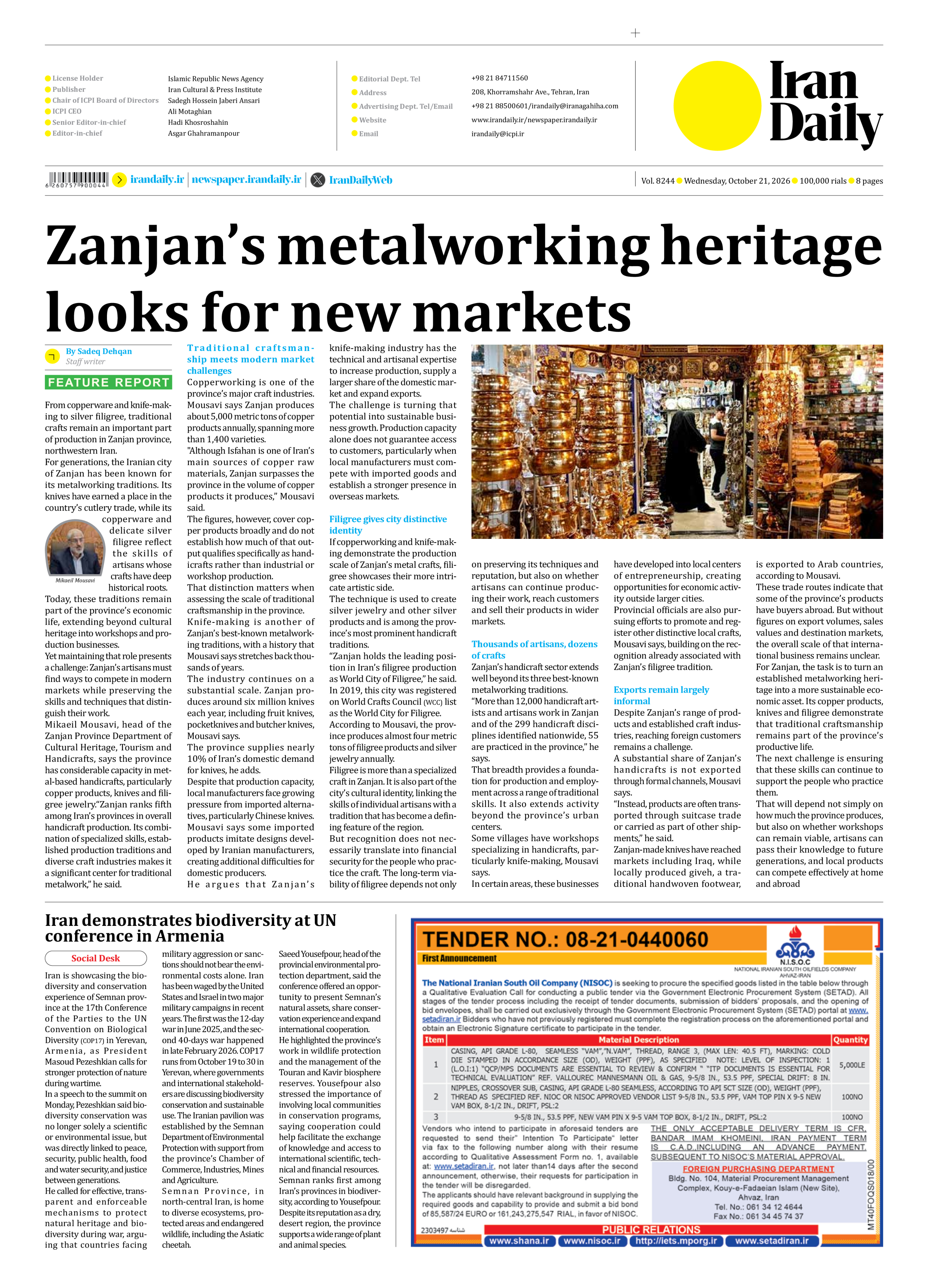
Copperworking is one of the province’s major craft industries. Mousavi says Zanjan produces about 5,000 metric tons of copper products annually, spanning more than 1,400 varieties.
"Although Isfahan is one of Iran’s main sources of copper raw materials, Zanjan surpasses the province in the volume of copper products it produces,” Mousavi said.
The figures, however, cover copper products broadly and do not establish how much of that output qualifies specifically as handicrafts rather than industrial or workshop production.
That distinction matters when assessing the scale of traditional craftsmanship in the province.
Knife-making is another of Zanjan’s best-known metalworking traditions, with a history that Mousavi says stretches back thousands of years.
The industry continues on a substantial scale. Zanjan produces around six million knives each year, including fruit knives, pocketknives and butcher knives, Mousavi says.
The province supplies nearly 10% of Iran’s domestic demand for knives, he adds.
Despite that production capacity, local manufacturers face growing pressure from imported alternatives, particularly Chinese knives.
Mousavi says some imported products imitate designs developed by Iranian manufacturers, creating additional difficulties for domestic producers.
He argues that Zanjan’s knife-making industry has the technical and artisanal expertise to increase production, supply a larger share of the domestic market and expand exports.
The challenge is turning that potential into sustainable business growth. Production capacity alone does not guarantee access to customers, particularly when local manufacturers must compete with imported goods and establish a stronger presence in overseas markets.
Filigree gives city distinctive identity
If copperworking and knife-making demonstrate the production scale of Zanjan’s metal crafts, filigree showcases their more intricate artistic side.
The technique is used to create silver jewelry and other silver products and is among the province’s most prominent handicraft traditions.
“Zanjan holds the leading position in Iran’s filigree production as World City of Filigree,” he said.
In 2019, this city was registered on World Crafts Council (WCC) list as the World City for Filigree.
According to Mousavi, the province produces almost four metric tons of filigree products and silver jewelry annually.
Filigree is more than a specialized craft in Zanjan. It is also part of the city’s cultural identity, linking the skills of individual artisans with a tradition that has become a defining feature of the region.
But recognition does not necessarily translate into financial security for the people who practice the craft. The long-term viability of filigree depends not only on preserving its techniques and reputation, but also on whether artisans can continue producing their work, reach customers and sell their products in wider markets.
Thousands of artisans, dozens of crafts
Zanjan’s handicraft sector extends well beyond its three best-known metalworking traditions.
“More than 12,000 handicraft artists and artisans work in Zanjan and of the 299 handicraft disciplines identified nationwide, 55 are practiced in the province,” he says.
That breadth provides a foundation for production and employment across a range of traditional skills. It also extends activity beyond the province’s urban centers.
Some villages have workshops specializing in handicrafts, particularly knife-making, Mousavi says.
In certain areas, these businesses have developed into local centers of entrepreneurship, creating opportunities for economic activity outside larger cities.
Provincial officials are also pursuing efforts to promote and register other distinctive local crafts, Mousavi says, building on the recognition already associated with Zanjan’s filigree tradition.
Exports remain largely informal
Despite Zanjan’s range of products and established craft industries, reaching foreign customers remains a challenge.
A substantial share of Zanjan’s handicrafts is not exported through formal channels, Mousavi says.
“Instead, products are often transported through suitcase trade or carried as part of other shipments,” he said.
Zanjan-made knives have reached markets including Iraq, while locally produced giveh, a traditional handwoven footwear, is exported to Arab countries, according to Mousavi.
These trade routes indicate that some of the province’s products have buyers abroad. But without figures on export volumes, sales values and destination markets, the overall scale of that international business remains unclear.
For Zanjan, the task is to turn an established metalworking heritage into a more sustainable economic asset. Its copper products, knives and filigree demonstrate that traditional craftsmanship remains part of the province’s productive life.
The next challenge is ensuring that these skills can continue to support the people who practice them.
That will depend not simply on how much the province produces, but also on whether workshops can remain viable, artisans can pass their knowledge to future generations, and local products can compete effectively at home and abroad