




Iran’s textile heritage inspires new fashion trend
From ancient Persian horsemen to contemporary luxury collections, the fabric belt is making a comeback — bringing with it a history that stretches back centuries.
Imagine stepping into the atelier of a fashion designer in Paris. Strips of fabric adorned with geometric patterns lie across a worktable beside leather samples. One of the industry’s best-known designers picks up a woven fabric belt and smiles. “These fabric belts are a modern trend,” they say. Yet the fashion world may be rediscovering something Iranians understood centuries ago: strength does not always lie in rigidity, but in flexibility, according to IRNA.
This accessory, now taking pride of place in the windows of contemporary fashion boutiques around the world, has deep historical connections to Iran. From the days when Persian horsemen relied on flexible fabric bands rather than heavy bronze and metal fittings for greater freedom of movement to the Safavid era, when silk waist sashes became an integral part of the attire of aristocrats and artists, the fabric belt has long held a place in Iranian dress.
In Iranian culture, the belt has always been more than a simple means of holding up trousers. Today, as the fashion world grows weary of the rigid conventions of the past and searches for ways to combine comfort with identity, it is returning — perhaps unwittingly — to a tradition that once travelled from Iran to the wider world along the Silk Road.
The history of clothing in Iran is a story of ingenuity, reflecting a people who have long sought to balance beauty with practicality. For Iranians, clothing was never merely a way to cover the body; it was an expression of culture, identity and lifestyle. From garments designed for ancient horsemen to silk fabrics and the elaborate attire of royal courts, each reflects Iranians’ expertise in working with raw materials, colours and textile craftsmanship.
In earlier times, climate and lifestyle played a significant role in shaping what people wore. Persian horsemen, for example, needed garments that allowed them greater freedom of movement in the saddle and on the battlefield. Trousers, boots and other riding-friendly clothing consequently became widespread among many Iranian peoples.
The use of wool, cotton and silk also illustrates how Iranians made use of the natural resources available to them. Over time, this practical knowledge merged with weaving traditions and a sophisticated aesthetic sensibility, transforming Iranian clothing into a valuable part of the country’s cultural heritage.
Iran’s position along major trade routes has also ensured centuries of contact with diverse cultures. Textiles, motifs and tailoring techniques travelled along these routes to other lands, sometimes acquiring new names as they spread. Part of Iran’s sartorial legacy, therefore, can be traced through designs that remain visible in other cultures today.
Many items now considered commonplace — or even iconic — in Western fashion have connections to Iranian aesthetic traditions, although their origins have not always been widely acknowledged. From woolen shawls to the Boteh Jegheh motif, known in the West as paisley, these designs travelled from Iran to India and eventually to Europe, evolving along the way.
Today, numerous global luxury brands draw inspiration from Persian carpets and miniature paintings for their collections, revisiting an aesthetic tradition associated with historic centers such as Persepolis and Isfahan.
These brands continue to turn to Iran’s artistic heritage as a seemingly inexhaustible source of inspiration, although the origins of such influences are not always explicitly acknowledged.
Fashion designer Riccardo Tisci, for example, incorporated motifs inspired by Iranian textiles into luxurious velvet garments for Givenchy’s 2015 collection. Maison Margiela, meanwhile, presented designs combining traditional Persian carpets with transparent plastic.
Even the celebrated Boteh Jegheh pattern, popularized internationally by the Italian fashion house Etro, is often linked to the cypress-like motif found in Persian art, including imagery associated with the Sassanid period. Over the centuries, the design has travelled far beyond its original cultural setting, becoming a familiar feature of expensive European scarves and a recognized motif in international fashion.
The return of wide fabric belts to the latest collections of international fashion houses offers another example of historical influences re-emerging in contemporary design.
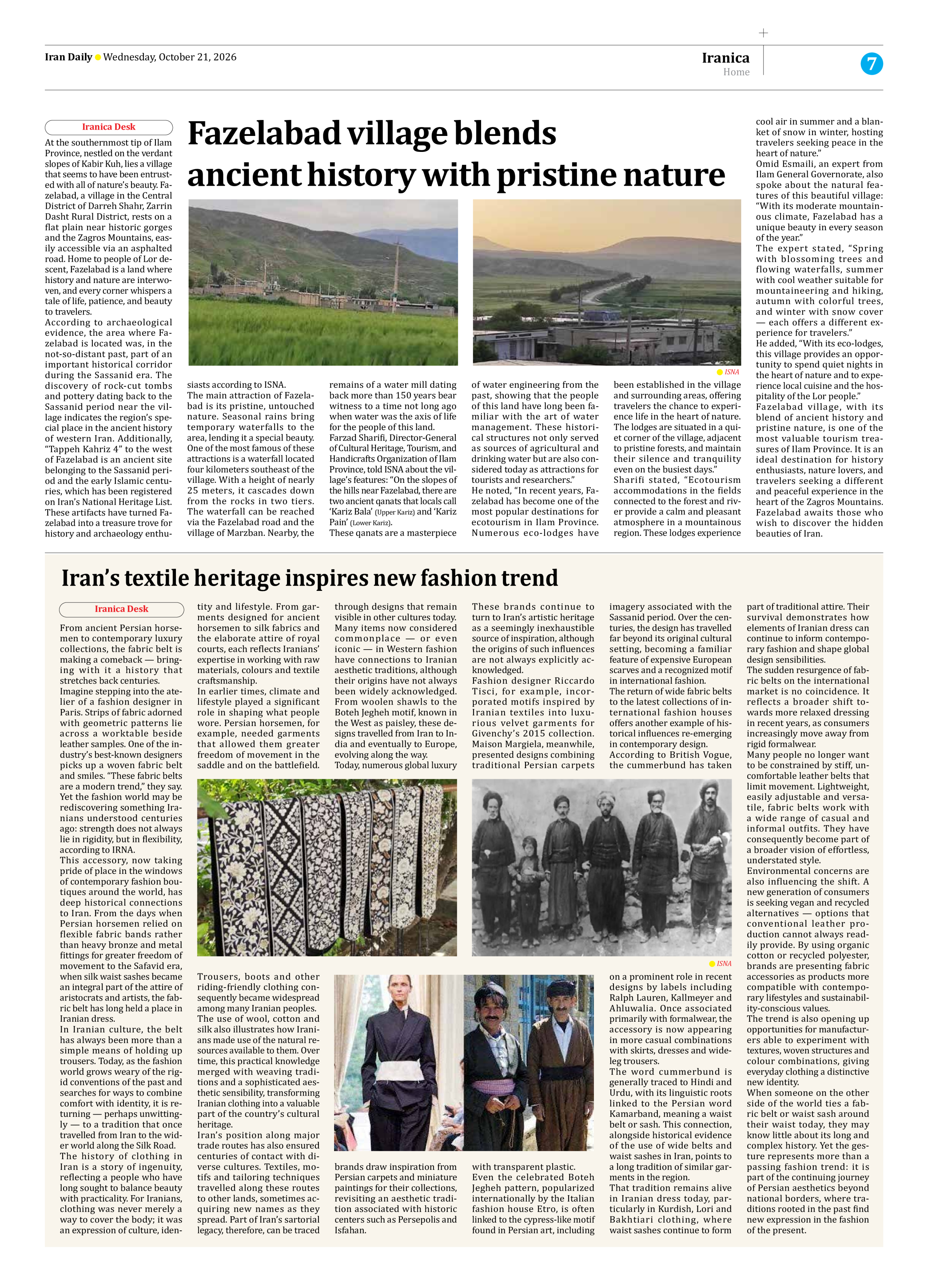
According to British Vogue, the cummerbund has taken on a prominent role in recent designs by labels including Ralph Lauren, Kallmeyer and Ahluwalia. Once associated primarily with formalwear, the accessory is now appearing in more casual combinations with skirts, dresses and wide-leg trousers.
The word cummerbund is generally traced to Hindi and Urdu, with its linguistic roots linked to the Persian word Kamarband, meaning a waist belt or sash. This connection, alongside historical evidence of the use of wide belts and waist sashes in Iran, points to a long tradition of similar garments in the region.
That tradition remains alive in Iranian dress today, particularly in Kurdish, Lori and Bakhtiari clothing, where waist sashes continue to form part of traditional attire. Their survival demonstrates how elements of Iranian dress can continue to inform contemporary fashion and shape global design sensibilities.
The sudden resurgence of fabric belts on the international market is no coincidence. It reflects a broader shift towards more relaxed dressing in recent years, as consumers increasingly move away from rigid formalwear.
Many people no longer want to be constrained by stiff, uncomfortable leather belts that limit movement. Lightweight, easily adjustable and versatile, fabric belts work with a wide range of casual and informal outfits. They have consequently become part of a broader vision of effortless, understated style.
Environmental concerns are also influencing the shift. A new generation of consumers is seeking vegan and recycled alternatives — options that conventional leather production cannot always readily provide. By using organic cotton or recycled polyester, brands are presenting fabric accessories as products more compatible with contemporary lifestyles and sustainability-conscious values.
The trend is also opening up opportunities for manufacturers able to experiment with textures, woven structures and colour combinations, giving everyday clothing a distinctive new identity.
When someone on the other side of the world ties a fabric belt or waist sash around their waist today, they may know little about its long and complex history. Yet the gesture represents more than a passing fashion trend: it is part of the continuing journey of Persian aesthetics beyond national borders, where traditions rooted in the past find new expression in the fashion of the present.