




Washington weaponizes history against Iran
American hypocrisy at Acropolis
By Saman Sofalgar
Political researcher
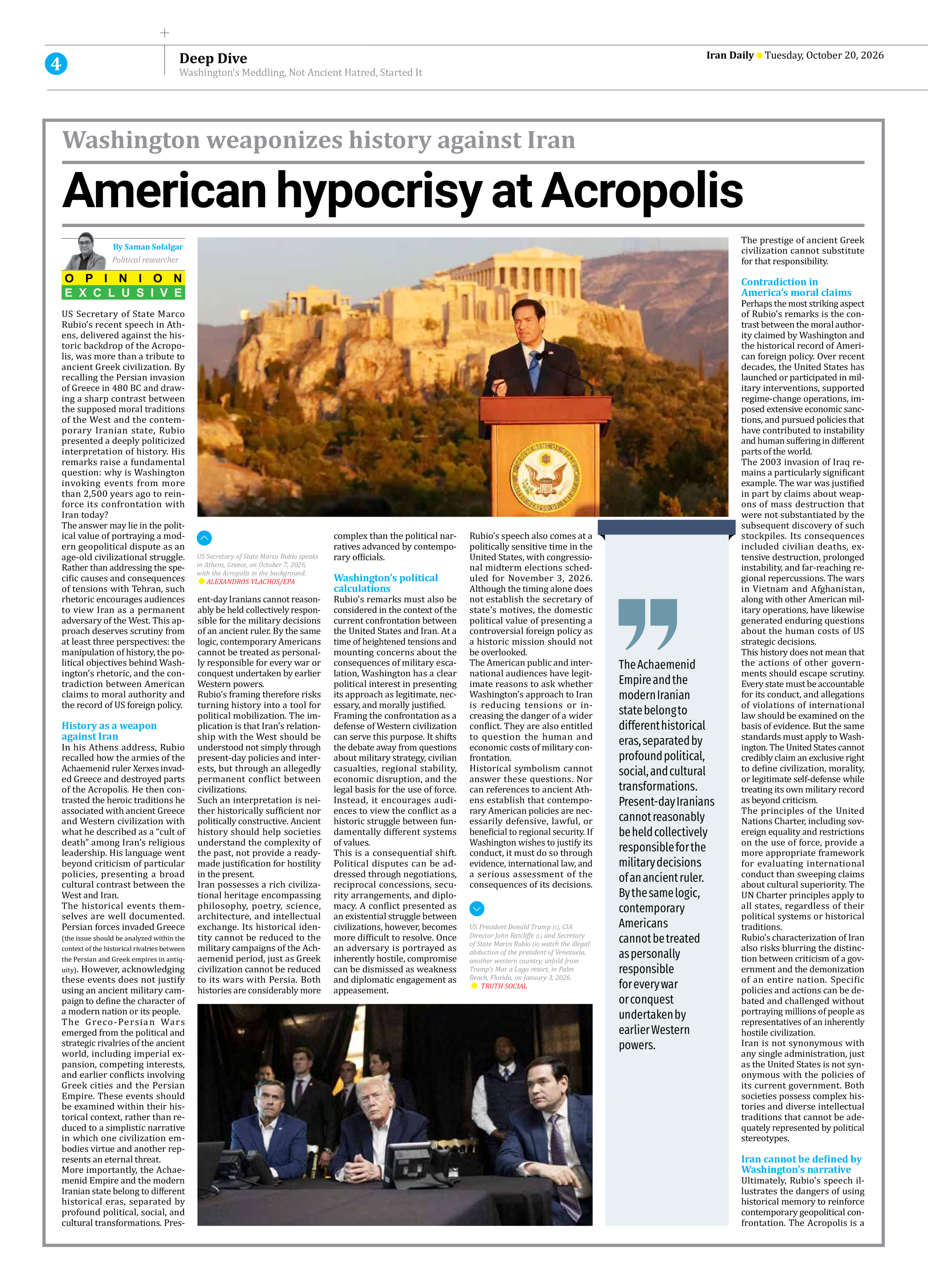
US Secretary of State Marco Rubio’s recent speech in Athens, delivered against the historic backdrop of the Acropolis, was more than a tribute to ancient Greek civilization. By recalling the Persian invasion of Greece in 480 BC and drawing a sharp contrast between the supposed moral traditions of the West and the contemporary Iranian state, Rubio presented a deeply politicized interpretation of history. His remarks raise a fundamental question: why is Washington invoking events from more than 2,500 years ago to reinforce its confrontation with Iran today?
The answer may lie in the political value of portraying a modern geopolitical dispute as an age-old civilizational struggle. Rather than addressing the specific causes and consequences of tensions with Tehran, such rhetoric encourages audiences to view Iran as a permanent adversary of the West. This approach deserves scrutiny from at least three perspectives: the manipulation of history, the political objectives behind Washington’s rhetoric, and the contradiction between American claims to moral authority and the record of US foreign policy.
History as a weapon against Iran
In his Athens address, Rubio recalled how the armies of the Achaemenid ruler Xerxes invaded Greece and destroyed parts of the Acropolis. He then contrasted the heroic traditions he associated with ancient Greece and Western civilization with what he described as a “cult of death” among Iran’s religious leadership. His language went beyond criticism of particular policies, presenting a broad cultural contrast between the West and Iran.
The historical events themselves are well documented. Persian forces invaded Greece (the issue should be analyzed within the context of the historical rivalries between the Persian and Greek empires in antiquity). However, acknowledging these events does not justify using an ancient military campaign to define the character of a modern nation or its people.
The Greco-Persian Wars emerged from the political and strategic rivalries of the ancient world, including imperial expansion, competing interests, and earlier conflicts involving Greek cities and the Persian Empire. These events should be examined within their historical context, rather than reduced to a simplistic narrative in which one civilization embodies virtue and another represents an eternal threat.
More importantly, the Achaemenid Empire and the modern Iranian state belong to different historical eras, separated by profound political, social, and cultural transformations. Present-day Iranians cannot reasonably be held collectively responsible for the military decisions of an ancient ruler. By the same logic, contemporary Americans cannot be treated as personally responsible for every war or conquest undertaken by earlier Western powers.
Rubio’s framing therefore risks turning history into a tool for political mobilization. The implication is that Iran’s relationship with the West should be understood not simply through present-day policies and interests, but through an allegedly permanent conflict between civilizations.
Such an interpretation is neither historically sufficient nor politically constructive. Ancient history should help societies understand the complexity of the past, not provide a ready-made justification for hostility in the present.
Iran possesses a rich civilizational heritage encompassing philosophy, poetry, science, architecture, and intellectual exchange. Its historical identity cannot be reduced to the military campaigns of the Achaemenid period, just as Greek civilization cannot be reduced to its wars with Persia. Both histories are considerably more complex than the political narratives advanced by contemporary officials.
Washington’s political calculations
Rubio’s remarks must also be considered in the context of the current confrontation between the United States and Iran. At a time of heightened tensions and mounting concerns about the consequences of military escalation, Washington has a clear political interest in presenting its approach as legitimate, necessary, and morally justified.
Framing the confrontation as a defense of Western civilization can serve this purpose. It shifts the debate away from questions about military strategy, civilian casualties, regional stability, economic disruption, and the legal basis for the use of force. Instead, it encourages audiences to view the conflict as a historic struggle between fundamentally different systems of values.
This is a consequential shift. Political disputes can be addressed through negotiations, reciprocal concessions, security arrangements, and diplomacy. A conflict presented as an existential struggle between civilizations, however, becomes more difficult to resolve. Once an adversary is portrayed as inherently hostile, compromise can be dismissed as weakness and diplomatic engagement as appeasement.
Rubio’s speech also comes at a politically sensitive time in the United States, with congressional midterm elections scheduled for November 3, 2026. Although the timing alone does not establish the secretary of state’s motives, the domestic political value of presenting a controversial foreign policy as a historic mission should not be overlooked.
The American public and international audiences have legitimate reasons to ask whether Washington’s approach to Iran is reducing tensions or increasing the danger of a wider conflict. They are also entitled to question the human and economic costs of military confrontation.
Historical symbolism cannot answer these questions. Nor can references to ancient Athens establish that contemporary American policies are necessarily defensive, lawful, or beneficial to regional security. If Washington wishes to justify its conduct, it must do so through evidence, international law, and a serious assessment of the consequences of its decisions. The prestige of ancient Greek civilization cannot substitute for that responsibility.
Contradiction in America’s moral claims
Perhaps the most striking aspect of Rubio’s remarks is the contrast between the moral authority claimed by Washington and the historical record of American foreign policy. Over recent decades, the United States has launched or participated in military interventions, supported regime-change operations, imposed extensive economic sanctions, and pursued policies that have contributed to instability and human suffering in different parts of the world.
The 2003 invasion of Iraq remains a particularly significant example. The war was justified in part by claims about weapons of mass destruction that were not substantiated by the subsequent discovery of such stockpiles. Its consequences included civilian deaths, extensive destruction, prolonged instability, and far-reaching regional repercussions. The wars in Vietnam and Afghanistan, along with other American military operations, have likewise generated enduring questions about the human costs of US strategic decisions.
This history does not mean that the actions of other governments should escape scrutiny. Every state must be accountable for its conduct, and allegations of violations of international law should be examined on the basis of evidence. But the same standards must apply to Washington. The United States cannot credibly claim an exclusive right to define civilization, morality, or legitimate self-defense while treating its own military record as beyond criticism.
The principles of the United Nations Charter, including sovereign equality and restrictions on the use of force, provide a more appropriate framework for evaluating international conduct than sweeping claims about cultural superiority. The UN Charter principles apply to all states, regardless of their political systems or historical traditions.
Rubio’s characterization of Iran also risks blurring the distinction between criticism of a government and the demonization of an entire nation. Specific policies and actions can be debated and challenged without portraying millions of people as representatives of an inherently hostile civilization.
Iran is not synonymous with any single administration, just as the United States is not synonymous with the policies of its current government. Both societies possess complex histories and diverse intellectual traditions that cannot be adequately represented by political stereotypes.
Iran cannot be defined by Washington’s narrative
Ultimately, Rubio’s speech illustrates the dangers of using historical memory to reinforce contemporary geopolitical confrontation. The Acropolis is a monument to the achievements of ancient Greece, but it should not become a stage for turning ancient rivalries into arguments against modern Iran. The legacy of Greek civilization belongs to the broader history of humanity. Likewise, Iran’s contributions to world civilization cannot be erased or diminished by the rhetoric of American officials. Neither nation’s historical identity should be manipulated to justify hostility toward the other.
The real test of American foreign policy is not the ability to construct a compelling historical narrative. It is whether Washington respects international law, protects civilian life, acknowledges the consequences of its decisions, and pursues diplomatic solutions instead of escalating conflict. Iran and the United States have serious disagreements, but those disagreements must be assessed through contemporary evidence and political realities, not through selective interpretations of events from antiquity.
Washington cannot rewrite Iran’s history to serve its strategic interests, nor can it claim moral superiority while avoiding scrutiny of its own actions. If the United States genuinely seeks stability, it must abandon the politics of demonization and recognize that sustainable security depends on diplomacy, respect for national sovereignty, and equal application of international law.
The Acropolis should remind the world of humanity’s capacity for intellectual and cultural achievement. It should not be used to revive ancient conflicts as a rhetorical justification for modern confrontation. Iran’s history is not Washington’s to define, and the future of relations between the two countries should be determined by political realities and the pursuit of peace, not by attempts to portray an entire nation as a perpetual enemy.