







Tombak speaking in ‘universal language of rhythm’
Musician proving that Iranian percussion instrument can shine solo
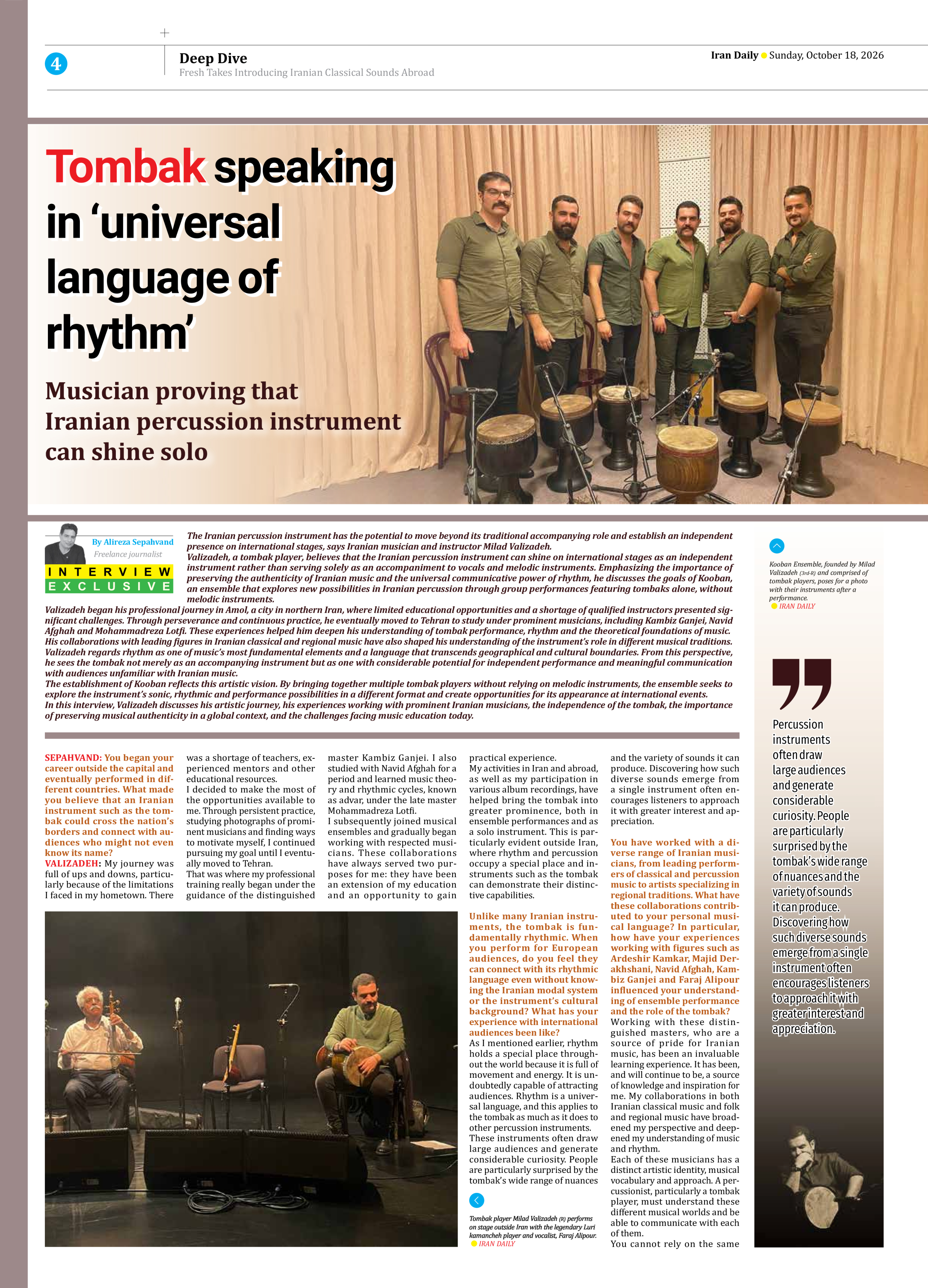
The Iranian percussion instrument has the potential to move beyond its traditional accompanying role and establish an independent presence on international stages, says Iranian musician and instructor Milad Valizadeh. Valizadeh, a tombak player, believes that the Iranian percussion instrument can shine on international stages as an independent instrument rather than serving solely as an accompaniment to vocals and melodic instruments. Emphasizing the importance of preserving the authenticity of Iranian music and the universal communicative power of rhythm, he discusses the goals of Kooban, an ensemble that explores new possibilities in Iranian percussion through group performances featuring tombaks alone, without melodic instruments. Valizadeh began his professional journey in Amol, a city in northern Iran, where limited educational opportunities and a shortage of qualified instructors presented significant challenges. Through perseverance and continuous practice, he eventually moved to Tehran to study under prominent musicians, including Kambiz Ganjei, Navid Afghah and Mohammadreza Lotfi. These experiences helped him deepen his understanding of tombak performance, rhythm and the theoretical foundations of music. His collaborations with leading figures in Iranian classical and regional music have also shaped his understanding of the instrument’s role in different musical traditions. Valizadeh regards rhythm as one of music’s most fundamental elements and a language that transcends geographical and cultural boundaries. From this perspective, he sees the tombak not merely as an accompanying instrument but as one with considerable potential for independent performance and meaningful communication with audiences unfamiliar with Iranian music. The establishment of Kooban reflects this artistic vision. By bringing together multiple tombak players without relying on melodic instruments, the ensemble seeks to explore the instrument’s sonic, rhythmic and performance possibilities in a different format and create opportunities for its appearance at international events. In this interview, Valizadeh discusses his artistic journey, his experiences working with prominent Iranian musicians, the independence of the tombak, the importance of preserving musical authenticity in a global context, and the challenges facing music education today.
Freelance journalist
SEPAHVAND: You began your career outside the capital and eventually performed in different countries. What made you believe that an Iranian instrument such as the tombak could cross the nation’s borders and connect with audiences who might not even know its name?
VALIZADEH: My journey was full of ups and downs, particularly because of the limitations I faced in my hometown. There was a shortage of teachers, experienced mentors and other educational resources.
I decided to make the most of the opportunities available to me. Through persistent practice, studying photographs of prominent musicians and finding ways to motivate myself, I continued pursuing my goal until I eventually moved to Tehran.
That was where my professional training really began under the guidance of the distinguished master Kambiz Ganjei. I also studied with Navid Afghah for a period and learned music theory and rhythmic cycles, known as advar, under the late master Mohammadreza Lotfi.
I subsequently joined musical ensembles and gradually began working with respected musicians. These collaborations have always served two purposes for me: they have been an extension of my education and an opportunity to gain practical experience.
My activities in Iran and abroad, as well as my participation in various album recordings, have helped bring the tombak into greater prominence, both in ensemble performances and as a solo instrument. This is particularly evident outside Iran, where rhythm and percussion occupy a special place and instruments such as the tombak can demonstrate their distinctive capabilities.
Unlike many Iranian instruments, the tombak is fundamentally rhythmic. When you perform for European audiences, do you feel they can connect with its rhythmic language even without knowing the Iranian modal system or the instrument’s cultural background? What has your experience with international audiences been like?
As I mentioned earlier, rhythm holds a special place throughout the world because it is full of movement and energy. It is undoubtedly capable of attracting audiences. Rhythm is a universal language, and this applies to the tombak as much as it does to other percussion instruments.
These instruments often draw large audiences and generate considerable curiosity. People are particularly surprised by the tombak’s wide range of nuances and the variety of sounds it can produce. Discovering how such diverse sounds emerge from a single instrument often encourages listeners to approach it with greater interest and appreciation.
You have worked with a diverse range of Iranian musicians, from leading performers of classical and percussion music to artists specializing in regional traditions. What have these collaborations contributed to your personal musical language? In particular, how have your experiences working with figures such as Ardeshir Kamkar, Majid Derakhshani, Navid Afghah, Kambiz Ganjei and Faraj Alipour influenced your understanding of ensemble performance and the role of the tombak?
Working with these distinguished masters, who are a source of pride for Iranian music, has been an invaluable learning experience. It has been, and will continue to be, a source of knowledge and inspiration for me. My collaborations in both Iranian classical music and folk and regional music have broadened my perspective and deepened my understanding of music and rhythm.
Each of these musicians has a distinct artistic identity, musical vocabulary and approach. A percussionist, particularly a tombak player, must understand these different musical worlds and be able to communicate with each of them.
You cannot rely on the same
repetitive style when performing works by different composers. Instead, you must understand the character and atmosphere of each composer’s music and adapt your performance accordingly. Your playing must reflect the particular feeling and artistic expression of the work. This is one of the most important lessons I have learned throughout my career.
If we are to present the tombak not merely as an accompanying instrument for a singer or a melodic instrument, but as an independent instrument, where should we draw the line between preserving tradition and developing a new musical language?
Absolutely. The tombak has its own distinct identity and independence. More broadly, Iranian percussion encompasses the tombak, the daf and other instruments, each of which has its own capabilities.
I want to emphasize the importance of percussion because rhythm and movement are fundamental elements of music. Without rhythm, movement would not occur, and musical ideas would lose one of their essential foundations.
In Iranian classical music, we have different forms, including avaz (free-rhythm vocal music), tasnif (structured vocal compositions), chaharmezrab (a fast, rhythmically driven instrumental form) and reng (a lively instrumental composition, traditionally associated with dance).
My question is simple: Can a tasnif be created without rhythm? Rhythm is an essential component of music, and the tombak has an independent role within that framework.
Around the world, major percussion festivals provide opportunities for soloists and ensembles to demonstrate the capabilities of percussion instruments. Many distinguished Iranian musicians have also performed internationally as soloists, whether on the tombak, the daf or other percussion instruments. Their achievements demonstrate that these instruments are capable of standing on their own.
What convinced you that three tombaks could create a complete and independent musical performance? Do you see Kooban primarily as a musical ensemble or as an experiment to discover the instrument’s unexplored possibilities?
Kooban certainly has a distinctive concept, both in its approach to ensemble performance and in the number of musicians involved. We currently have players in training, including both men and women.
As the founder of Kooban, I have ambitious plans for the group, including releasing albums and staging performances in Iran and abroad. My principal goal is to present Kooban on international stages.
One of the defining features of the ensemble is its commitment to performing without melodic instruments. The entire performance is built around rhythm, with different arrangements developed using one or two rhythmic lines.
Another important aspect of the project is that it will draw on outstanding students. Some of these young musicians face personal challenges, including educational commitments and work responsibilities. They need motivation, clear goals and opportunities to develop their skills. This means analyzing their individual practice, providing practical guidance and giving them the experience of playing in recording studios and on stage.
The process will undoubtedly involve many challenges, but I believe the outcome will be worthwhile. The establishment of Kooban, its recordings and its performances on international stages will be the result of this collective effort.
When a European musician or student picks up a tombak for the first time, which of its characteristics tends to attract the most attention? Has teaching non-Iranian students encouraged you to reconsider any aspects of your own teaching methods or performance?
In workshops held outside Iran, one of the first things that attracts attention is the instrument’s physical structure, shape, design and skin.
However, what fascinates people most is the playing technique. The tombak involves intricate finger movements and a range of striking techniques that produce an extraordinary variety of sounds. These sounds can be used to create different musical expressions, styles and rhythmic patterns, both in ensemble performances and in solo playing.
What do you believe is the best way to introduce Iranian music to the world? Should musicians attempt to make it more international, or should they preserve its distinctly Iranian character and allow international audiences to discover it on its own terms?
I firmly believe that the original cultural identity of the music must be preserved. Consider regional and folk music. Should its original melodic character, musical atmosphere and traditional instruments be altered, or should musicians preserve its authenticity and allow it to reach listeners in its original form?
We have seen the latter approach in the music of Lorestan, Mazandaran, Kurdistan, Baluchistan, Khorasan and other regions of Iran. These traditions have continued to develop while retaining their essential characteristics.
Iranian classical music should follow the same path. Many distinguished musicians, including Mohammad Reza Shajarian, Parviz Meshkatian, Mohammadreza Lotfi, the Kamkar family and Majid Derakhshani, have presented authentic Iranian musical traditions on major international stages. Their commitment to preserving the foundations of this music resulted in enduring works that introduced Iranian culture to audiences around the world.
Unfortunately, I feel that some of this legacy is gradually being forgotten because of declining cultural awareness and insufficient attention to the traditions that shaped earlier generations. This is particularly concerning among younger people today.
You have learned from generations of tombak masters whose playing styles differed considerably, from Hossein Tehrani and Mohammad Esmaeili to Nasser Farhangfar and contemporary musicians. What is the most important lesson the younger generation should retain from the traditional master-apprentice system? Conversely, what aspects of music education need to change to meet the needs of today’s musicians?
The first thing worth retaining is gratitude and respect. The second is maintaining a clear sense of one’s own place and responsibilities as an artist, without becoming conceited.
Unfortunately, over the past decade, I have witnessed many instances of people losing their sense of professional boundaries and failing to respect the positions of others.
In music education, for example, some people begin teaching without sufficient performance experience. Online classes and instructional posts on social media have also become widespread. What concerns me is that some individuals reproduce lessons they learned from their own teachers and present them as their original material, without developing their own ideas or creating anything new.
Some publish instructional books without an adequate professional background, a substantial body of work or an understanding of the responsibilities involved. This problem is not confined to the tombak; it exists in other musical disciplines as well.
Such practices can be damaging. Overconfidence, a lack of critical thinking and disregard for professional boundaries can lead musicians in the wrong direction. Instead of concentrating on artistic discipline and developing their individual performance skills, some become preoccupied with appearances and superficial displays of musicianship.
Consider the distinguished masters who have accumulated decades of teaching experience, performed extensively and collaborated with leading musicians. Some have spent more than 40 years in professional music without rushing to publish instructional books. Why? Because they understand the responsibilities involved. They respect their roots, recognize the limits of their own knowledge and observe the ethical standards of their profession.
The younger generation must learn to recognize these boundaries and show the respect that their teachers deserve.
In recent decades, the tombak has evolved from an accompanying instrument into one with an increasingly sophisticated technique and a broad range of expressive possibilities. Do you believe it can establish an independent role in contemporary world music, jazz, experimental music and intercultural collaborations, or will it continue to be recognized primarily as part of Iranian music?
The tombak undoubtedly has a distinctive place of its own. As I mentioned earlier, rhythm and the tombak can function independently. We are increasingly seeing a variety of percussion and rhythmic performances, including tombak playing, in recordings, albums, concerts and live performances. Audiences are responding positively, demonstrating that these performances have considerable potential to attract listeners.
The instrument can generate a remarkable level of excitement and energy, both through its technical possibilities and through the expressive power of live performance. I believe these qualities will continue to help the tombak find a special place in the experience of audiences around the world.
For you, is the sound of the tombak simply a musical sound, or does it also carry elements of Iranian history, identity and worldview?
I would want the audience to experience the culture, civilization, history and artistic heritage embodied in this instrument. I believe a powerful live performance can communicate these qualities directly to listeners, allowing them to experience something of the cultural identity behind the music.
In recordings and live performances, microphone placement and sound quality remain major challenges for percussion instruments. The problem is particularly noticeable with the daf, whose natural sound can be difficult to reproduce accurately. To what extent does the tombak face similar challenges?
The situation is very similar to that of the daf. One of the main problems is a lack of understanding of percussion sound, both in album production and in live performances. Some sound engineers seem to assume that because an instrument is percussion, its sound does not require particular attention.
That is a serious misconception. Percussion is one of the pillars of an ensemble and plays a crucial role in shaping its overall sonic character. It helps maintain the tempo of a piece, contributes to the ensemble’s rhythmic precision and adds colors and dynamics that make the music more engaging. Properly balanced percussion also allows listeners to hear and understand the performance more clearly.
Unfortunately, I do not believe this is adequately understood in Iran in many cases. In other countries, by contrast, I have encountered sound engineers who demonstrate a high level of professionalism in mixing and balancing percussion instruments. They understand acoustic principles and the specific characteristics of percussion sounds, allowing even the finest details of a tombak player’s technique to be reproduced clearly. This level of attention makes a significant difference to the final listening experience.
Finally, could you outline your main artistic activities, including notable performances, albums and educational publications?
I have performed at various venues in Europe and Australia alongside distinguished musicians, including Ardeshir Kamkar, Majid Derakhshani and Faraj Alipour.
I have also participated in recording several albums, both in duo formats and as part of larger ensembles, working with fellow musicians and respected masters.
At present, three volumes of my tombak instructional book series are in preparation and are expected to be published soon. I hope they will become useful resources for students and anyone interested in learning more about the tombak and its musical possibilities.