





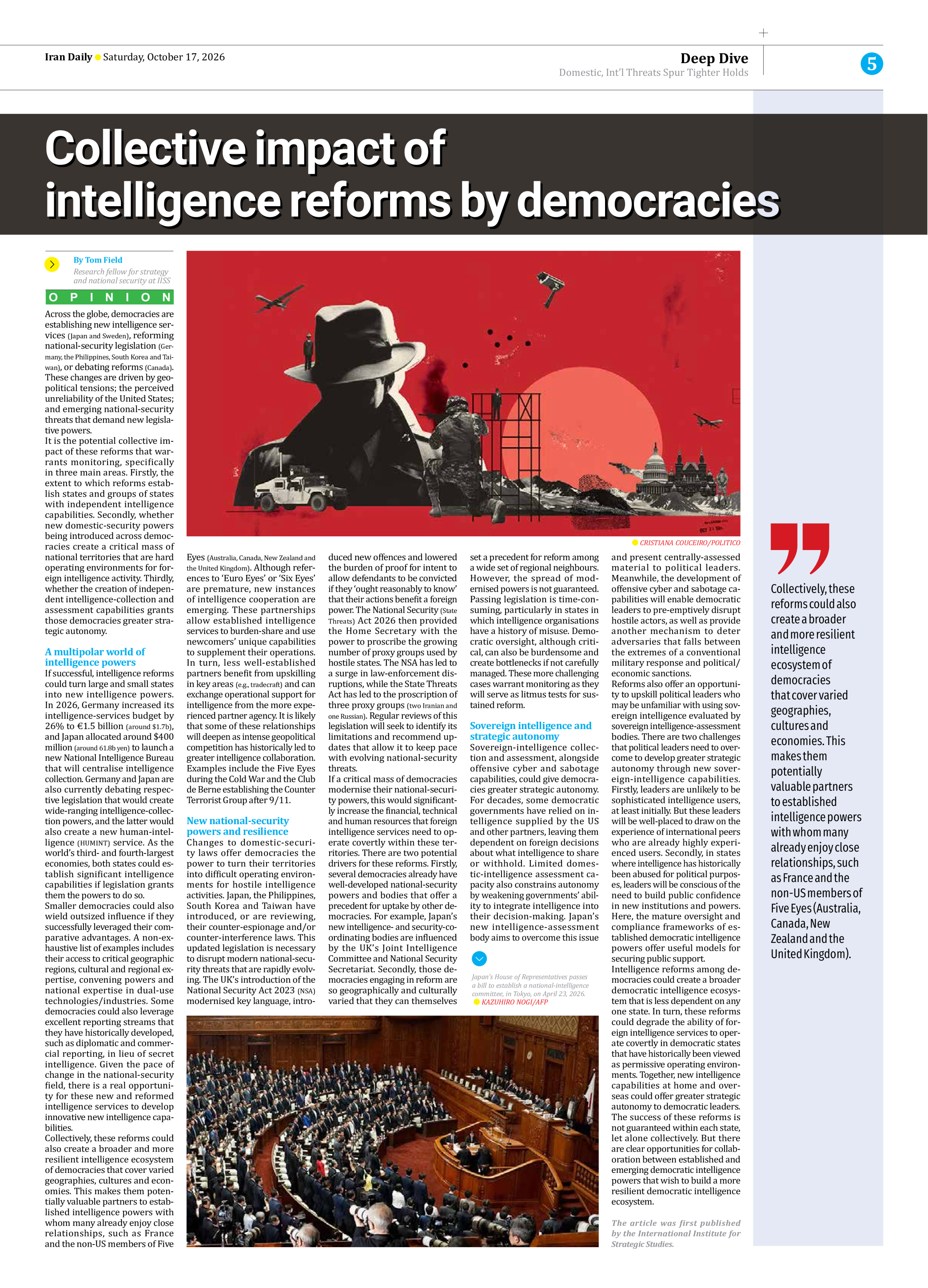


Collective impact of intelligence reforms by democracies
Across the globe, democracies are establishing new intelligence services (Japan and Sweden), reforming national-security legislation (Germany, the Philippines, South Korea and Taiwan), or debating reforms (Canada). These changes are driven by geopolitical tensions; the perceived unreliability of the United States; and emerging national-security threats that demand new legislative powers.
It is the potential collective impact of these reforms that warrants monitoring, specifically in three main areas. Firstly, the extent to which reforms establish states and groups of states with independent intelligence capabilities. Secondly, whether new domestic-security powers being introduced across democracies create a critical mass of national territories that are hard operating environments for foreign intelligence activity. Thirdly, whether the creation of independent intelligence-collection and assessment capabilities grants those democracies greater strategic autonomy.
A multipolar world of intelligence powers
If successful, intelligence reforms could turn large and small states into new intelligence powers. In 2026, Germany increased its intelligence-services budget by 26% to €1.5 billion (around $1.7b), and Japan allocated around $400 million (around 61.8b yen) to launch a new National Intelligence Bureau that will centralise intelligence collection. Germany and Japan are also currently debating respective legislation that would create wide-ranging intelligence-collection powers, and the latter would also create a new human-intelligence (HUMINT) service. As the world’s third- and fourth-largest economies, both states could establish significant intelligence capabilities if legislation grants them the powers to do so.
Smaller democracies could also wield outsized influence if they successfully leveraged their comparative advantages. A non-exhaustive list of examples includes their access to critical geographic regions, cultural and regional expertise, convening powers and national expertise in dual-use technologies/industries. Some democracies could also leverage excellent reporting streams that they have historically developed, such as diplomatic and commercial reporting, in lieu of secret intelligence. Given the pace of change in the national-security field, there is a real opportunity for these new and reformed intelligence services to develop innovative new intelligence capabilities.
Collectively, these reforms could also create a broader and more resilient intelligence ecosystem of democracies that cover varied geographies, cultures and economies. This makes them potentially valuable partners to established intelligence powers with whom many already enjoy close relationships, such as France and the non-US members of Five Eyes (Australia, Canada, New Zealand and the United Kingdom). Although references to ‘Euro Eyes’ or ‘Six Eyes’ are premature, new instances of intelligence cooperation are emerging. These partnerships allow established intelligence services to burden-share and use newcomers’ unique capabilities to supplement their operations. In turn, less well-established partners benefit from upskilling in key areas (e.g., tradecraft) and can exchange operational support for intelligence from the more experienced partner agency. It is likely that some of these relationships will deepen as intense geopolitical competition has historically led to greater intelligence collaboration. Examples include the Five Eyes during the Cold War and the Club de Berne establishing the Counter Terrorist Group after 9/11.
New national-security powers and resilience
Changes to domestic-security laws offer democracies the power to turn their territories into difficult operating environments for hostile intelligence activities. Japan, the Philippines, South Korea and Taiwan have introduced, or are reviewing, their counter-espionage and/or counter-interference laws. This updated legislation is necessary to disrupt modern national-security threats that are rapidly evolving. The UK’s introduction of the National Security Act 2023 (NSA) modernised key language, introduced new offences and lowered the burden of proof for intent to allow defendants to be convicted if they ‘ought reasonably to know’ that their actions benefit a foreign power. The National Security (State Threats) Act 2026 then provided the Home Secretary with the power to proscribe the growing number of proxy groups used by hostile states. The NSA has led to a surge in law-enforcement disruptions, while the State Threats Act has led to the proscription of three proxy groups (two Iranian and one Russian). Regular reviews of this legislation will seek to identify its limitations and recommend updates that allow it to keep pace with evolving national-security threats.
If a critical mass of democracies modernise their national-security powers, this would significantly increase the financial, technical and human resources that foreign intelligence services need to operate covertly within these territories. There are two potential drivers for these reforms. Firstly, several democracies already have well-developed national-security powers and bodies that offer a precedent for uptake by other democracies. For example, Japan’s new intelligence- and security-coordinating bodies are influenced by the UK’s Joint Intelligence Committee and National Security Secretariat. Secondly, those democracies engaging in reform are so geographically and culturally varied that they can themselves set a precedent for reform among a wide set of regional neighbours.
However, the spread of modernised powers is not guaranteed. Passing legislation is time-consuming, particularly in states in which intelligence organisations have a history of misuse. Democratic oversight, although critical, can also be burdensome and create bottlenecks if not carefully managed. These more challenging cases warrant monitoring as they will serve as litmus tests for sustained reform.
Sovereign intelligence and strategic autonomy
Sovereign-intelligence collection and assessment, alongside offensive cyber and sabotage capabilities, could give democracies greater strategic autonomy. For decades, some democratic governments have relied on intelligence supplied by the US and other partners, leaving them dependent on foreign decisions about what intelligence to share or withhold. Limited domestic-intelligence assessment capacity also constrains autonomy by weakening governments’ ability to integrate intelligence into their decision-making. Japan’s new intelligence-assessment body aims to overcome this issue and present centrally-assessed material to political leaders. Meanwhile, the development of offensive cyber and sabotage capabilities will enable democratic leaders to pre-emptively disrupt hostile actors, as well as provide another mechanism to deter adversaries that falls between the extremes of a conventional military response and political/economic sanctions.
Reforms also offer an opportunity to upskill political leaders who may be unfamiliar with using sovereign intelligence evaluated by sovereign intelligence-assessment bodies. There are two challenges that political leaders need to overcome to develop greater strategic autonomy through new sovereign-intelligence capabilities. Firstly, leaders are unlikely to be sophisticated intelligence users, at least initially. But these leaders will be well-placed to draw on the experience of international peers who are already highly experienced users. Secondly, in states where intelligence has historically been abused for political purposes, leaders will be conscious of the need to build public confidence in new institutions and powers. Here, the mature oversight and compliance frameworks of established democratic intelligence powers offer useful models for securing public support.
Intelligence reforms among democracies could create a broader democratic intelligence ecosystem that is less dependent on any one state. In turn, these reforms could degrade the ability of foreign intelligence services to operate covertly in democratic states that have historically been viewed as permissive operating environments. Together, new intelligence capabilities at home and overseas could offer greater strategic autonomy to democratic leaders. The success of these reforms is not guaranteed within each state, let alone collectively. But there are clear opportunities for collaboration between established and emerging democratic intelligence powers that wish to build a more resilient democratic intelligence ecosystem.
The article was first published by the International Institute for
Strategic Studies.