







Restoration projects breathe new life into Isfahan’s Dardasht Neighborhood
More than 60 urban development and restoration projects have been carried out over the past three and a half years in Isfahan’s historic Dardasht Neighborhood , covering an area of 70 hectares, as part of a major initiative to revive and regenerate the neighborhood, a former head of the Isfahan Municipality’s Renovation and Rehabilitation Organization said.
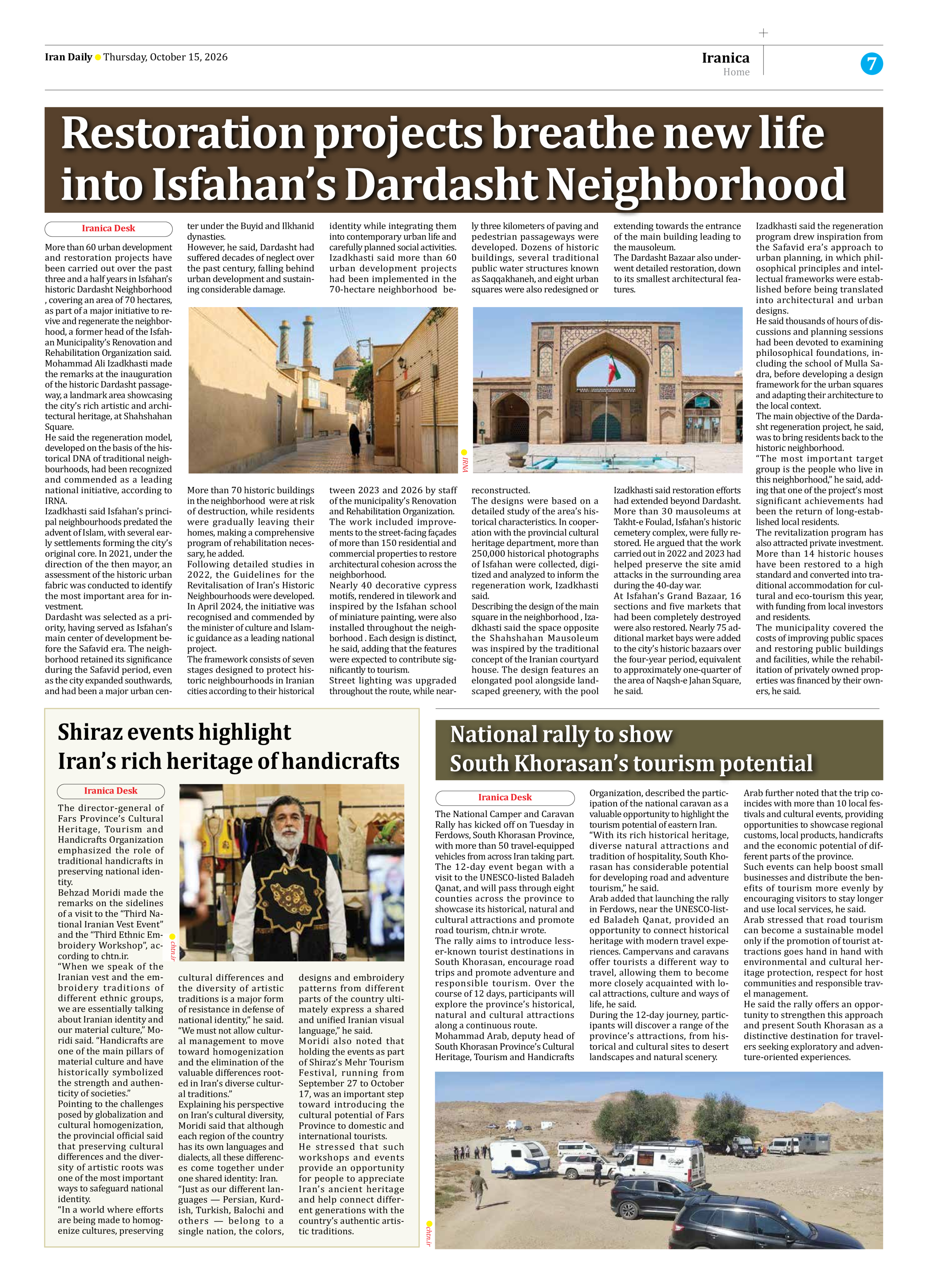
Mohammad Ali Izadkhasti made the remarks at the inauguration of the historic Dardasht passageway, a landmark area showcasing the city’s rich artistic and architectural heritage, at Shahshahan Square.
He said the regeneration model, developed on the basis of the historical DNA of traditional neighbourhoods, had been recognized and commended as a leading national initiative, according to IRNA.
Izadkhasti said Isfahan’s principal neighbourhoods predated the advent of Islam, with several early settlements forming the city’s original core. In 2021, under the direction of the then mayor, an assessment of the historic urban fabric was conducted to identify the most important area for investment.
Dardasht was selected as a priority, having served as Isfahan’s main center of development before the Safavid era. The neighborhood retained its significance during the Safavid period, even as the city expanded southwards, and had been a major urban center under the Buyid and Ilkhanid dynasties.
However, he said, Dardasht had suffered decades of neglect over the past century, falling behind urban development and sustaining considerable damage.
More than 70 historic buildings in the neighborhood were at risk of destruction, while residents were gradually leaving their homes, making a comprehensive program of rehabilitation necessary, he added.
Following detailed studies in 2022, the Guidelines for the Revitalisation of Iran’s Historic Neighbourhoods were developed. In April 2024, the initiative was recognised and commended by the minister of culture and Islamic guidance as a leading national project.
The framework consists of seven stages designed to protect historic neighbourhoods in Iranian cities according to their historical identity while integrating them into contemporary urban life and carefully planned social activities.
Izadkhasti said more than 60 urban development projects had been implemented in the 70-hectare neighborhood between 2023 and 2026 by staff of the municipality’s Renovation and Rehabilitation Organization.
The work included improvements to the street-facing façades of more than 150 residential and commercial properties to restore architectural cohesion across the neighborhood.
Nearly 40 decorative cypress motifs, rendered in tilework and inspired by the Isfahan school of miniature painting, were also installed throughout the neighborhood . Each design is distinct, he said, adding that the features were expected to contribute significantly to tourism.
Street lighting was upgraded throughout the route, while nearly three kilometers of paving and pedestrian passageways were developed. Dozens of historic buildings, several traditional public water structures known as Saqqakhaneh, and eight urban squares were also redesigned or reconstructed.
The designs were based on a detailed study of the area’s historical characteristics. In cooperation with the provincial cultural heritage department, more than 250,000 historical photographs of Isfahan were collected, digitized and analyzed to inform the regeneration work, Izadkhasti said.
Describing the design of the main square in the neighborhood , Izadkhasti said the space opposite the Shahshahan Mausoleum was inspired by the traditional concept of the Iranian courtyard house. The design features an elongated pool alongside landscaped greenery, with the pool extending towards the entrance of the main building leading to the mausoleum.
The Dardasht Bazaar also underwent detailed restoration, down to its smallest architectural features.
Izadkhasti said restoration efforts had extended beyond Dardasht. More than 30 mausoleums at Takht-e Foulad, Isfahan’s historic cemetery complex, were fully restored. He argued that the work carried out in 2022 and 2023 had helped preserve the site amid attacks in the surrounding area during the 40-day war.
At Isfahan’s Grand Bazaar, 16 sections and five markets that had been completely destroyed were also restored. Nearly 75 additional market bays were added to the city’s historic bazaars over the four-year period, equivalent to approximately one-quarter of the area of Naqsh-e Jahan Square, he said.
Izadkhasti said the regeneration program drew inspiration from the Safavid era’s approach to urban planning, in which philosophical principles and intellectual frameworks were established before being translated into architectural and urban designs.
He said thousands of hours of discussions and planning sessions had been devoted to examining philosophical foundations, including the school of Mulla Sadra, before developing a design framework for the urban squares and adapting their architecture to the local context.
The main objective of the Dardasht regeneration project, he said, was to bring residents back to the historic neighborhood.
“The most important target group is the people who live in this neighborhood,” he said, adding that one of the project’s most significant achievements had been the return of long-established local residents.
The revitalization program has also attracted private investment. More than 14 historic houses have been restored to a high standard and converted into traditional accommodation for cultural and eco-tourism this year, with funding from local investors and residents.
The municipality covered the costs of improving public spaces and restoring public buildings and facilities, while the rehabilitation of privately owned properties was financed by their owners, he said.