







America’s endless wars yield another defeat
Empire of intervention meets its limits
Political researcher
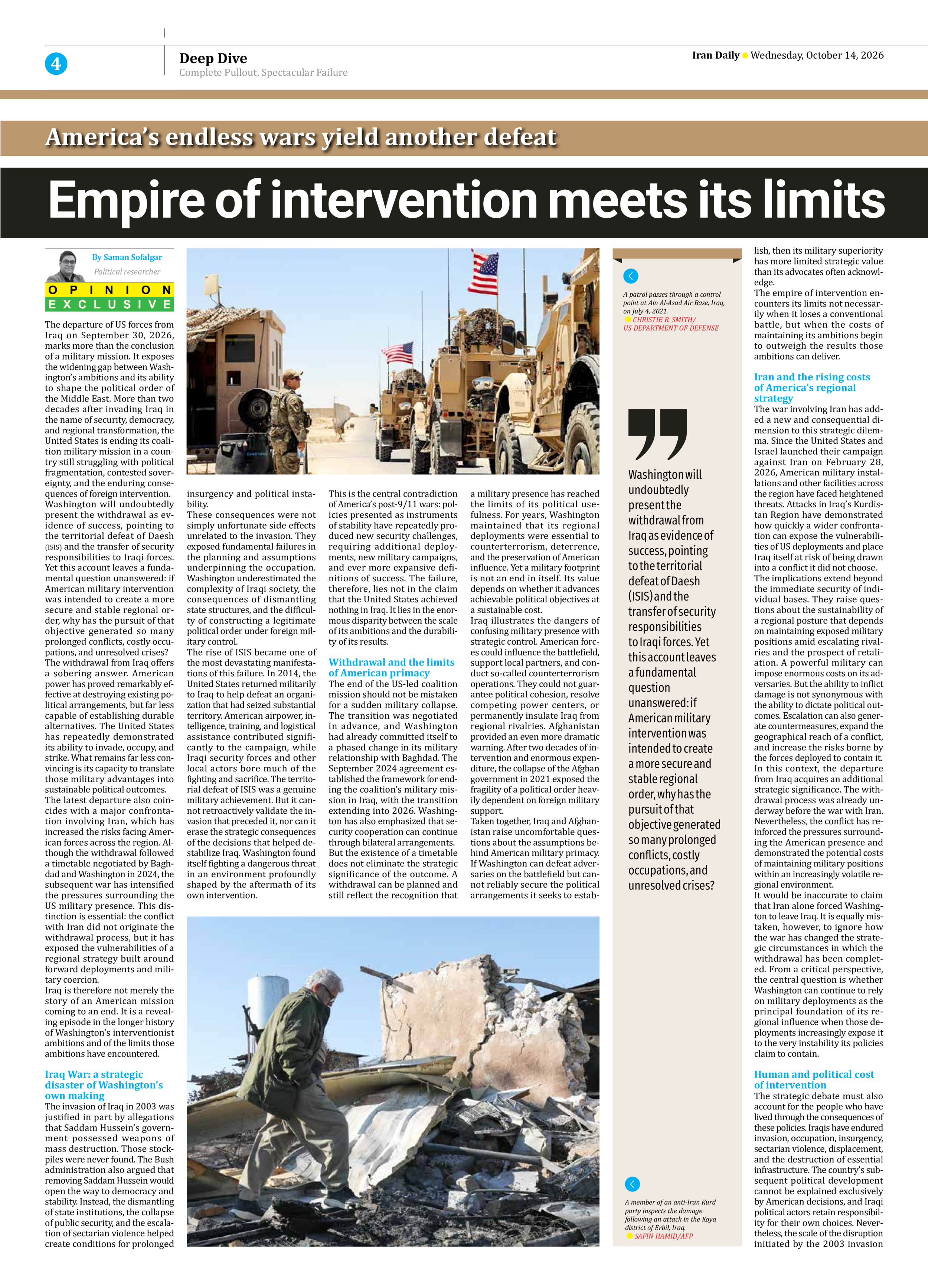
The departure of US forces from Iraq on September 30, 2026, marks more than the conclusion of a military mission. It exposes the widening gap between Washington’s ambitions and its ability to shape the political order of the Middle East. More than two decades after invading Iraq in the name of security, democracy, and regional transformation, the United States is ending its coalition military mission in a country still struggling with political fragmentation, contested sovereignty, and the enduring consequences of foreign intervention.
Washington will undoubtedly present the withdrawal as evidence of success, pointing to the territorial defeat of Daesh (ISIS) and the transfer of security responsibilities to Iraqi forces. Yet this account leaves a fundamental question unanswered: if American military intervention was intended to create a more secure and stable regional order, why has the pursuit of that objective generated so many prolonged conflicts, costly occupations, and unresolved crises?
The withdrawal from Iraq offers a sobering answer. American power has proved remarkably effective at destroying existing political arrangements, but far less capable of establishing durable alternatives. The United States has repeatedly demonstrated its ability to invade, occupy, and strike. What remains far less convincing is its capacity to translate those military advantages into sustainable political outcomes.
The latest departure also coincides with a major confrontation involving Iran, which has increased the risks facing American forces across the region. Although the withdrawal followed a timetable negotiated by Baghdad and Washington in 2024, the subsequent war has intensified the pressures surrounding the US military presence. This distinction is essential: the conflict with Iran did not originate the withdrawal process, but it has exposed the vulnerabilities of a regional strategy built around forward deployments and military coercion.
Iraq is therefore not merely the story of an American mission coming to an end. It is a revealing episode in the longer history of Washington’s interventionist ambitions and of the limits those ambitions have encountered.
Iraq War: a strategic disaster of Washington’s own making
The invasion of Iraq in 2003 was justified in part by allegations that Saddam Hussein’s government possessed weapons of mass destruction. Those stockpiles were never found. The Bush administration also argued that removing Saddam Hussein would open the way to democracy and stability. Instead, the dismantling of state institutions, the collapse of public security, and the escalation of sectarian violence helped create conditions for prolonged insurgency and political instability.
These consequences were not simply unfortunate side effects unrelated to the invasion. They exposed fundamental failures in the planning and assumptions underpinning the occupation. Washington underestimated the complexity of Iraqi society, the consequences of dismantling state structures, and the difficulty of constructing a legitimate political order under foreign military control.
The rise of ISIS became one of the most devastating manifestations of this failure. In 2014, the United States returned militarily to Iraq to help defeat an organization that had seized substantial territory. American airpower, intelligence, training, and logistical assistance contributed significantly to the campaign, while Iraqi security forces and other local actors bore much of the fighting and sacrifice. The territorial defeat of ISIS was a genuine military achievement. But it cannot retroactively validate the invasion that preceded it, nor can it erase the strategic consequences of the decisions that helped destabilize Iraq. Washington found itself fighting a dangerous threat in an environment profoundly shaped by the aftermath of its own intervention.
This is the central contradiction of America’s post-9/11 wars: policies presented as instruments of stability have repeatedly produced new security challenges, requiring additional deployments, new military campaigns, and ever more expansive definitions of success. The failure, therefore, lies not in the claim that the United States achieved nothing in Iraq. It lies in the enormous disparity between the scale of its ambitions and the durability of its results.
Withdrawal and the limits of American primacy
The end of the US-led coalition mission should not be mistaken for a sudden military collapse. The transition was negotiated in advance, and Washington had already committed itself to a phased change in its military relationship with Baghdad. The September 2024 agreement established the framework for ending the coalition’s military mission in Iraq, with the transition extending into 2026. Washington has also emphasized that security cooperation can continue through bilateral arrangements.
But the existence of a timetable does not eliminate the strategic significance of the outcome. A withdrawal can be planned and still reflect the recognition that a military presence has reached the limits of its political usefulness. For years, Washington maintained that its regional deployments were essential to counterterrorism, deterrence, and the preservation of American influence. Yet a military footprint is not an end in itself. Its value depends on whether it advances achievable political objectives at a sustainable cost.
Iraq illustrates the dangers of confusing military presence with strategic control. American forces could influence the battlefield, support local partners, and conduct so-called counterterrorism operations. They could not guarantee political cohesion, resolve competing power centers, or permanently insulate Iraq from regional rivalries. Afghanistan provided an even more dramatic warning. After two decades of intervention and enormous expenditure, the collapse of the Afghan government in 2021 exposed the fragility of a political order heavily dependent on foreign military support.
Taken together, Iraq and Afghanistan raise uncomfortable questions about the assumptions behind American military primacy. If Washington can defeat adversaries on the battlefield but cannot reliably secure the political arrangements it seeks to establish, then its military superiority has more limited strategic value than its advocates often acknowledge.
The empire of intervention encounters its limits not necessarily when it loses a conventional battle, but when the costs of maintaining its ambitions begin to outweigh the results those ambitions can deliver.
Iran and the rising costs of America’s regional strategy
The war involving Iran has added a new and consequential dimension to this strategic dilemma. Since the United States and Israel launched their campaign against Iran on February 28, 2026, American military installations and other facilities across the region have faced heightened threats. Attacks in Iraq’s Kurdistan Region have demonstrated how quickly a wider confrontation can expose the vulnerabilities of US deployments and place Iraq itself at risk of being drawn into a conflict it did not choose.
The implications extend beyond the immediate security of individual bases. They raise questions about the sustainability of a regional posture that depends on maintaining exposed military positions amid escalating rivalries and the prospect of retaliation. A powerful military can impose enormous costs on its adversaries. But the ability to inflict damage is not synonymous with the ability to dictate political outcomes. Escalation can also generate countermeasures, expand the geographical reach of a conflict, and increase the risks borne by the forces deployed to contain it.
In this context, the departure from Iraq acquires an additional strategic significance. The withdrawal process was already underway before the war with Iran. Nevertheless, the conflict has reinforced the pressures surrounding the American presence and demonstrated the potential costs of maintaining military positions within an increasingly volatile regional environment.
It would be inaccurate to claim that Iran alone forced Washington to leave Iraq. It is equally mistaken, however, to ignore how the war has changed the strategic circumstances in which the withdrawal has been completed. From a critical perspective, the central question is whether Washington can continue to rely on military deployments as the principal foundation of its regional influence when those deployments increasingly expose it to the very instability its policies claim to contain.
Human and political cost of intervention
The strategic debate must also account for the people who have lived through the consequences of these policies. Iraqis have endured invasion, occupation, insurgency, sectarian violence, displacement, and the destruction of essential infrastructure. The country’s subsequent political development cannot be explained exclusively by American decisions, and Iraqi political actors retain responsibility for their own choices. Nevertheless, the scale of the disruption initiated by the 2003 invasion remains central to any serious assessment of its legacy.
The language of counterterrorism has often obscured this broader record. Military operations can be measured in territory recovered, targets struck, or militants eliminated. The consequences of intervention are more difficult to quantify: weakened institutions, diminished public trust, prolonged insecurity, and the political fragmentation that can persist long after foreign troops leave.
Nor does withdrawal automatically resolve these problems. Iraq still faces the challenge of strengthening its institutions, managing competing armed groups, and maintaining its independence amid regional competition. The departure of foreign forces creates an opportunity to reinforce national sovereignty, but the outcome will depend on the ability of Iraqi leaders to translate that opportunity into effective governance.
For Washington, the lesson is equally important. A foreign military presence may create leverage in the short term, but it can also generate resentment, expose personnel to retaliation, and entangle the intervening power in disputes it cannot settle on its own. The claim that intervention is necessary to preserve stability must therefore be judged against the instability that intervention itself can produce.
A retreat from Iraq, or a reckoning with strategic failure?
The United States will retain important sources of influence in the Middle East after the end of its coalition military mission in Iraq. Diplomatic relationships, economic ties, intelligence cooperation, and bilateral security arrangements will continue to shape its regional position. The withdrawal does not mean that American power has disappeared.
But preserving influence is not the same as achieving the objectives that originally justified a war. Washington invaded Iraq promising a transformed political order. More than two decades later, the end of its military mission highlights the limits of its ability to determine the country’s future through sustained military involvement.
The confrontation with Iran makes this reckoning more urgent. If escalation increases the dangers facing American forces without producing a durable political settlement, repeating the same strategy under a different name will not resolve the underlying problem.
The fundamental issue is not whether the United States possesses sufficient military power to fight another war. It is whether military intervention can deliver the political outcomes Washington repeatedly promises and whether the costs imposed on the societies in which it intervenes can be justified by the results. Iraq offers little reason for complacency about those assumptions. Its history since 2003 demonstrates that overwhelming force cannot substitute for political legitimacy, that occupation does not guarantee stability, and that tactical victories can coexist with profound strategic disappointment.
The departure of US forces is thus both the completion of a negotiated transition and a warning about the limitations of American interventionism. Washington may describe the end of the mission as a success against ISIS. Yet the larger record is far more complicated: an invasion that destabilized a state, a prolonged military commitment that failed to meet its goals, and a regional strategy now operating under the additional pressures of war with Iran.
For more than two decades, Iraq has been a test of the proposition that American military power can remake the Middle East. The withdrawal does not settle every argument about US influence, nor does it determine the region’s future. It does, however, expose the enduring gap between the ambition to dominate events and the ability to shape their consequences. The most important lesson is that military supremacy cannot guarantee strategic success. Unless Washington draws that conclusion from Iraq, the end of this mission may become merely another pause in a cycle of intervention, escalation, and diminishing returns.