





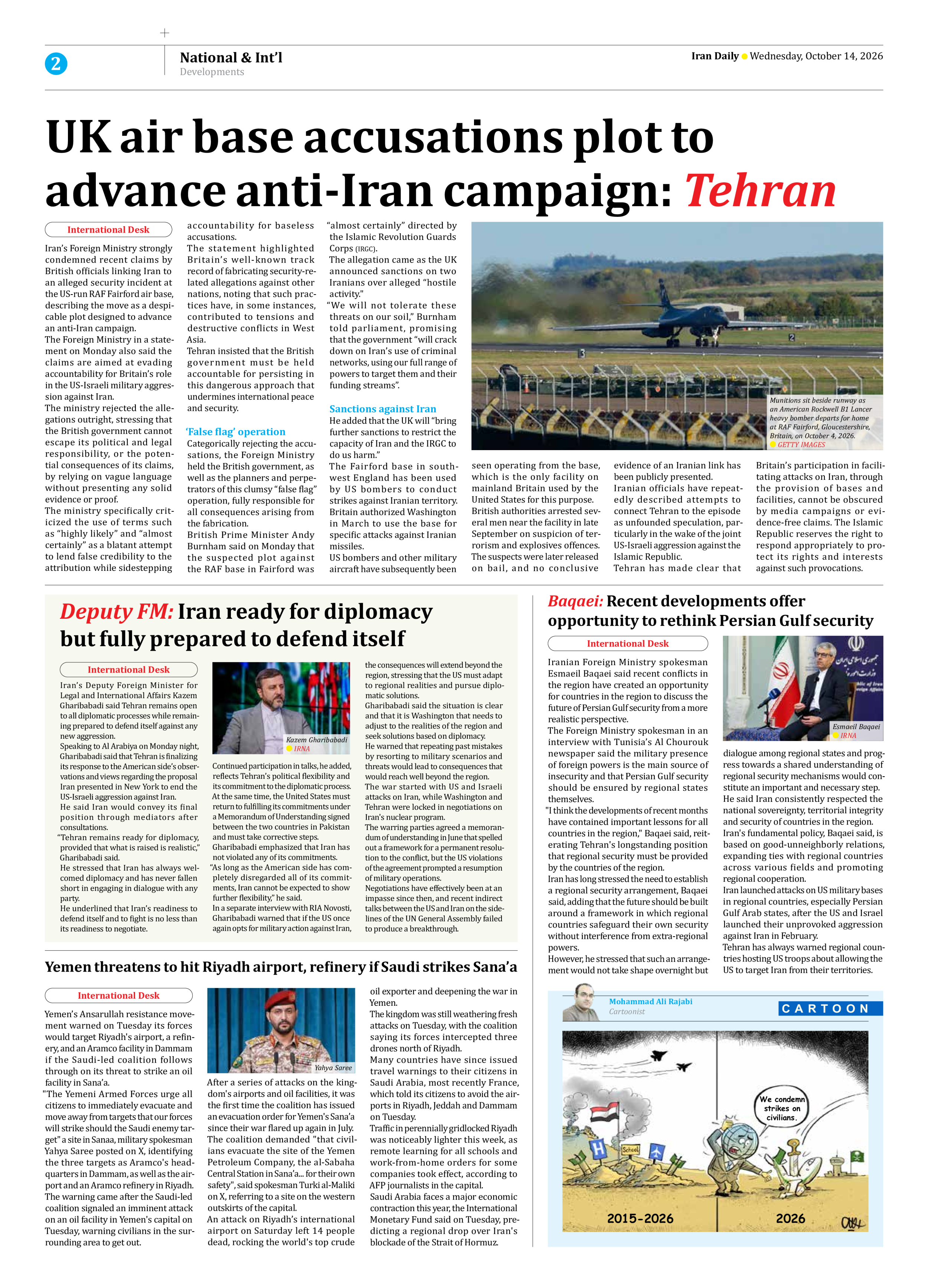


Deputy FM: Iran ready for diplomacy but fully prepared to defend itself
Iran’s Deputy Foreign Minister for Legal and International Affairs Kazem Gharibabadi said Tehran remains open to all diplomatic processes while remaining prepared to defend itself against any new aggression.
Speaking to Al Arabiya on Monday night, Gharibabadi said that Tehran is finalizing its response to the American side’s observations and views regarding the proposal Iran presented in New York to end the US-Israeli aggression against Iran.
He said Iran would convey its final position through mediators after consultations.
“Tehran remains ready for diplomacy, provided that what is raised is realistic,” Gharibabadi said.
He stressed that Iran has always welcomed diplomacy and has never fallen short in engaging in dialogue with any party.
He underlined that Iran’s readiness to defend itself and to fight is no less than its readiness to negotiate.
Continued participation in talks, he added, reflects Tehran’s political flexibility and its commitment to the diplomatic process. At the same time, the United States must return to fulfilling its commitments under a Memorandum of Understanding signed between the two countries in Pakistan and must take corrective steps.
Gharibabadi emphasized that Iran has not violated any of its commitments.
“As long as the American side has completely disregarded all of its commitments, Iran cannot be expected to show further flexibility,” he said.
In a separate interview with RIA Novosti, Gharibabadi warned that if the US once again opts for military action against Iran, the consequences will extend beyond the region, stressing that the US must adapt to regional realities and pursue diplomatic solutions.
Gharibabadi said the situation is clear and that it is Washington that needs to adjust to the realities of the region and seek solutions based on diplomacy.
He warned that repeating past mistakes by resorting to military scenarios and threats would lead to consequences that would reach well beyond the region.
The war started with US and Israeli attacks on Iran, while Washington and Tehran were locked in negotiations on Iran's nuclear program.
The warring parties agreed a memorandum of understanding in June that spelled out a framework for a permanent resolution to the conflict, but the US violations of the agreement prompted a resumption of military operations.
Negotiations have effectively been at an impasse since then, and recent indirect talks between the US and Iran on the sidelines of the UN General Assembly failed to produce a breakthrough.