





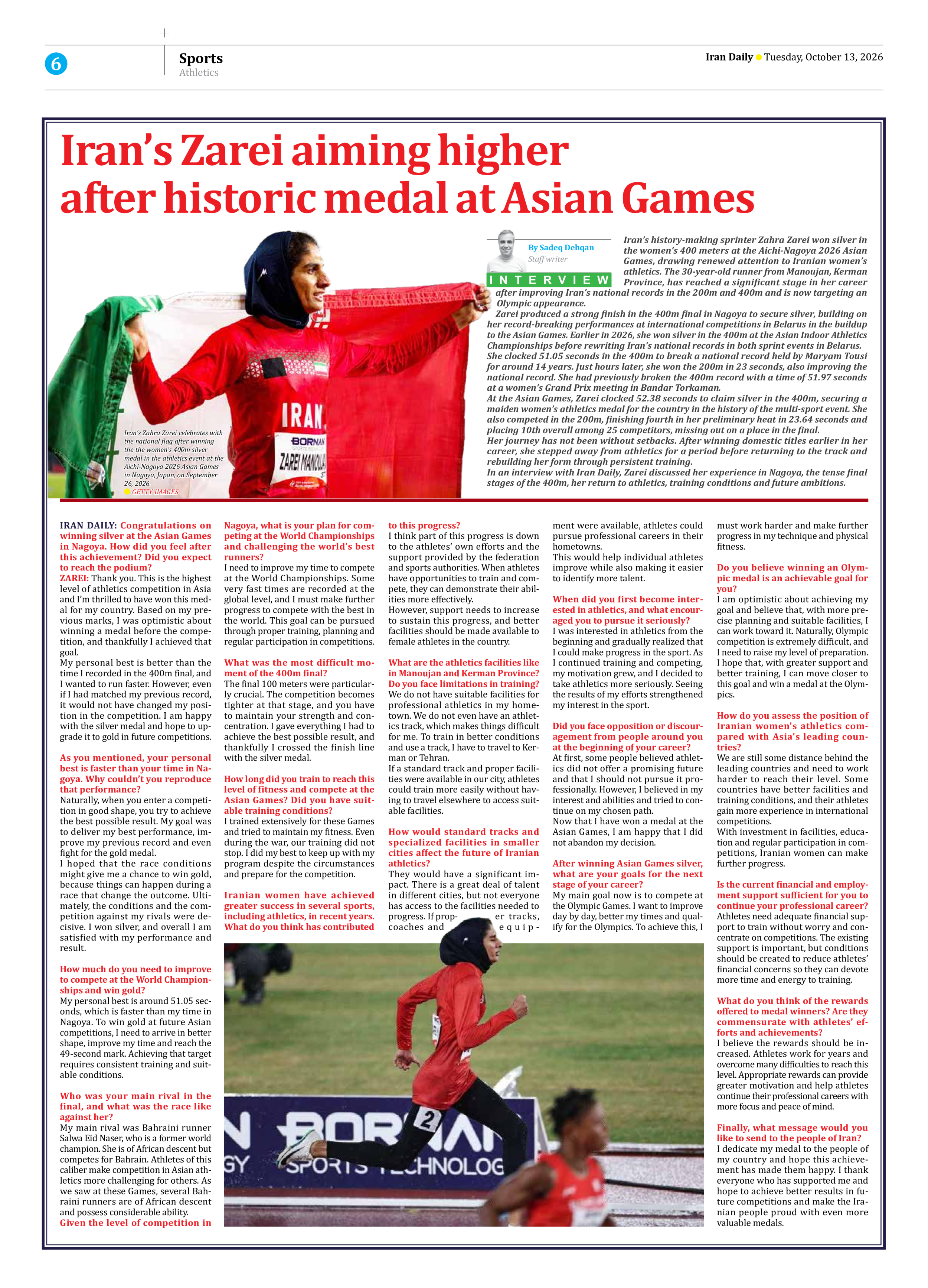


Iran’s Zarei aiming higher after historic medal at Asian Games
Iran’s history-making sprinter Zahra Zarei won silver in the women’s 400 meters at the Aichi-Nagoya 2026 Asian Games, drawing renewed attention to Iranian women’s athletics. The 30-year-old runner from Manoujan, Kerman Province, has reached a significant stage in her career after improving Iran’s national records in the 200m and 400m and is now targeting an Olympic appearance. Zarei produced a strong finish in the 400m final in Nagoya to secure silver, building on her record-breaking performances at international competitions in Belarus in the buildup to the Asian Games. Earlier in 2026, she won silver in the 400m at the Asian Indoor Athletics Championships before rewriting Iran’s national records in both sprint events in Belarus. She clocked 51.05 seconds in the 400m to break a national record held by Maryam Tousi for around 14 years. Just hours later, she won the 200m in 23 seconds, also improving the national record. She had previously broken the 400m record with a time of 51.97 seconds at a women’s Grand Prix meeting in Bandar Torkaman. At the Asian Games, Zarei clocked 52.38 seconds to claim silver in the 400m, securing a maiden women’s athletics medal for the country in the history of the multi-sport event. She also competed in the 200m, finishing fourth in her preliminary heat in 23.64 seconds and placing 10th overall among 25 competitors, missing out on a place in the final. Her journey has not been without setbacks. After winning domestic titles earlier in her career, she stepped away from athletics for a period before returning to the track and rebuilding her form through persistent training. In an interview with Iran Daily, Zarei discussed her experience in Nagoya, the tense final stages of the 400m, her return to athletics, training conditions and future ambitions.
By Sadeq Dehqan
Staff writer
IRAN DAILY: Congratulations on winning silver at the Asian Games in Nagoya. How did you feel after this achievement? Did you expect to reach the podium?
ZAREI: Thank you. This is the highest level of athletics competition in Asia and I’m thrilled to have won this medal for my country. Based on my previous marks, I was optimistic about winning a medal before the competition, and thankfully I achieved that goal.
My personal best is better than the time I recorded in the 400m final, and I wanted to run faster. However, even if I had matched my previous record, it would not have changed my position in the competition. I am happy with the silver medal and hope to upgrade it to gold in future competitions.
As you mentioned, your personal best is faster than your time in Nagoya. Why couldn’t you reproduce that performance?
Naturally, when you enter a competition in good shape, you try to achieve the best possible result. My goal was to deliver my best performance, improve my previous record and even fight for the gold medal.
I hoped that the race conditions might give me a chance to win gold, because things can happen during a race that change the outcome. Ultimately, the conditions and the competition against my rivals were decisive. I won silver, and overall I am satisfied with my performance and result.
How much do you need to improve to compete at the World Championships and win gold?
My personal best is around 51.05 seconds, which is faster than my time in Nagoya. To win gold at future Asian competitions, I need to arrive in better shape, improve my time and reach the 49-second mark. Achieving that target requires consistent training and suitable conditions.
Who was your main rival in the final, and what was the race like against her?
My main rival was Bahraini runner Salwa Eid Naser, who is a former world champion. She is of African descent but competes for Bahrain. Athletes of this caliber make competition in Asian athletics more challenging for others. As we saw at these Games, several Bahraini runners are of African descent and possess considerable ability.
Given the level of competition in Nagoya, what is your plan for competing at the World Championships and challenging the world’s best runners?
I need to improve my time to compete at the World Championships. Some very fast times are recorded at the global level, and I must make further progress to compete with the best in the world. This goal can be pursued through proper training, planning and regular participation in competitions.
What was the most difficult moment of the 400m final?
The final 100 meters were particularly crucial. The competition becomes tighter at that stage, and you have to maintain your strength and concentration. I gave everything I had to achieve the best possible result, and thankfully I crossed the finish line with the silver medal.
How long did you train to reach this level of fitness and compete at the Asian Games? Did you have suitable training conditions?
I trained extensively for these Games and tried to maintain my fitness. Even during the war, our training did not stop. I did my best to keep up with my program despite the circumstances and prepare for the competition.
Iranian women have achieved greater success in several sports, including athletics, in recent years. What do you think has contributed to this progress?
I think part of this progress is down to the athletes’ own efforts and the support provided by the federation and sports authorities. When athletes have opportunities to train and compete, they can demonstrate their abilities more effectively.
However, support needs to increase to sustain this progress, and better facilities should be made available to female athletes in the country.
What are the athletics facilities like in Manoujan and Kerman Province? Do you face limitations in training?
We do not have suitable facilities for professional athletics in my hometown. We do not even have an athletics track, which makes things difficult for me. To train in better conditions and use a track, I have to travel to Kerman or Tehran.
If a standard track and proper facilities were available in our city, athletes could train more easily without having to travel elsewhere to access suitable facilities.
How would standard tracks and specialized facilities in smaller cities affect the future of Iranian athletics?
They would have a significant impact. There is a great deal of talent in different cities, but not everyone has access to the facilities needed to progress. If proper tracks, coaches and equipment were available, athletes could pursue professional careers in their hometowns.
This would help individual athletes improve while also making it easier to identify more talent.
When did you first become interested in athletics, and what encouraged you to pursue it seriously?
I was interested in athletics from the beginning and gradually realized that I could make progress in the sport. As I continued training and competing, my motivation grew, and I decided to take athletics more seriously. Seeing the results of my efforts strengthened my interest in the sport.
Did you face opposition or discouragement from people around you at the beginning of your career?
At first, some people believed athletics did not offer a promising future and that I should not pursue it professionally. However, I believed in my interest and abilities and tried to continue on my chosen path.
Now that I have won a medal at the Asian Games, I am happy that I did not abandon my decision.
After winning Asian Games silver, what are your goals for the next stage of your career?
My main goal now is to compete at the Olympic Games. I want to improve day by day, better my times and qualify for the Olympics. To achieve this, I must work harder and make further progress in my technique and physical fitness.
Do you believe winning an Olympic medal is an achievable goal for you?
I am optimistic about achieving my goal and believe that, with more precise planning and suitable facilities, I can work toward it. Naturally, Olympic competition is extremely difficult, and I need to raise my level of preparation.
I hope that, with greater support and better training, I can move closer to this goal and win a medal at the Olympics.
How do you assess the position of Iranian women’s athletics compared with Asia’s leading countries?
We are still some distance behind the leading countries and need to work harder to reach their level. Some countries have better facilities and training conditions, and their athletes gain more experience in international competitions.
With investment in facilities, education and regular participation in competitions, Iranian women can make further progress.
Is the current financial and employment support sufficient for you to continue your professional career?
Athletes need adequate financial support to train without worry and concentrate on competitions. The existing support is important, but conditions should be created to reduce athletes’ financial concerns so they can devote more time and energy to training.
What do you think of the rewards offered to medal winners? Are they commensurate with athletes’ efforts and achievements?
I believe the rewards should be increased. Athletes work for years and overcome many difficulties to reach this level. Appropriate rewards can provide greater motivation and help athletes continue their professional careers with more focus and peace of mind.
Finally, what message would you like to send to the people of Iran?
I dedicate my medal to the people of my country and hope this achievement has made them happy. I thank everyone who has supported me and hope to achieve better results in future competitions and make the Iranian people proud with even more valuable medals.