







From grief to ‘Hope’
Homayoun Shajarian pays tribute to his parents at new concert series
By Alireza Sepahvand
Freelance journalist
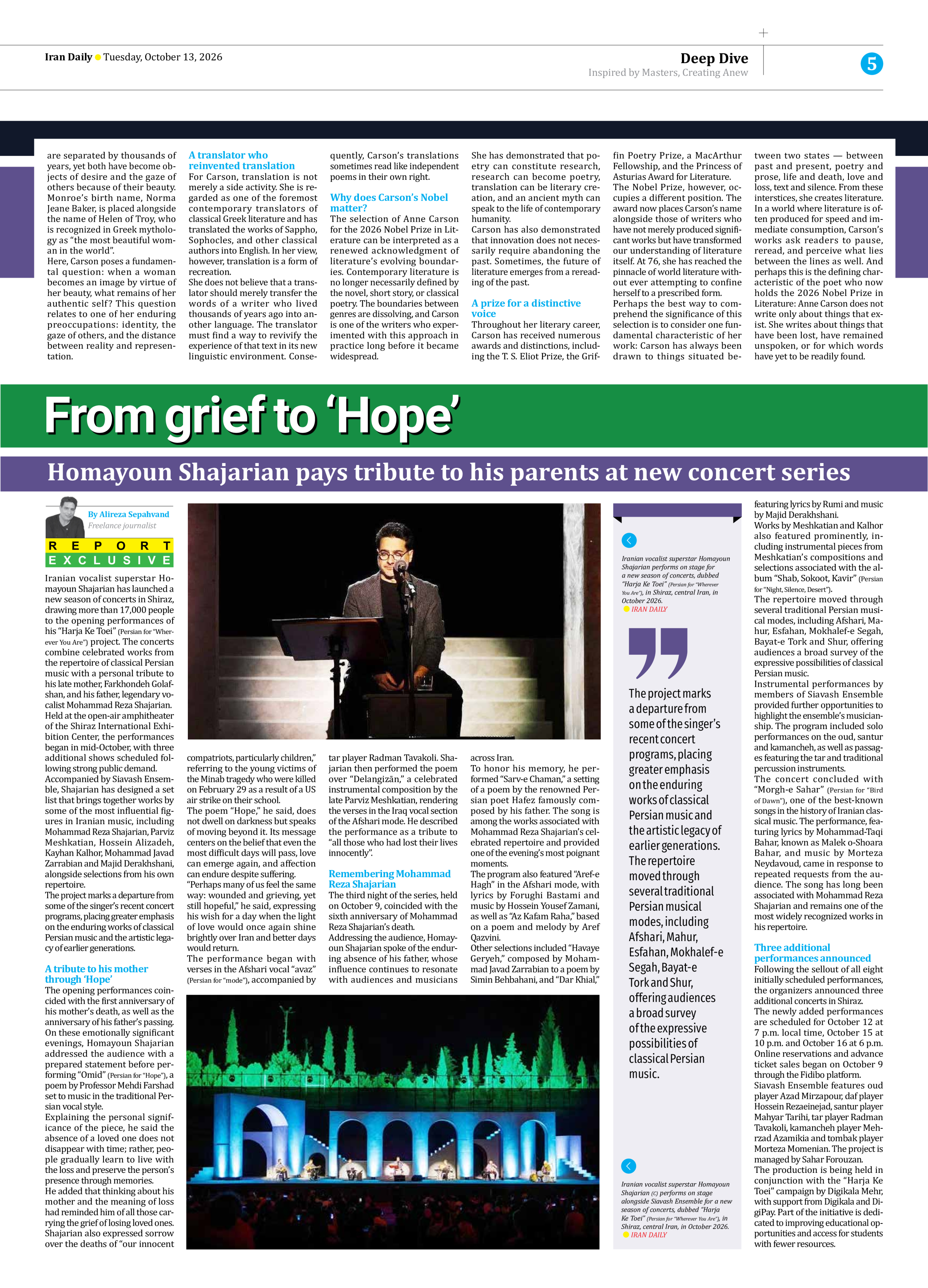
Iranian vocalist superstar Homayoun Shajarian has launched a new season of concerts in Shiraz, drawing more than 17,000 people to the opening performances of his “Harja Ke Toei” (Persian for “Wherever You Are”) project. The concerts combine celebrated works from the repertoire of classical Persian music with a personal tribute to his late mother, Farkhondeh Golafshan, and his father, legendary vocalist Mohammad Reza Shajarian.
Held at the open-air amphitheater of the Shiraz International Exhibition Center, the performances began in mid-October, with three additional shows scheduled following strong public demand.
Accompanied by Siavash Ensemble, Shajarian has designed a set list that brings together works by some of the most influential figures in Iranian music, including Mohammad Reza Shajarian, Parviz Meshkatian, Hossein Alizadeh, Kayhan Kalhor, Mohammad Javad Zarrabian and Majid Derakhshani, alongside selections from his own repertoire.
The project marks a departure from some of the singer’s recent concert programs, placing greater emphasis on the enduring works of classical Persian music and the artistic legacy of earlier generations.
A tribute to his mother through ‘Hope’
The opening performances coincided with the first anniversary of his mother’s death, as well as the anniversary of his father’s passing. On these emotionally significant evenings, Homayoun Shajarian addressed the audience with a prepared statement before performing “Omid” (Persian for “Hope”), a poem by Professor Mehdi Farshad set to music in the traditional Persian vocal style.
Explaining the personal significance of the piece, he said the absence of a loved one does not disappear with time; rather, people gradually learn to live with the loss and preserve the person’s presence through memories.
He added that thinking about his mother and the meaning of loss had reminded him of all those carrying the grief of losing loved ones.
Shajarian also expressed sorrow over the deaths of “our innocent compatriots, particularly children,” referring to the young victims of the Minab tragedy who were killed on February 29 as a result of a US air strike on their school.
The poem “Hope,” he said, does not dwell on darkness but speaks of moving beyond it. Its message centers on the belief that even the most difficult days will pass, love can emerge again, and affection can endure despite suffering.
“Perhaps many of us feel the same way: wounded and grieving, yet still hopeful,” he said, expressing his wish for a day when the light of love would once again shine brightly over Iran and better days would return.
The performance began with verses in the Afshari vocal “avaz” (Persian for “mode”), accompanied by tar player Radman Tavakoli. Shajarian then performed the poem over “Delangizān,” a celebrated instrumental composition by the late Parviz Meshkatian, rendering the verses in the Iraq vocal section of the Afshari mode. He described the performance as a tribute to “all those who had lost their lives innocently”.
Remembering Mohammad Reza Shajarian
The third night of the series, held on October 9, coincided with the sixth anniversary of Mohammad Reza Shajarian’s death.
Addressing the audience, Homayoun Shajarian spoke of the enduring absence of his father, whose influence continues to resonate with audiences and musicians across Iran.
To honor his memory, he performed “Sarv-e Chaman,” a setting of a poem by the renowned Persian poet Hafez famously composed by his father. The song is among the works associated with Mohammad Reza Shajarian’s celebrated repertoire and provided one of the evening’s most poignant moments.
The program also featured “Aref-e Hagh” in the Afshari mode, with lyrics by Forughi Bastami and music by Hossein Yousef Zamani, as well as “Az Kafam Raha,” based on a poem and melody by Aref Qazvini.
Other selections included “Havaye Geryeh,” composed by Mohammad Javad Zarrabian to a poem by Simin Behbahani, and “Dar Khial,” featuring lyrics by Rumi and music by Majid Derakhshani.
Works by Meshkatian and Kalhor also featured prominently, including instrumental pieces from Meshkatian’s compositions and selections associated with the album “Shab, Sokoot, Kavir” (Persian for “Night, Silence, Desert”).
The repertoire moved through several traditional Persian musical modes, including Afshari, Mahur, Esfahan, Mokhalef-e Segah, Bayat-e Tork and Shur, offering audiences a broad survey of the expressive possibilities of classical Persian music.
Instrumental performances by members of Siavash Ensemble provided further opportunities to highlight the ensemble’s musicianship. The program included solo performances on the oud, santur and kamancheh, as well as passages featuring the tar and traditional percussion instruments.
The concert concluded with “Morgh-e Sahar” (Persian for “Bird of Dawn”), one of the best-known songs in the history of Iranian classical music. The performance, featuring lyrics by Mohammad-Taqi Bahar, known as Malek o-Shoara Bahar, and music by Morteza Neydavoud, came in response to repeated requests from the audience. The song has long been associated with Mohammad Reza Shajarian and remains one of the most widely recognized works in his repertoire.
Three additional performances announced
Following the sellout of all eight initially scheduled performances, the organizers announced three additional concerts in Shiraz.
The newly added performances are scheduled for October 12 at 7 p.m. local time, October 15 at 10 p.m. and October 16 at 6 p.m. Online reservations and advance ticket sales began on October 9 through the Fidibo platform.
Siavash Ensemble features oud player Azad Mirzapour, daf player Hossein Rezaeinejad, santur player Mahyar Tarihi, tar player Radman Tavakoli, kamancheh player Mehrzad Azamikia and tombak player Morteza Momenian. The project is managed by Sahar Forouzan.
The production is being held in conjunction with the “Harja Ke Toei” campaign by Digikala Mehr, with support from Digikala and DigiPay. Part of the initiative is dedicated to improving educational opportunities and access for students with fewer resources.