







TPO says local-currency payments possible with EAEU
Iran has established the capacity to use national currencies and transfer funds in trade with members of the Eurasian Economic Union despite sanctions and banking restrictions, the head of the Trade Promotion Organization of Iran said on Monday, adding that the country's foreign trade volume by weight fell 34% in the first half of the current Iranian year.
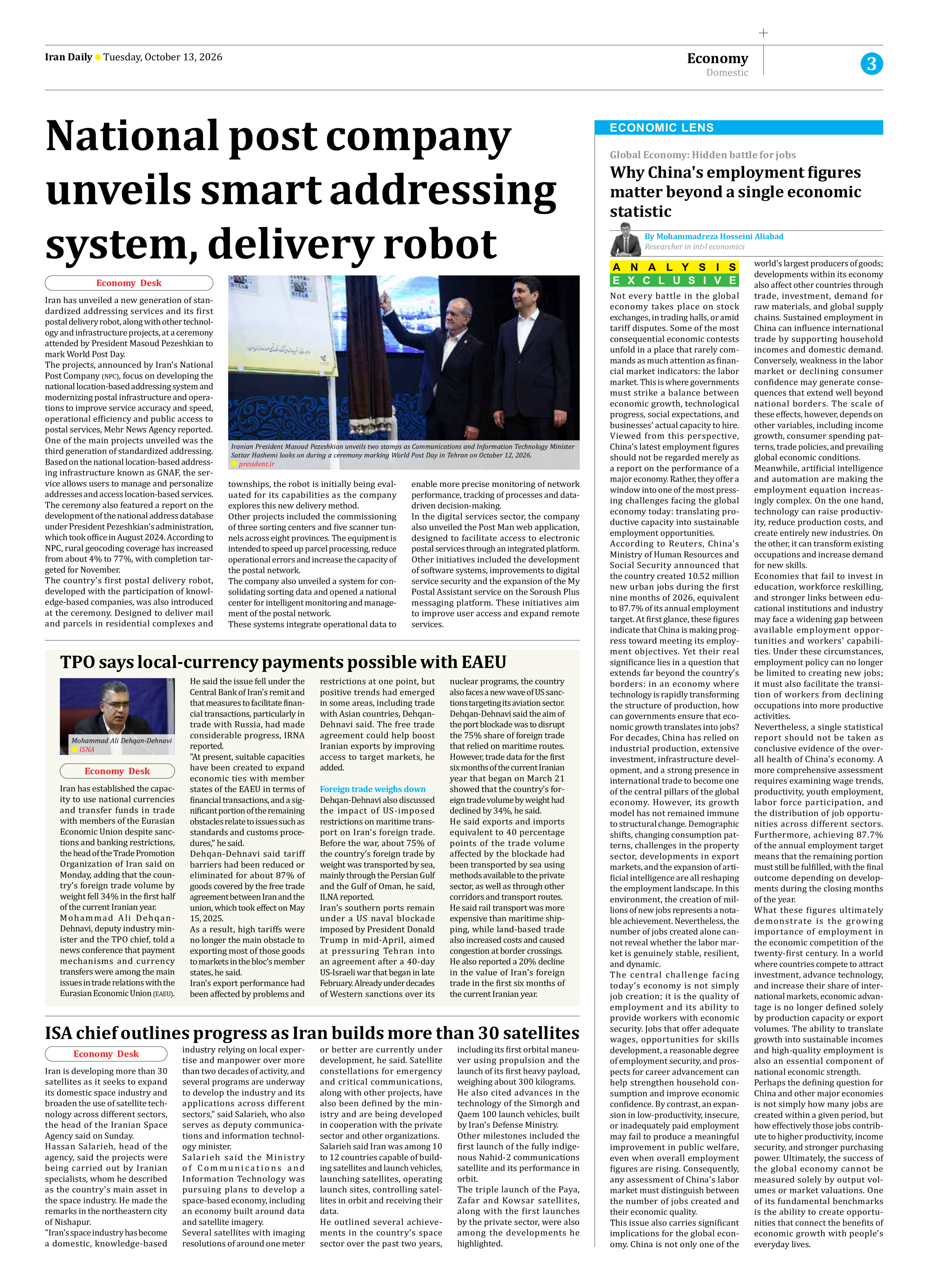
Mohammad Ali Dehqan-Dehnavi, deputy industry minister and the TPO chief, told a news conference that payment mechanisms and currency transfers were among the main issues in trade relations with the Eurasian Economic Union (EAEU).
He said the issue fell under the Central Bank of Iran's remit and that measures to facilitate financial transactions, particularly in trade with Russia, had made considerable progress, IRNA reported.
"At present, suitable capacities have been created to expand economic ties with member states of the EAEU in terms of financial transactions, and a significant portion of the remaining obstacles relate to issues such as standards and customs procedures," he said.
Dehqan-Dehnavi said tariff barriers had been reduced or eliminated for about 87% of goods covered by the free trade agreement between Iran and the union, which took effect on May 15, 2025.
As a result, high tariffs were no longer the main obstacle to exporting most of those goods to markets in the bloc's member states, he said.
Iran's export performance had been affected by problems and restrictions at one point, but positive trends had emerged in some areas, including trade with Asian countries, Dehqan-Dehnavi said. The free trade agreement could help boost Iranian exports by improving access to target markets, he added.
Foreign trade weighs down
Dehqan-Dehnavi also discussed the impact of US-imposed restrictions on maritime transport on Iran's foreign trade. Before the war, about 75% of the country's foreign trade by weight was transported by sea, mainly through the Persian Gulf and the Gulf of Oman, he said, ILNA reported.
Iran's southern ports remain under a US naval blockade imposed by President Donald Trump in mid-April, aimed at pressuring Tehran into an agreement after a 40-day US-Israeli war that began in late February. Already under decades of Western sanctions over its nuclear programs, the country also faces a new wave of US sanctions targeting its aviation sector.
Dehqan-Dehnavi said the aim of the port blockade was to disrupt the 75% share of foreign trade that relied on maritime routes. However, trade data for the first six months of the current Iranian year that began on March 21 showed that the country's foreign trade volume by weight had declined by 34%, he said.
He said exports and imports equivalent to 40 percentage points of the trade volume affected by the blockade had been transported by sea using methods available to the private sector, as well as through other corridors and transport routes.
He said rail transport was more expensive than maritime shipping, while land-based trade also increased costs and caused congestion at border crossings.
He also reported a 20% decline in the value of Iran's foreign trade in the first six months of the current Iranian year.