







Iran expresses readiness to facilitate political dialogue between Riyadh, Sana’a
Iran expressed readiness to facilitate dialogue between Yemen’s Ansarullah resistance movement and Saudi Arabia to end the ongoing conflict between the two sides.
Iranian Foreign Minister Abbas Araghchi in a phone conversation with his Saudi counterpart Faisal bin Farhan on Sunday said that Tehran is fully prepared to facilitate a direct political dialogue between Riyadh and Sana’a, stressing that persisting with a military approach in Yemen will only further complicate the regional landscape.
Araghchi expressed deep concern over the worsening situation, stressing that the crises currently plaguing the region fundamentally lack a military solution.
“Insisting on a military approach and disregarding a political solution will only complicate the current situation,” Araghchi told the Saudi foreign minister.
He reaffirmed the Islamic Republic’s readiness to provide any necessary assistance to help initiate talks between Saudi Arabia and Yemen, paving the way for a durable political resolution.
Iran’s Foreign Ministry spokesman Esmaeil Baqaei also on Monday expressed concern about developments on the Arabian Peninsula and reiterated Iran’s readiness to facilitate dialogue, noting that escalating tensions would benefit only the Israeli regime.
“We, therefore, do not want hostilities and war to continue between two Muslim countries. Our region is already experiencing enough tension as a result of US and Israeli actions,” he said.
Baqaei maintained that the Yemeni people had the right to live with dignity, free from pressure, sanctions, and blockade, saying that conditions in the country over the past 10 to 12 years were unjustifiable under Islamic principles or international law.
The remarks came as military tensions between Yemen’s Ansarullah movement and Saudi Arabia have deteriorated in recent weeks.
At least 14 people have been killed in recent attacks by Ansarullah’s forces on Saudi Arabia.
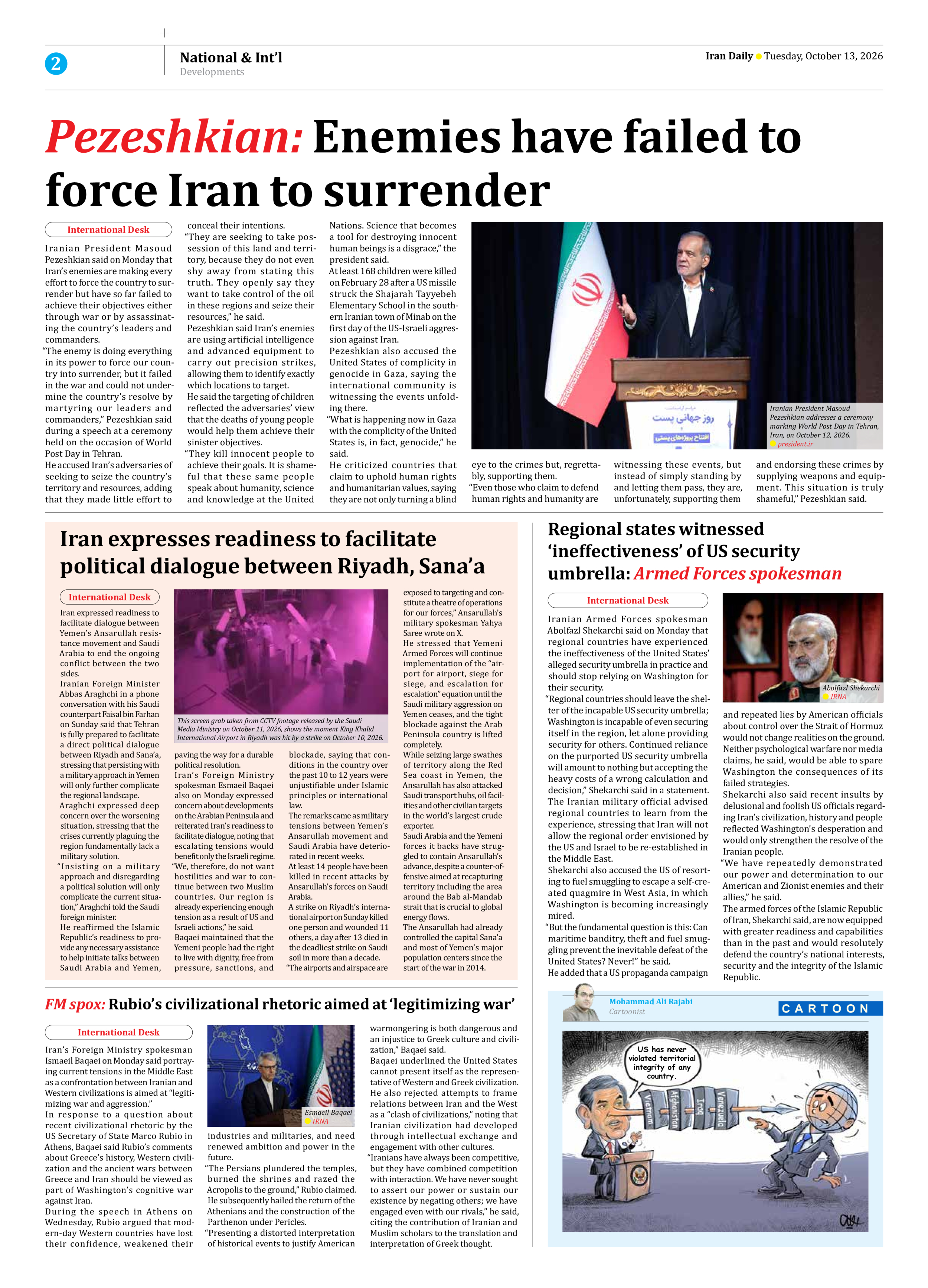
A strike on Riyadh’s international airport on Sunday killed one person and wounded 11 others, a day after 13 died in the deadliest strike on Saudi soil in more than a decade.
“The airports and airspace are exposed to targeting and constitute a theatre of operations for our forces,” Ansarullah’s military spokesman Yahya Saree wrote on X.
He stressed that Yemeni Armed Forces will continue implementation of the “airport for airport, siege for siege, and escalation for escalation” equation until the Saudi military aggression on Yemen ceases, and the tight blockade against the Arab Peninsula country is lifted completely.
While seizing large swathes of territory along the Red Sea coast in Yemen, the Ansarullah has also attacked Saudi transport hubs, oil facilities and other civilian targets in the world’s largest crude exporter.
Saudi Arabia and the Yemeni forces it backs have struggled to contain Ansarullah’s advance, despite a counter-offensive aimed at recapturing territory including the area around the Bab al-Mandab strait that is crucial to global energy flows.
The Ansarullah had already controlled the capital Sana’a and most of Yemen’s major population centers since the start of the war in 2014.