







Teen prodigy Beheshti sets sights on Olympic gold after Nagoya success
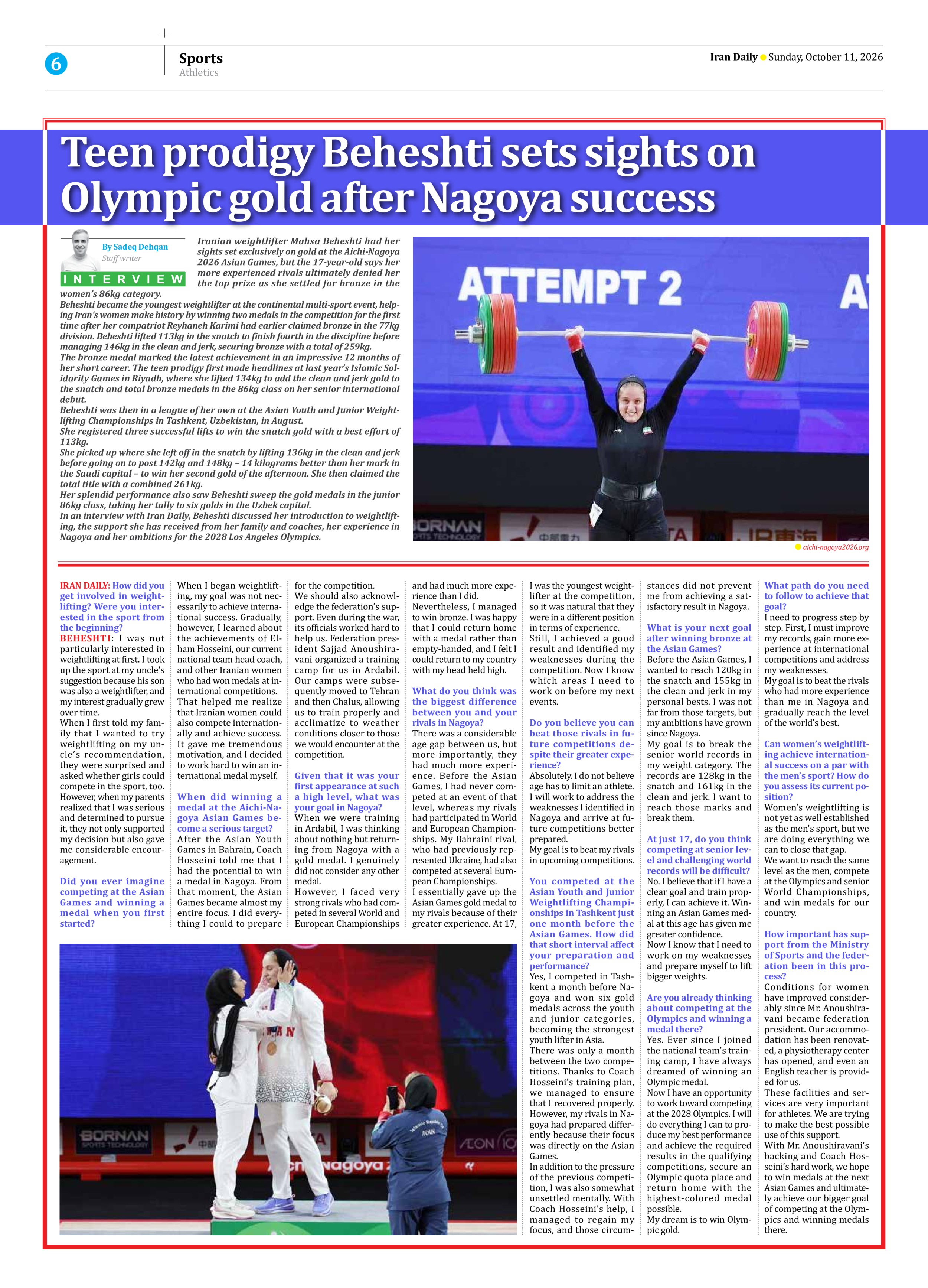
Iranian weightlifter Mahsa Beheshti had her sights set exclusively on gold at the Aichi-Nagoya 2026 Asian Games, but the 17-year-old says her more experienced rivals ultimately denied her the top prize as she settled for bronze in the women’s 86kg category. Beheshti became the youngest weightlifter at the continental multi-sport event, helping Iran’s women make history by winning two medals in the competition for the first time after her compatriot Reyhaneh Karimi had earlier claimed bronze in the 77kg division. Beheshti lifted 113kg in the snatch to finish fourth in the discipline before managing 146kg in the clean and jerk, securing bronze with a total of 259kg. The bronze medal marked the latest achievement in an impressive 12 months of her short career. The teen prodigy first made headlines at last year’s Islamic Solidarity Games in Riyadh, where she lifted 134kg to add the clean and jerk gold to the snatch and total bronze medals in the 86kg class on her senior international debut. Beheshti was then in a league of her own at the Asian Youth and Junior Weightlifting Championships in Tashkent, Uzbekistan, in August. She registered three successful lifts to win the snatch gold with a best effort of 113kg. She picked up where she left off in the snatch by lifting 136kg in the clean and jerk before going on to post 142kg and 148kg – 14 kilograms better than her mark in the Saudi capital – to win her second gold of the afternoon. She then claimed the total title with a combined 261kg. Her splendid performance also saw Beheshti sweep the gold medals in the junior 86kg class, taking her tally to six golds in the Uzbek capital. In an interview with Iran Daily, Beheshti discussed her introduction to weightlifting, the support she has received from her family and coaches, her experience in Nagoya and her ambitions for the 2028 Los Angeles Olympics.
By Sadeq Dehqan
Staff writer
IRAN DAILY: How did you get involved in weightlifting? Were you interested in the sport from the beginning?
BEHESHTI: I was not particularly interested in weightlifting at first. I took up the sport at my uncle’s suggestion because his son was also a weightlifter, and my interest gradually grew over time.
When I first told my family that I wanted to try weightlifting on my uncle’s recommendation, they were surprised and asked whether girls could compete in the sport, too. However, when my parents realized that I was serious and determined to pursue it, they not only supported my decision but also gave me considerable encouragement.
Did you ever imagine competing at the Asian Games and winning a medal when you first started?
When I began weightlifting, my goal was not necessarily to achieve international success. Gradually, however, I learned about the achievements of Elham Hosseini, our current national team head coach, and other Iranian women who had won medals at international competitions.
That helped me realize that Iranian women could also compete internationally and achieve success. It gave me tremendous motivation, and I decided to work hard to win an international medal myself.
When did winning a medal at the Aichi-Nagoya Asian Games become a serious target?
After the Asian Youth Games in Bahrain, Coach Hosseini told me that I had the potential to win a medal in Nagoya. From that moment, the Asian Games became almost my entire focus. I did everything I could to prepare for the competition.
We should also acknowledge the federation’s support. Even during the war, its officials worked hard to help us. Federation president Sajjad Anoushiravani organized a training camp for us in Ardabil. Our camps were subsequently moved to Tehran and then Chalus, allowing us to train properly and acclimatize to weather conditions closer to those we would encounter at the competition.
Given that it was your first appearance at such a high level, what was your goal in Nagoya?
When we were training in Ardabil, I was thinking about nothing but returning from Nagoya with a gold medal. I genuinely did not consider any other medal.
However, I faced very strong rivals who had competed in several World and European Championships and had much more experience than I did.
Nevertheless, I managed to win bronze. I was happy that I could return home with a medal rather than empty-handed, and I felt I could return to my country with my head held high.
What do you think was the biggest difference between you and your rivals in Nagoya?
There was a considerable age gap between us, but more importantly, they had much more experience. Before the Asian Games, I had never competed at an event of that level, whereas my rivals had participated in World and European Championships. My Bahraini rival, who had previously represented Ukraine, had also competed at several European Championships.
I essentially gave up the Asian Games gold medal to my rivals because of their greater experience. At 17, I was the youngest weightlifter at the competition, so it was natural that they were in a different position in terms of experience.
Still, I achieved a good result and identified my weaknesses during the competition. Now I know which areas I need to work on before my next events.
Do you believe you can beat those rivals in future competitions despite their greater experience?
Absolutely. I do not believe age has to limit an athlete. I will work to address the weaknesses I identified in Nagoya and arrive at future competitions better prepared.
My goal is to beat my rivals in upcoming competitions.
You competed at the Asian Youth and Junior Weightlifting Championships in Tashkent just one month before the Asian Games. How did that short interval affect your preparation and performance?
Yes, I competed in Tashkent a month before Nagoya and won six gold medals across the youth and junior categories, becoming the strongest youth lifter in Asia.
There was only a month between the two competitions. Thanks to Coach Hosseini’s training plan, we managed to ensure that I recovered properly. However, my rivals in Nagoya had prepared differently because their focus was directly on the Asian Games.
In addition to the pressure of the previous competition, I was also somewhat unsettled mentally. With Coach Hosseini’s help, I managed to regain my focus, and those circumstances did not prevent me from achieving a satisfactory result in Nagoya.
What is your next goal after winning bronze at the Asian Games?
Before the Asian Games, I wanted to reach 120kg in the snatch and 155kg in the clean and jerk in my personal bests. I was not far from those targets, but my ambitions have grown since Nagoya.
My goal is to break the senior world records in my weight category. The records are 128kg in the snatch and 161kg in the clean and jerk. I want to reach those marks and break them.
At just 17, do you think competing at senior level and challenging world records will be difficult?
No. I believe that if I have a clear goal and train properly, I can achieve it. Winning an Asian Games medal at this age has given me greater confidence.
Now I know that I need to work on my weaknesses and prepare myself to lift bigger weights.
Are you already thinking about competing at the Olympics and winning a medal there?
Yes. Ever since I joined the national team’s training camp, I have always dreamed of winning an Olympic medal.
Now I have an opportunity to work toward competing at the 2028 Olympics. I will do everything I can to produce my best performance and achieve the required results in the qualifying competitions, secure an Olympic quota place and return home with the highest-colored medal possible.
My dream is to win Olympic gold.
What path do you need to follow to achieve that goal?
I need to progress step by step. First, I must improve my records, gain more experience at international competitions and address my weaknesses.
My goal is to beat the rivals who had more experience than me in Nagoya and gradually reach the level of the world’s best.
Can women’s weightlifting achieve international success on a par with the men’s sport? How do you assess its current position?
Women’s weightlifting is not yet as well established as the men’s sport, but we are doing everything we can to close that gap.
We want to reach the same level as the men, compete at the Olympics and senior World Championships, and win medals for our country.
How important has support from the Ministry of Sports and the federation been in this process?
Conditions for women have improved considerably since Mr. Anoushiravani became federation president. Our accommodation has been renovated, a physiotherapy center has opened, and even an English teacher is provided for us.
These facilities and services are very important for athletes. We are trying to make the best possible use of this support.
With Mr. Anoushiravani’s backing and Coach Hosseini’s hard work, we hope to win medals at the next Asian Games and ultimately achieve our bigger goal of competing at the Olympics and winning medals there.