





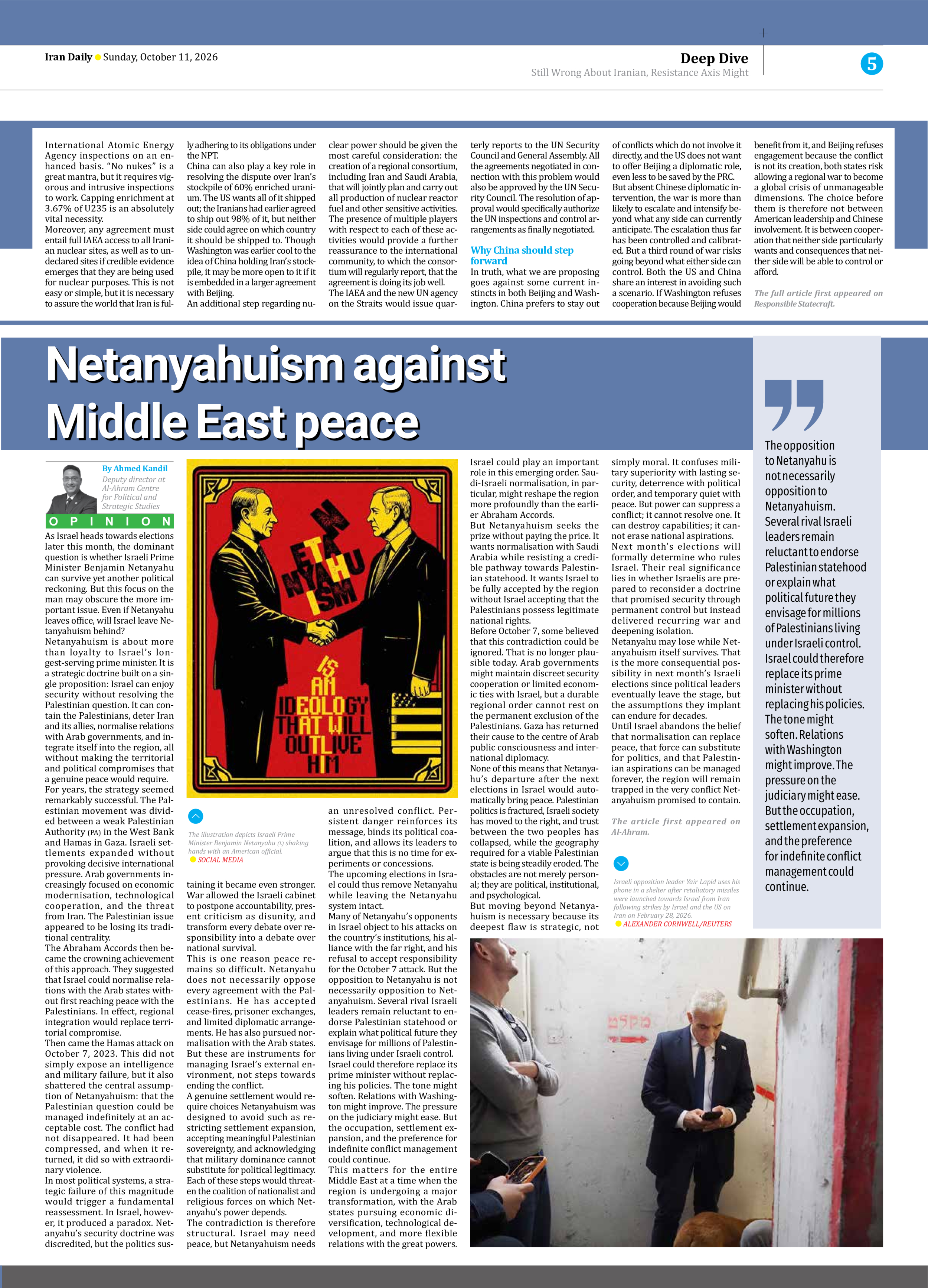


Netanyahuism against Middle East peace
By Ahmed Kandil
Deputy director at Al-Ahram Centre for Political and Strategic Studies
As Israel heads towards elections later this month, the dominant question is whether Israeli Prime Minister Benjamin Netanyahu can survive yet another political reckoning. But this focus on the man may obscure the more important issue. Even if Netanyahu leaves office, will Israel leave Netanyahuism behind?
Netanyahuism is about more than loyalty to Israel’s longest-serving prime minister. It is a strategic doctrine built on a single proposition: Israel can enjoy security without resolving the Palestinian question. It can contain the Palestinians, deter Iran and its allies, normalise relations with Arab governments, and integrate itself into the region, all without making the territorial and political compromises that a genuine peace would require.
For years, the strategy seemed remarkably successful. The Palestinian movement was divided between a weak Palestinian Authority (PA) in the West Bank and Hamas in Gaza. Israeli settlements expanded without provoking decisive international pressure. Arab governments increasingly focused on economic modernisation, technological cooperation, and the threat from Iran. The Palestinian issue appeared to be losing its traditional centrality.
The Abraham Accords then became the crowning achievement of this approach. They suggested that Israel could normalise relations with the Arab states without first reaching peace with the Palestinians. In effect, regional integration would replace territorial compromise.
Then came the Hamas attack on October 7, 2023. This did not simply expose an intelligence and military failure, but it also shattered the central assumption of Netanyahuism: that the Palestinian question could be managed indefinitely at an acceptable cost. The conflict had not disappeared. It had been compressed, and when it returned, it did so with extraordinary violence.
In most political systems, a strategic failure of this magnitude would trigger a fundamental reassessment. In Israel, however, it produced a paradox. Netanyahu’s security doctrine was discredited, but the politics sustaining it became even stronger. War allowed the Israeli cabinet to postpone accountability, present criticism as disunity, and transform every debate over responsibility into a debate over national survival.
This is one reason peace remains so difficult. Netanyahu does not necessarily oppose every agreement with the Palestinians. He has accepted cease-fires, prisoner exchanges, and limited diplomatic arrangements. He has also pursued normalisation with the Arab states. But these are instruments for managing Israel’s external environment, not steps towards ending the conflict.
A genuine settlement would require choices Netanyahuism was designed to avoid such as restricting settlement expansion, accepting meaningful Palestinian sovereignty, and acknowledging that military dominance cannot substitute for political legitimacy. Each of these steps would threaten the coalition of nationalist and religious forces on which Netanyahu’s power depends.
The contradiction is therefore structural. Israel may need peace, but Netanyahuism needs an unresolved conflict. Persistent danger reinforces its message, binds its political coalition, and allows its leaders to argue that this is no time for experiments or concessions.
The upcoming elections in Israel could thus remove Netanyahu while leaving the Netanyahu system intact.
Many of Netanyahu’s opponents in Israel object to his attacks on the country’s institutions, his alliance with the far right, and his refusal to accept responsibility for the October 7 attack. But the opposition to Netanyahu is not necessarily opposition to Netanyahuism. Several rival Israeli leaders remain reluctant to endorse Palestinian statehood or explain what political future they envisage for millions of Palestinians living under Israeli control.
Israel could therefore replace its prime minister without replacing his policies. The tone might soften. Relations with Washington might improve. The pressure on the judiciary might ease. But the occupation, settlement expansion, and the preference for indefinite conflict management could continue.
This matters for the entire Middle East at a time when the region is undergoing a major transformation, with the Arab states pursuing economic diversification, technological development, and more flexible relations with the great powers. Israel could play an important role in this emerging order. Saudi-Israeli normalisation, in particular, might reshape the region more profoundly than the earlier Abraham Accords.
But Netanyahuism seeks the prize without paying the price. It wants normalisation with Saudi Arabia while resisting a credible pathway towards Palestinian statehood. It wants Israel to be fully accepted by the region without Israel accepting that the Palestinians possess legitimate national rights.
Before October 7, some believed that this contradiction could be ignored. That is no longer plausible today. Arab governments might maintain discreet security cooperation or limited economic ties with Israel, but a durable regional order cannot rest on the permanent exclusion of the Palestinians. Gaza has returned their cause to the centre of Arab public consciousness and international diplomacy.
None of this means that Netanyahu’s departure after the next elections in Israel would automatically bring peace. Palestinian politics is fractured, Israeli society has moved to the right, and trust between the two peoples has collapsed, while the geography required for a viable Palestinian state is being steadily eroded. The obstacles are not merely personal; they are political, institutional, and psychological.
But moving beyond Netanyahuism is necessary because its deepest flaw is strategic, not simply moral. It confuses military superiority with lasting security, deterrence with political order, and temporary quiet with peace. But power can suppress a conflict; it cannot resolve one. It can destroy capabilities; it cannot erase national aspirations.
Next month’s elections will formally determine who rules Israel. Their real significance lies in whether Israelis are prepared to reconsider a doctrine that promised security through permanent control but instead delivered recurring war and deepening isolation.
Netanyahu may lose while Netanyahuism itself survives. That is the more consequential possibility in next month’s Israeli elections since political leaders eventually leave the stage, but the assumptions they implant can endure for decades.
Until Israel abandons the belief that normalisation can replace peace, that force can substitute for politics, and that Palestinian aspirations can be managed forever, the region will remain trapped in the very conflict Netanyahuism promised to contain.
The article first appeared on Al-Ahram.