





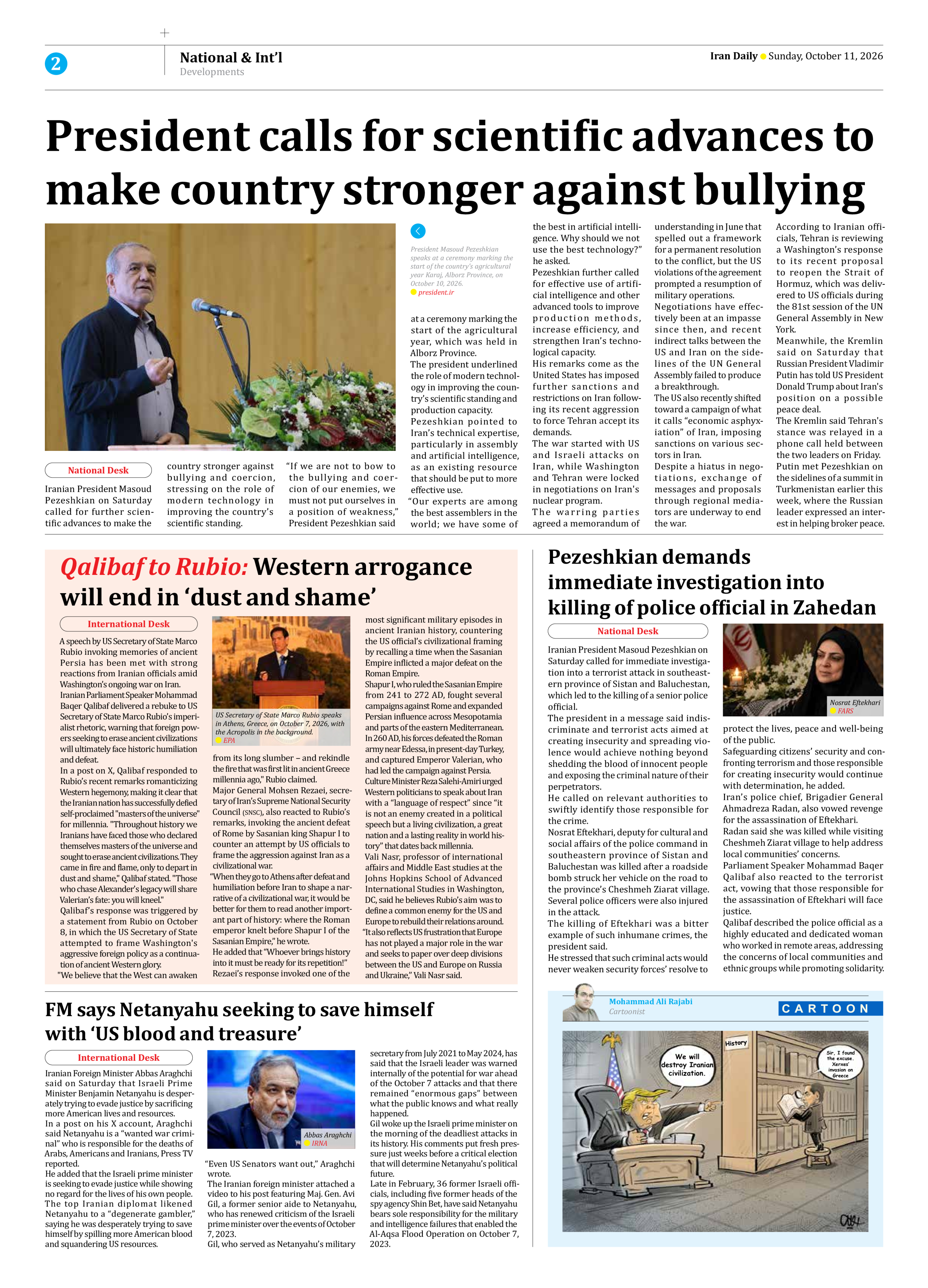


Qalibaf to Rubio: Western arrogance will end in ‘dust and shame’
A speech by US Secretary of State Marco Rubio invoking memories of ancient Persia has been met with strong reactions from Iranian officials amid Washington’s ongoing war on Iran.
Iranian Parliament Speaker Mohammad Baqer Qalibaf delivered a rebuke to US Secretary of State Marco Rubio’s imperialist rhetoric, warning that foreign powers seeking to erase ancient civilizations will ultimately face historic humiliation and defeat.
In a post on X, Qalibaf responded to Rubio’s recent remarks romanticizing Western hegemony, making it clear that the Iranian nation has successfully defied self-proclaimed "masters of the universe" for millennia. "Throughout history we Iranians have faced those who declared themselves masters of the universe and sought to erase ancient civilizations. They came in fire and flame, only to depart in dust and shame," Qalibaf stated. "Those who chase Alexander’s legacy will share Valerian’s fate: you will kneel."
Qalibaf’s response was triggered by a statement from Rubio on October 8, in which the US Secretary of State attempted to frame Washington's aggressive foreign policy as a continuation of ancient Western glory.
"We believe that the West can awaken from its long slumber – and rekindle the fire that was first lit in ancient Greece millennia ago," Rubio claimed.
Major General Mohsen Rezaei, secretary of Iran’s Supreme National Security Council (SNSC), also reacted to Rubio’s remarks, invoking the ancient defeat of Rome by Sasanian king Shapur I to counter an attempt by US officials to frame the aggression against Iran as a civilizational war.
“When they go to Athens after defeat and humiliation before Iran to shape a narrative of a civilizational war, it would be better for them to read another important part of history: where the Roman emperor knelt before Shapur I of the Sasanian Empire,” he wrote.
He added that “Whoever brings history into it must be ready for its repetition!”
Rezaei’s response invoked one of the most significant military episodes in ancient Iranian history, countering the US official’s civilizational framing by recalling a time when the Sasanian Empire inflicted a major defeat on the Roman Empire.
Shapur I, who ruled the Sasanian Empire from 241 to 272 AD, fought several campaigns against Rome and expanded Persian influence across Mesopotamia and parts of the eastern Mediterranean. In 260 AD, his forces defeated the Roman army near Edessa, in present-day Turkey, and captured Emperor Valerian, who had led the campaign against Persia.
Culture Minister Reza Salehi-Amiri urged Western politicians to speak about Iran with a “language of respect” since “it is not an enemy created in a political speech but a living civilization, a great nation and a lasting reality in world history” that dates back millennia.
Vali Nasr, professor of international affairs and Middle East studies at the Johns Hopkins School of Advanced International Studies in Washington, DC, said he believes Rubio’s aim was to define a common enemy for the US and Europe to rebuild their relations around.
“It also reflects US frustration that Europe has not played a major role in the war and seeks to paper over deep divisions between the US and Europe on Russia and Ukraine,” Vali Nasr said.