







Biabank puts on display resilience of Iranian civilization
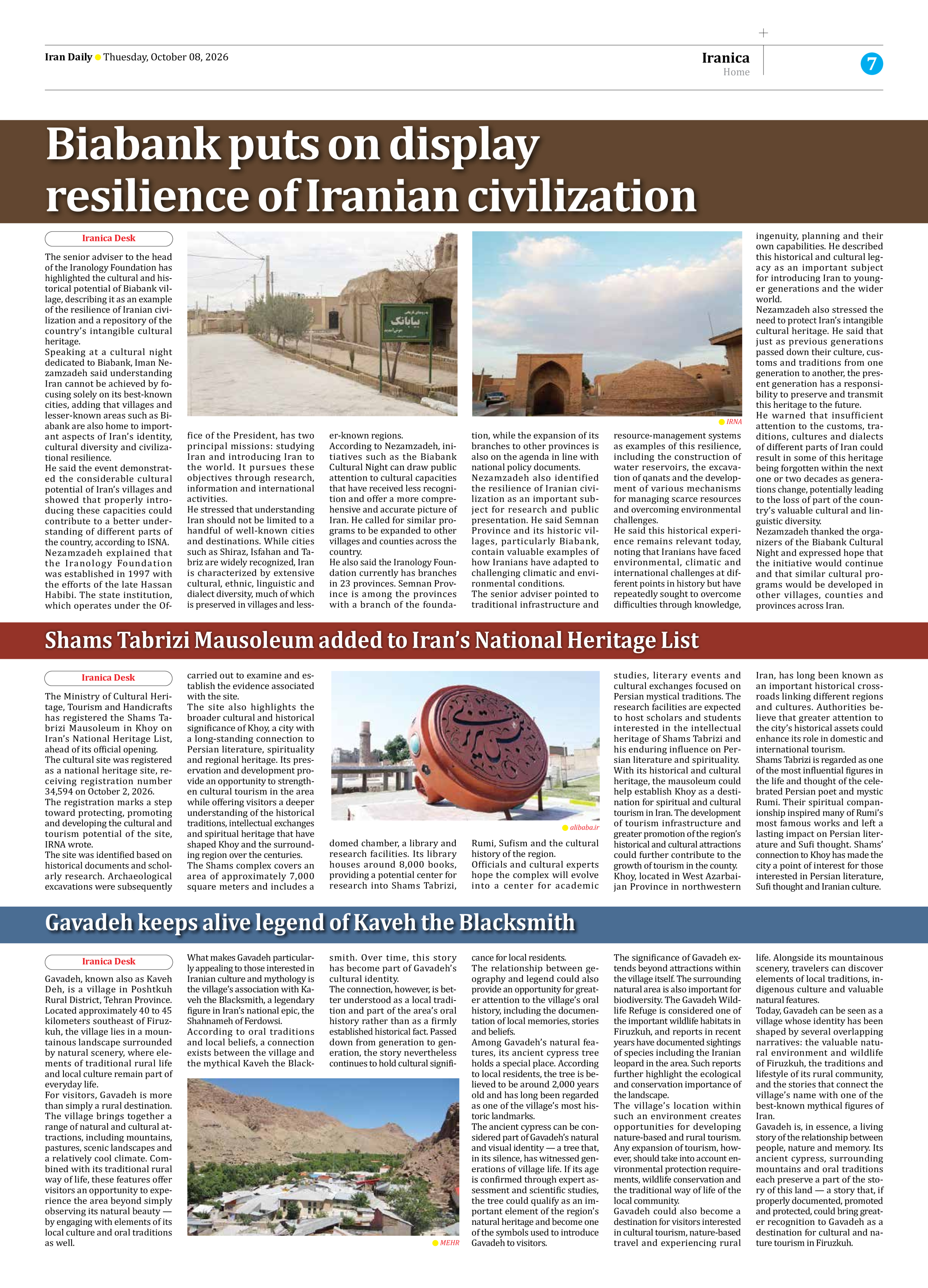
The senior adviser to the head of the Iranology Foundation has highlighted the cultural and historical potential of Biabank village, describing it as an example of the resilience of Iranian civilization and a repository of the country’s intangible cultural heritage.
Speaking at a cultural night dedicated to Biabank, Iman Nezamzadeh said understanding Iran cannot be achieved by focusing solely on its best-known cities, adding that villages and lesser-known areas such as Biabank are also home to important aspects of Iran’s identity, cultural diversity and civilizational resilience.
He said the event demonstrated the considerable cultural potential of Iran’s villages and showed that properly introducing these capacities could contribute to a better understanding of different parts of the country, according to ISNA.
Nezamzadeh explained that the Iranology Foundation was established in 1997 with the efforts of the late Hassan Habibi. The state institution, which operates under the Office of the President, has two principal missions: studying Iran and introducing Iran to the world. It pursues these objectives through research, information and international activities.
He stressed that understanding Iran should not be limited to a handful of well-known cities and destinations. While cities such as Shiraz, Isfahan and Tabriz are widely recognized, Iran is characterized by extensive cultural, ethnic, linguistic and dialect diversity, much of which is preserved in villages and lesser-known regions.
According to Nezamzadeh, initiatives such as the Biabank Cultural Night can draw public attention to cultural capacities that have received less recognition and offer a more comprehensive and accurate picture of Iran. He called for similar programs to be expanded to other villages and counties across the country.
He also said the Iranology Foundation currently has branches in 23 provinces. Semnan Province is among the provinces with a branch of the foundation, while the expansion of its branches to other provinces is also on the agenda in line with national policy documents.
Nezamzadeh also identified the resilience of Iranian civilization as an important subject for research and public presentation. He said Semnan Province and its historic villages, particularly Biabank, contain valuable examples of how Iranians have adapted to challenging climatic and environmental conditions.
The senior adviser pointed to traditional infrastructure and resource-management systems as examples of this resilience, including the construction of water reservoirs, the excavation of qanats and the development of various mechanisms for managing scarce resources and overcoming environmental challenges.
He said this historical experience remains relevant today, noting that Iranians have faced environmental, climatic and international challenges at different points in history but have repeatedly sought to overcome difficulties through knowledge, ingenuity, planning and their own capabilities. He described this historical and cultural legacy as an important subject for introducing Iran to younger generations and the wider world.
Nezamzadeh also stressed the need to protect Iran’s intangible cultural heritage. He said that just as previous generations passed down their culture, customs and traditions from one generation to another, the present generation has a responsibility to preserve and transmit this heritage to the future.
He warned that insufficient attention to the customs, traditions, cultures and dialects of different parts of Iran could result in some of this heritage being forgotten within the next one or two decades as generations change, potentially leading to the loss of part of the country’s valuable cultural and linguistic diversity.
Nezamzadeh thanked the organizers of the Biabank Cultural Night and expressed hope that the initiative would continue and that similar cultural programs would be developed in other villages, counties and provinces across Iran.