





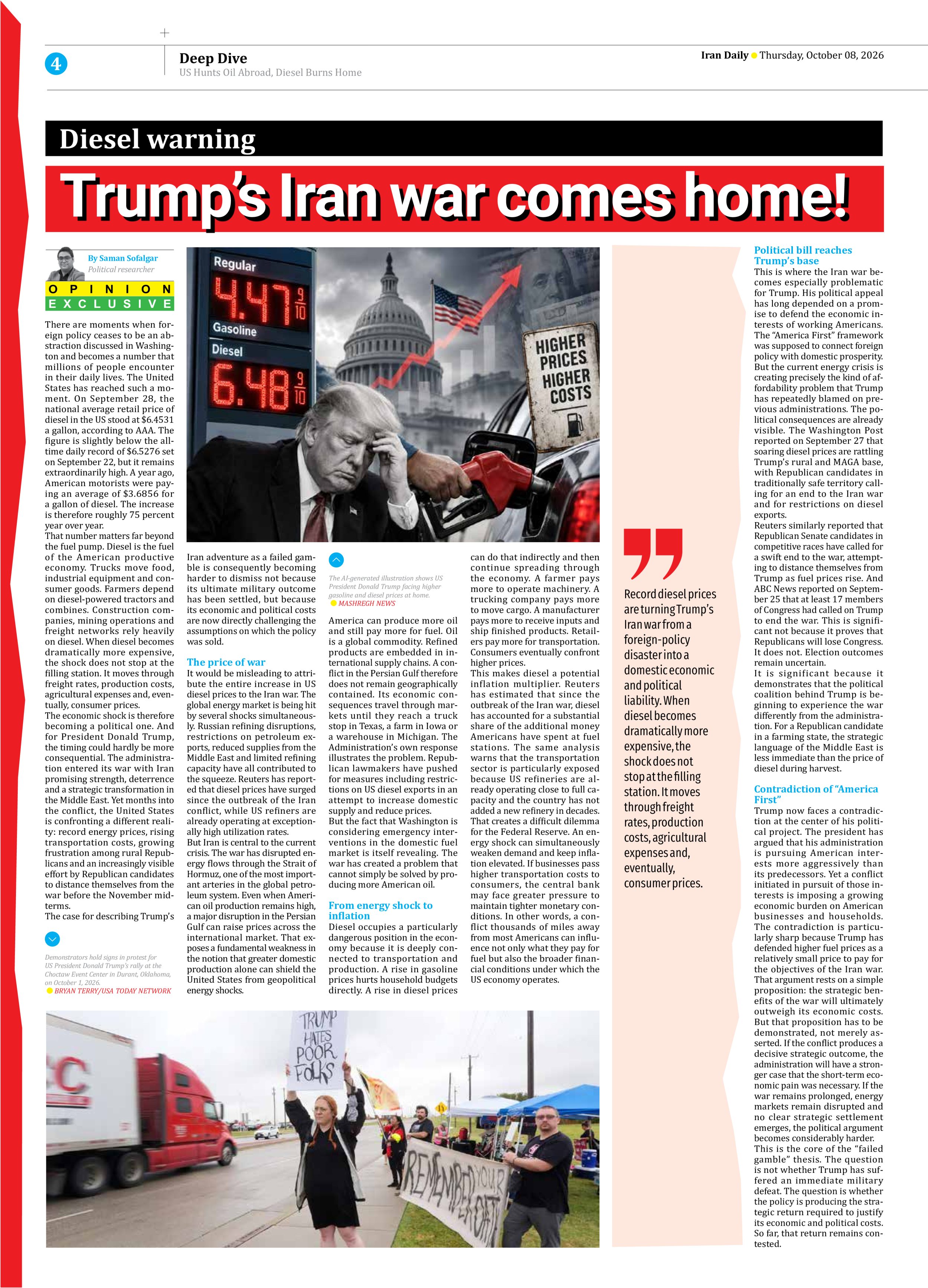


Diesel warning
Trump’s Iran war comes home!
By Saman Sofalgar
Political researcher
There are moments when foreign policy ceases to be an abstraction discussed in Washington and becomes a number that millions of people encounter in their daily lives. The United States has reached such a moment. On September 28, the national average retail price of diesel in the US stood at $6.4531 a gallon, according to AAA. The figure is slightly below the all-time daily record of $6.5276 set on September 22, but it remains extraordinarily high. A year ago, American motorists were paying an average of $3.6856 for a gallon of diesel. The increase is therefore roughly 75 percent year over year.
That number matters far beyond the fuel pump. Diesel is the fuel of the American productive economy. Trucks move food, industrial equipment and consumer goods. Farmers depend on diesel-powered tractors and combines. Construction companies, mining operations and freight networks rely heavily on diesel. When diesel becomes dramatically more expensive, the shock does not stop at the filling station. It moves through freight rates, production costs, agricultural expenses and, eventually, consumer prices.
The economic shock is therefore becoming a political one. And for President Donald Trump, the timing could hardly be more consequential. The administration entered its war with Iran promising strength, deterrence and a strategic transformation in the Middle East. Yet months into the conflict, the United States is confronting a different reality: record energy prices, rising transportation costs, growing frustration among rural Republicans and an increasingly visible effort by Republican candidates to distance themselves from the war before the November midterms.
The case for describing Trump’s Iran adventure as a failed gamble is consequently becoming harder to dismiss not because its ultimate military outcome has been settled, but because its economic and political costs are now directly challenging the assumptions on which the policy was sold.
The price of war
It would be misleading to attribute the entire increase in US diesel prices to the Iran war. The global energy market is being hit by several shocks simultaneously. Russian refining disruptions, restrictions on petroleum exports, reduced supplies from the Middle East and limited refining capacity have all contributed to the squeeze. Reuters has reported that diesel prices have surged since the outbreak of the Iran conflict, while US refiners are already operating at exceptionally high utilization rates.
But Iran is central to the current crisis. The war has disrupted energy flows through the Strait of Hormuz, one of the most important arteries in the global petroleum system. Even when American oil production remains high, a major disruption in the Persian Gulf can raise prices across the international market. That exposes a fundamental weakness in the notion that greater domestic production alone can shield the United States from geopolitical energy shocks.
America can produce more oil and still pay more for fuel. Oil is a global commodity. Refined products are embedded in international supply chains. A conflict in the Persian Gulf therefore does not remain geographically contained. Its economic consequences travel through markets until they reach a truck stop in Texas, a farm in Iowa or a warehouse in Michigan. The Administration’s own response illustrates the problem. Republican lawmakers have pushed for measures including restrictions on US diesel exports in an attempt to increase domestic supply and reduce prices.
But the fact that Washington is considering emergency interventions in the domestic fuel market is itself revealing. The war has created a problem that cannot simply be solved by producing more American oil.
From energy shock to inflation
Diesel occupies a particularly dangerous position in the economy because it is deeply connected to transportation and production. A rise in gasoline prices hurts household budgets directly. A rise in diesel prices can do that indirectly and then continue spreading through the economy. A farmer pays more to operate machinery. A trucking company pays more to move cargo. A manufacturer pays more to receive inputs and ship finished products. Retailers pay more for transportation. Consumers eventually confront higher prices.
This makes diesel a potential inflation multiplier. Reuters has estimated that since the outbreak of the Iran war, diesel has accounted for a substantial share of the additional money Americans have spent at fuel stations. The same analysis warns that the transportation sector is particularly exposed because US refineries are already operating close to full capacity and the country has not added a new refinery in decades.
That creates a difficult dilemma for the Federal Reserve. An energy shock can simultaneously weaken demand and keep inflation elevated. If businesses pass higher transportation costs to consumers, the central bank may face greater pressure to maintain tighter monetary conditions. In other words, a conflict thousands of miles away from most Americans can influence not only what they pay for fuel but also the broader financial conditions under which the US economy operates.
Political bill reaches Trump’s base
This is where the Iran war becomes especially problematic for Trump. His political appeal has long depended on a promise to defend the economic interests of working Americans. The “America First” framework was supposed to connect foreign policy with domestic prosperity.
But the current energy crisis is creating precisely the kind of affordability problem that Trump has repeatedly blamed on previous administrations. The political consequences are already visible. The Washington Post reported on September 27 that soaring diesel prices are rattling Trump’s rural and MAGA base, with Republican candidates in traditionally safe territory calling for an end to the Iran war and for restrictions on diesel exports.
Reuters similarly reported that Republican Senate candidates in competitive races have called for a swift end to the war, attempting to distance themselves from Trump as fuel prices rise. And ABC News reported on September 25 that at least 17 members of Congress had called on Trump to end the war. This is significant not because it proves that Republicans will lose Congress. It does not. Election outcomes remain uncertain.
It is significant because it demonstrates that the political coalition behind Trump is beginning to experience the war differently from the administration. For a Republican candidate in a farming state, the strategic language of the Middle East is less immediate than the price of diesel during harvest.
Contradiction of “America First”
Trump now faces a contradiction at the center of his political project. The president has argued that his administration is pursuing American interests more aggressively than its predecessors. Yet a conflict initiated in pursuit of those interests is imposing a growing economic burden on American businesses and households. The contradiction is particularly sharp because Trump has defended higher fuel prices as a relatively small price to pay for the objectives of the Iran war. That argument rests on a simple proposition: the strategic benefits of the war will ultimately outweigh its economic costs. But that proposition has to be demonstrated, not merely asserted. If the conflict produces a decisive strategic outcome, the administration will have a stronger case that the short-term economic pain was necessary. If the war remains prolonged, energy markets remain disrupted and no clear strategic settlement emerges, the political argument becomes considerably harder.
This is the core of the “failed gamble” thesis. The question is not whether Trump has suffered an immediate military defeat. The question is whether the policy is producing the strategic return required to justify its economic and political costs. So far, that return remains contested.
Midterm test
The November midterms provide the first major political test of this calculation. The conflict is already shaping the campaign environment. Time magazine reported that approval of Trump’s handling of the Iran war among Republican voters had fallen sharply as the conflict dragged on and began affecting household finances.
The Washington Post has likewise documented Republican candidates breaking with Trump as the election approaches. The political significance is not simply that some Republicans disagree with the president. It is that the issue is beginning to divide the party along the most politically sensitive line of all: economic self-interest.
A senator can defend a distant strategic objective. It is much harder to explain to a farmer why diesel costs hundreds or thousands of dollars more during a critical production season. This is how foreign policy becomes domestic politics. The war enters the household through the fuel bill.
A gamble with an uncertain return
Judging Trump’s policy towards Iran requires more than measuring military operations. It requires asking whether the defined objectives have been achieved at a cost proportionate to the benefits. By that measure, the warning signs are becoming difficult to ignore. Record diesel prices are squeezing transportation and agriculture. Republicans are demanding emergency measures. Candidates in competitive races are distancing themselves from the president’s war policy. And the conflict is increasingly becoming associated with the very affordability pressures that Trump built his political identity around addressing.
That does not establish an electoral outcome. Nor does it prove that the war will ultimately fail on every strategic objective. But it does establish something politically important: the administration has not been able to keep the costs of its Iran policy separate from the economic concerns of American voters.
That may become the defining weakness of the strategy. A war that was supposed to demonstrate American strength is now being measured, in part, by the price of diesel. A foreign policy decision designed to increase US leverage is producing pressure on the domestic economy. And a president who promised to put American workers first is asking many of those same workers to absorb a growing share of the conflict’s economic cost.
The $6.45 diesel price is therefore more than a market statistic. It is a political receipt. And as long as the war continues without a clear strategic resolution, that receipt will keep arriving at the most politically sensitive address in America: “the household budget”. For Trump, the central question is no longer whether his Iran gamble carries costs. It plainly does. The harder question is whether the United States is receiving enough strategic benefit to justify them.
Until the administration can answer that convincingly, the argument that Trump’s Iran gamble has failed (not necessarily militarily, but strategically, economically and politically) will only become harder to dismiss.