







Iran has what it takes to reach pinnacle of women’s karate, Saeidabadi insists
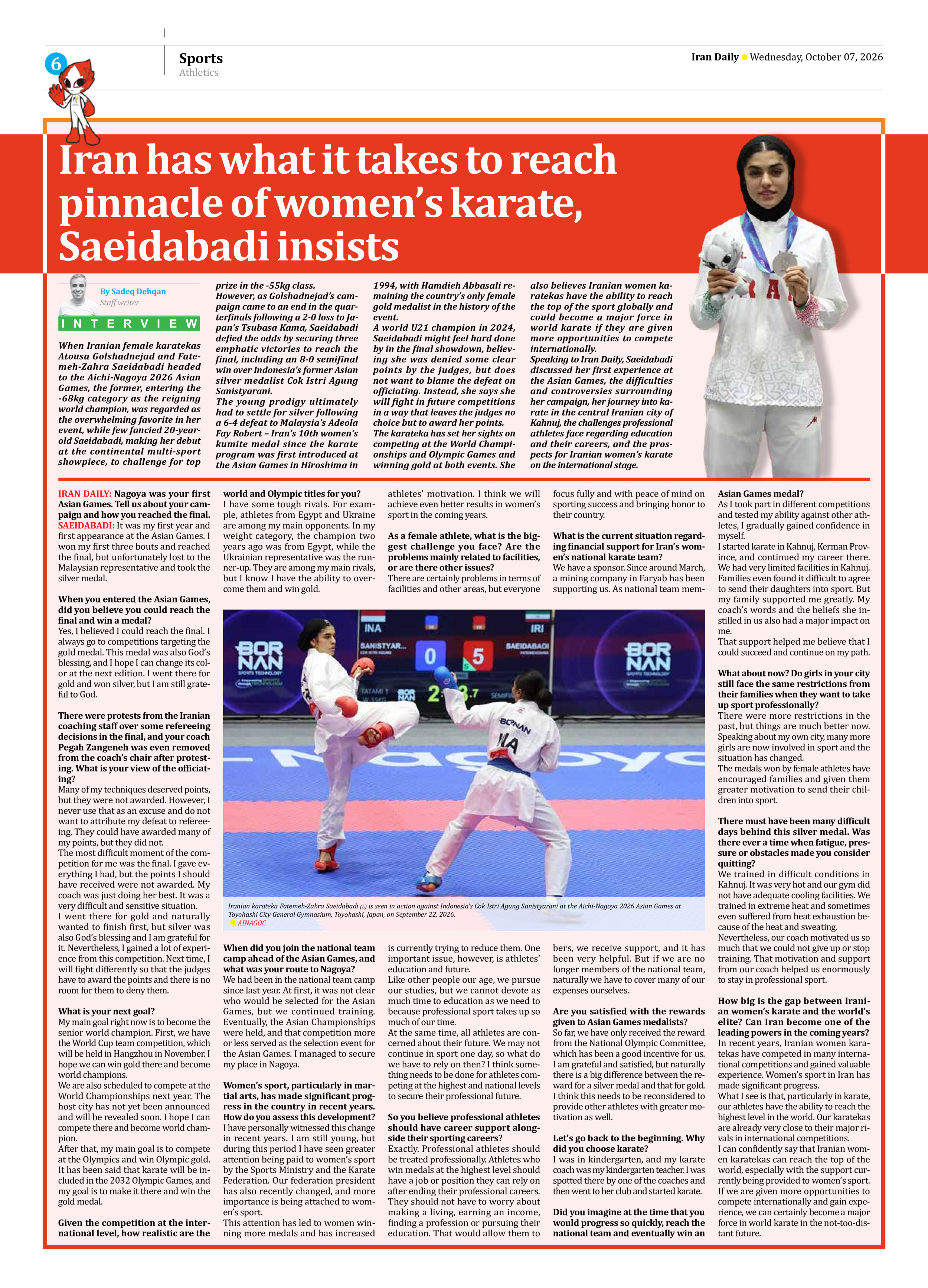
When Iranian female karatekas Atousa Golshadnejad and Fatemeh-Zahra Saeidabadi headed to the Aichi-Nagoya 2026 Asian Games, the former, entering the -68kg category as the reigning world champion, was regarded as the overwhelming favorite in her event, while few fancied 20-year-old Saeidabadi, making her debut at the continental multi-sport showpiece, to challenge for top prize in the -55kg class. However, as Golshadnejad’s campaign came to an end in the quarterfinals following a 2-0 loss to Japan’s Tsubasa Kama, Saeidabadi defied the odds by securing three emphatic victories to reach the final, including an 8-0 semifinal win over Indonesia’s former Asian silver medalist Cok Istri Agung Sanistyarani. The young prodigy ultimately had to settle for silver following a 6-4 defeat to Malaysia’s Adeola Fay Robert – Iran’s 10th women’s kumite medal since the karate program was first introduced at the Asian Games in Hiroshima in 1994, with Hamdieh Abbasali remaining the country’s only female gold medalist in the history of the event. A world U21 champion in 2024, Saeidabadi might feel hard done by in the final showdown, believing she was denied some clear points by the judges, but does not want to blame the defeat on officiating. Instead, she says she will fight in future competitions in a way that leaves the judges no choice but to award her points. The karateka has set her sights on competing at the World Championships and Olympic Games and winning gold at both events. She also believes Iranian women karatekas have the ability to reach the top of the sport globally and could become a major force in world karate if they are given more opportunities to compete internationally. Speaking to Iran Daily, Saeidabadi discussed her first experience at the Asian Games, the difficulties and controversies surrounding her campaign, her journey into karate in the central Iranian city of Kahnuj, the challenges professional athletes face regarding education and their careers, and the prospects for Iranian women’s karate on the international stage.
By Sadeq Dehqan
Staff writer
IRAN DAILY: Nagoya was your first Asian Games. Tell us about your campaign and how you reached the final.
SAEIDABADI: It was my first year and first appearance at the Asian Games. I won my first three bouts and reached the final, but unfortunately lost to the Malaysian representative and took the silver medal.
When you entered the Asian Games, did you believe you could reach the final and win a medal?
Yes, I believed I could reach the final. I always go to competitions targeting the gold medal. This medal was also God’s blessing, and I hope I can change its color at the next edition. I went there for gold and won silver, but I am still grateful to God.
There were protests from the Iranian coaching staff over some refereeing decisions in the final, and your coach Pegah Zangeneh was even removed from the coach’s chair after protesting. What is your view of the officiating?
Many of my techniques deserved points, but they were not awarded. However, I never use that as an excuse and do not want to attribute my defeat to refereeing. They could have awarded many of my points, but they did not.
The most difficult moment of the competition for me was the final. I gave everything I had, but the points I should have received were not awarded. My coach was just doing her best. It was a very difficult and sensitive situation.
I went there for gold and naturally wanted to finish first, but silver was also God’s blessing and I am grateful for it. Nevertheless, I gained a lot of experience from this competition. Next time, I will fight differently so that the judges have to award the points and there is no room for them to deny them.
What is your next goal?
My main goal right now is to become the senior world champion. First, we have the World Cup team competition, which will be held in Hangzhou in November. I hope we can win gold there and become world champions.
We are also scheduled to compete at the World Championships next year. The host city has not yet been announced and will be revealed soon. I hope I can compete there and become world champion.
After that, my main goal is to compete at the Olympics and win Olympic gold. It has been said that karate will be included in the 2032 Olympic Games, and my goal is to make it there and win the gold medal.
Given the competition at the international level, how realistic are the world and Olympic titles for you?
I have some tough rivals. For example, athletes from Egypt and Ukraine are among my main opponents. In my weight category, the champion two years ago was from Egypt, while the Ukrainian representative was the runner-up. They are among my main rivals, but I know I have the ability to overcome them and win gold.
When did you join the national team camp ahead of the Asian Games, and what was your route to Nagoya?
We had been in the national team camp since last year. At first, it was not clear who would be selected for the Asian Games, but we continued training. Eventually, the Asian Championships were held, and that competition more or less served as the selection event for the Asian Games. I managed to secure my place in Nagoya.
Women’s sport, particularly in martial arts, has made significant progress in the country in recent years. How do you assess this development?
I have personally witnessed this change in recent years. I am still young, but during this period I have seen greater attention being paid to women’s sport by the Sports Ministry and the Karate Federation. Our federation president has also recently changed, and more importance is being attached to women’s sport.
This attention has led to women winning more medals and has increased athletes’ motivation. I think we will achieve even better results in women’s sport in the coming years.
As a female athlete, what is the biggest challenge you face? Are the problems mainly related to facilities, or are there other issues?
There are certainly problems in terms of facilities and other areas, but everyone is currently trying to reduce them. One important issue, however, is athletes’ education and future.
Like other people our age, we pursue our studies, but we cannot devote as much time to education as we need to because professional sport takes up so much of our time.
At the same time, all athletes are concerned about their future. We may not continue in sport one day, so what do we have to rely on then? I think something needs to be done for athletes competing at the highest and national levels to secure their professional future.
So you believe professional athletes should have career support alongside their sporting careers?
Exactly. Professional athletes should be treated professionally. Athletes who win medals at the highest level should have a job or position they can rely on after ending their professional careers. They should not have to worry about making a living, earning an income, finding a profession or pursuing their education. That would allow them to focus fully and with peace of mind on sporting success and bringing honor to their country.
What is the current situation regarding financial support for Iran’s women’s national karate team?
We have a sponsor. Since around March, a mining company in Faryab has been supporting us. As national team members, we receive support, and it has been very helpful. But if we are no longer members of the national team, naturally we have to cover many of our expenses ourselves.
Are you satisfied with the rewards given to Asian Games medalists?
So far, we have only received the reward from the National Olympic Committee, which has been a good incentive for us. I am grateful and satisfied, but naturally there is a big difference between the reward for a silver medal and that for gold. I think this needs to be reconsidered to provide other athletes with greater motivation as well.
Let’s go back to the beginning. Why did you choose karate?
I was in kindergarten, and my karate coach was my kindergarten teacher. I was spotted there by one of the coaches and then went to her club and started karate.
Did you imagine at the time that you would progress so quickly, reach the national team and eventually win an Asian Games medal?
As I took part in different competitions and tested my ability against other athletes, I gradually gained confidence in myself.
I started karate in Kahnuj, Kerman Province, and continued my career there. We had very limited facilities in Kahnuj. Families even found it difficult to agree to send their daughters into sport. But my family supported me greatly. My coach’s words and the beliefs she instilled in us also had a major impact on me.
That support helped me believe that I could succeed and continue on my path.
What about now? Do girls in your city still face the same restrictions from their families when they want to take up sport professionally?
There were more restrictions in the past, but things are much better now. Speaking about my own city, many more girls are now involved in sport and the situation has changed.
The medals won by female athletes have encouraged families and given them greater motivation to send their children into sport.
There must have been many difficult days behind this silver medal. Was there ever a time when fatigue, pressure or obstacles made you consider quitting?
We trained in difficult conditions in Kahnuj. It was very hot and our gym did not have adequate cooling facilities. We trained in extreme heat and sometimes even suffered from heat exhaustion because of the heat and sweating.
Nevertheless, our coach motivated us so much that we could not give up or stop training. That motivation and support from our coach helped us enormously to stay in professional sport.
How big is the gap between Iranian women’s karate and the world’s elite? Can Iran become one of the leading powers in the coming years?
In recent years, Iranian women karatekas have competed in many international competitions and gained valuable experience. Women’s sport in Iran has made significant progress.
What I see is that, particularly in karate, our athletes have the ability to reach the highest level in the world. Our karatekas are already very close to their major rivals in international competitions.
I can confidently say that Iranian women karatekas can reach the top of the world, especially with the support currently being provided to women’s sport. If we are given more opportunities to compete internationally and gain experience, we can certainly become a major force in world karate in the not-too-distant future.