







UN chief urges US, Iran to return to diplomacy
Pezeshkian says negotiations with Washington ‘meaningless’
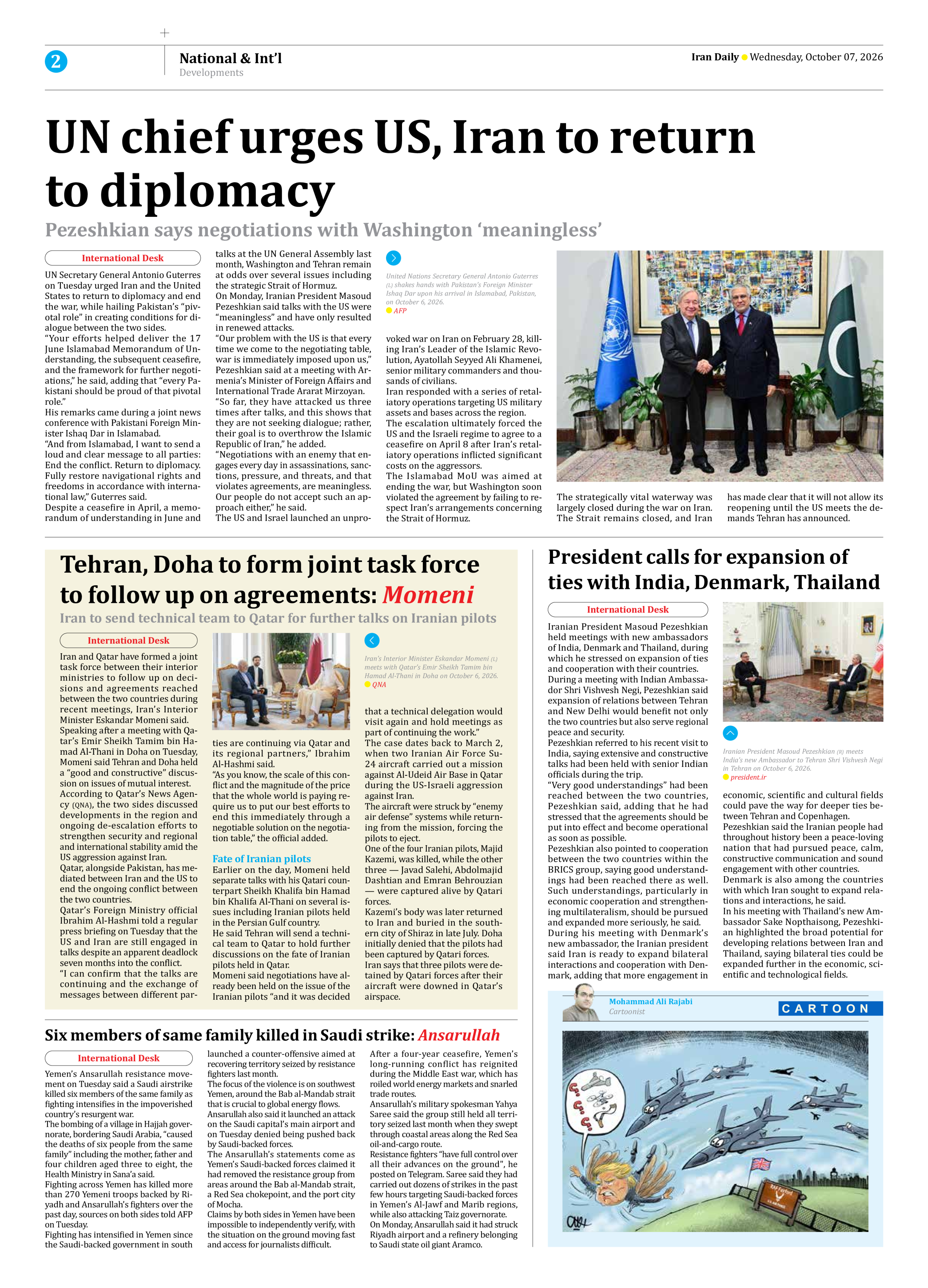
UN Secretary General Antonio Guterres on Tuesday urged Iran and the United States to return to diplomacy and end the war, while hailing Pakistan’s “pivotal role” in creating conditions for dialogue between the two sides.
“Your efforts helped deliver the 17 June Islamabad Memorandum of Understanding, the subsequent ceasefire, and the framework for further negotiations,” he said, adding that “every Pakistani should be proud of that pivotal role.”
His remarks came during a joint news conference with Pakistani Foreign Minister Ishaq Dar in Islamabad.
“And from Islamabad, I want to send a loud and clear message to all parties: End the conflict. Return to diplomacy. Fully restore navigational rights and freedoms in accordance with international law,” Guterres said.
Despite a ceasefire in April, a memorandum of understanding in June and talks at the UN General Assembly last month, Washington and Tehran remain at odds over several issues including the strategic Strait of Hormuz.
On Monday, Iranian President Masoud Pezeshkian said talks with the US were “meaningless” and have only resulted in renewed attacks.
“Our problem with the US is that every time we come to the negotiating table, war is immediately imposed upon us,” Pezeshkian said at a meeting with Armenia’s Minister of Foreign Affairs and International Trade Ararat Mirzoyan.
“So far, they have attacked us three times after talks, and this shows that they are not seeking dialogue; rather, their goal is to overthrow the Islamic Republic of Iran,” he added.
“Negotiations with an enemy that engages every day in assassinations, sanctions, pressure, and threats, and that violates agreements, are meaningless. Our people do not accept such an approach either,” he said.
The US and Israel launched an unprovoked war on Iran on February 28, killing Iran’s Leader of the Islamic Revolution, Ayatollah Seyyed Ali Khamenei, senior military commanders and thousands of civilians.
Iran responded with a series of retaliatory operations targeting US military assets and bases across the region.
The escalation ultimately forced the US and the Israeli regime to agree to a ceasefire on April 8 after Iran’s retaliatory operations inflicted significant costs on the aggressors.
The Islamabad MoU was aimed at ending the war, but Washington soon violated the agreement by failing to respect Iran’s arrangements concerning the Strait of Hormuz.
The strategically vital waterway was largely closed during the war on Iran. The Strait remains closed, and Iran has made clear that it will not allow its reopening until the US meets the demands Tehran has announced.