







Copy in clipboard...
Reading Room
Persian Language in Austria; a book on language, education
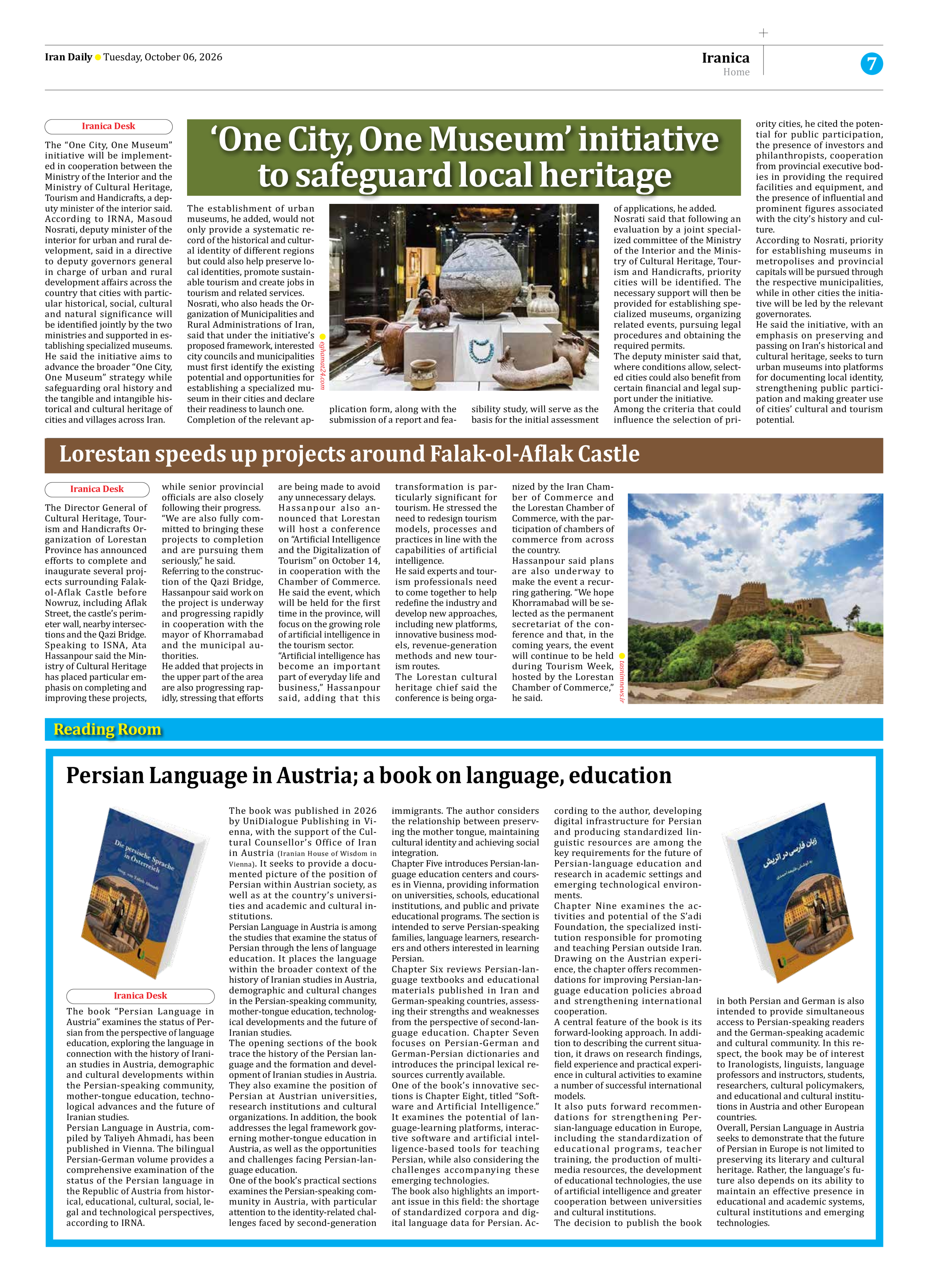
Persian Language in Austria, compiled by Taliyeh Ahmadi, has been published in Vienna. The bilingual Persian-German volume provides a comprehensive examination of the status of the Persian language in the Republic of Austria from historical, educational, cultural, social, legal and technological perspectives, according to IRNA.
The book was published in 2026 by UniDialogue Publishing in Vienna, with the support of the Cultural Counsellor’s Office of Iran in Austria (Iranian House of Wisdom in Vienna). It seeks to provide a documented picture of the position of Persian within Austrian society, as well as at the country’s universities and academic and cultural institutions.
Persian Language in Austria is among the studies that examine the status of Persian through the lens of language education. It places the language within the broader context of the history of Iranian studies in Austria, demographic and cultural changes in the Persian-speaking community, mother-tongue education, technological developments and the future of Iranian studies.
The opening sections of the book trace the history of the Persian language and the formation and development of Iranian studies in Austria. They also examine the position of Persian at Austrian universities, research institutions and cultural organizations. In addition, the book addresses the legal framework governing mother-tongue education in Austria, as well as the opportunities and challenges facing Persian-language education.
One of the book’s practical sections examines the Persian-speaking community in Austria, with particular attention to the identity-related challenges faced by second-generation immigrants. The author considers the relationship between preserving the mother tongue, maintaining cultural identity and achieving social integration.
Chapter Five introduces Persian-language education centers and courses in Vienna, providing information on universities, schools, educational institutions, and public and private educational programs. The section is intended to serve Persian-speaking families, language learners, researchers and others interested in learning Persian.
Chapter Six reviews Persian-language textbooks and educational materials published in Iran and German-speaking countries, assessing their strengths and weaknesses from the perspective of second-language education. Chapter Seven focuses on Persian-German and German-Persian dictionaries and introduces the principal lexical resources currently available.
One of the book’s innovative sections is Chapter Eight, titled “Software and Artificial Intelligence.” It examines the potential of language-learning platforms, interactive software and artificial intelligence-based tools for teaching Persian, while also considering the challenges accompanying these emerging technologies.
The book also highlights an important issue in this field: the shortage of standardized corpora and digital language data for Persian. According to the author, developing digital infrastructure for Persian and producing standardized linguistic resources are among the key requirements for the future of Persian-language education and research in academic settings and emerging technological environments.
Chapter Nine examines the activities and potential of the S’adi Foundation, the specialized institution responsible for promoting and teaching Persian outside Iran. Drawing on the Austrian experience, the chapter offers recommendations for improving Persian-language education policies abroad and strengthening international cooperation.
A central feature of the book is its forward-looking approach. In addition to describing the current situation, it draws on research findings, field experience and practical experience in cultural activities to examine a number of successful international models.
It also puts forward recommendations for strengthening Persian-language education in Europe, including the standardization of educational programs, teacher training, the production of multimedia resources, the development of educational technologies, the use of artificial intelligence and greater cooperation between universities and cultural institutions.
The decision to publish the book in both Persian and German is also intended to provide simultaneous access to Persian-speaking readers and the German-speaking academic and cultural community. In this respect, the book may be of interest to Iranologists, linguists, language professors and instructors, students, researchers, cultural policymakers, and educational and cultural institutions in Austria and other European countries.
Overall, Persian Language in Austria seeks to demonstrate that the future of Persian in Europe is not limited to preserving its literary and cultural heritage. Rather, the language’s future also depends on its ability to maintain an effective presence in educational and academic systems, cultural institutions and emerging technologies.