







Greenland, Trump, and new arctic security bargain
Vice president at Observer Research Foundation
The new US-Denmark-Greenland security agreement marks an important, if uneasy, adjustment in the strategic balance in the Arctic. It expands the American military and investment-screening role in Greenland without altering the island’s formal constitutional status or transferring sovereignty. Announced by President Donald Trump, with formal signing the following week at the UN General Assembly in New York, subject to parliamentary ratification, the agreement brings an end — at least for now — to months of extraordinary tension triggered by Trump’s repeated suggestions that Washington should acquire or even seize Greenland.
The significance of the agreement lies less in any change in sovereignty than in the expansion of the United States’ strategic access. Trump has described the arrangement as providing Washington “permanent control over security, and all other needs” through an “‘Infinite Life Agreement,” while insisting that it would come at no cost to the United States. The reported provisions point towards a substantial strengthening of the existing American military position on the island. Washington would gain expanded rights to develop additional bases, maintain permanent access, and exercise broader basing and overflight privileges.
This is, however, an extension of an existing architecture rather than a wholly new American presence. The United States already operates Pituffik Space Base under the 1951 Defense of Greenland Agreement, which provides Washington with broad and open-ended rights. What the new arrangement does is institutionalise and potentially widen that strategic footprint at a time when the Arctic is becoming an increasingly important theatre of great-power competition.
The agreement is equally significant for what it seeks to prevent. Non-NATO states — most obviously Russia and China — would be barred from establishing military bases or maintaining a military presence in Greenland, while sensitive investments would require US approval. The investment-screening provisions are particularly revealing. The emerging contest in the Arctic is not simply about military geography; it is also about control over infrastructure, critical minerals and technological supply chains. Greenland’s mineral wealth, including rare earth elements, has acquired added importance as Western governments seek to reduce dependence on China, which dominates global rare-earth processing.
Yet the agreement carefully preserves the political red lines that Copenhagen and Nuuk had insisted upon. Danish sovereignty and the territorial integrity of the Kingdom of Denmark are reaffirmed, while Greenlanders’ right to self-determination remains intact. There is no transfer of territory or ownership. Danish Prime Minister Mette Frederiksen and Greenlandic leaders have therefore presented the arrangement as a strengthening of Arctic and North Atlantic security rather than a surrender of sovereignty.
For Denmark, this distinction is critical. Copenhagen has avoided the far more destabilising possibility of a confrontation with its principal NATO ally over the territorial integrity of the kingdom. Danish leaders had warned that the use of force by one NATO member against another would strike at the foundations of the alliance itself. The new agreement therefore represents an attempt to separate the security relationship from the sovereignty question.
There are tangible advantages for Denmark. Greater American military engagement could strengthen the defence of the Arctic at a moment when Copenhagen itself has been increasing defence spending and regional capabilities. Expanded US activity could also generate economic opportunities. But the arrangement comes with costs. Copenhagen and Nuuk will have less room for manoeuvre over certain categories of foreign investment, particularly where Washington determines that Chinese or Russian involvement poses a strategic risk. More importantly, months of political pressure have left behind a degree of distrust that an agreement alone cannot easily remove.
Greenland’s position remains particularly delicate. The island, with a population of roughly 56,000, possesses an extraordinary strategic geography but limited political and economic capacity. Its location makes it important for missile warning, North Atlantic sea lanes and emerging Arctic shipping routes, while its mineral resources add an economic dimension to its strategic value. Greenlandic reactions to the agreement have consequently combined relief at the de-escalation with continuing apprehension about the long-term consequences of a much larger American role.
The European implications are broader still. The Greenland episode exposed a fundamental vulnerability within NATO: the possibility that an alliance built around territorial integrity and collective defence could be destabilised by a dispute between its own members. American pressure on Denmark forced European governments to contemplate an extraordinary scenario in which the territory of a NATO ally became the subject of coercive bargaining by the alliance’s leading power.
The agreement provides a diplomatic off-ramp from that crisis. NATO can now focus on the more conventional objective of strengthening the defence of the High North and North Atlantic. But the episode is unlikely to disappear from European strategic calculations. The damage to transatlantic trust may prove more durable than the immediate dispute. European governments have already been moving towards greater defence capabilities and strategic autonomy, and the Greenland crisis reinforces the logic behind those efforts.
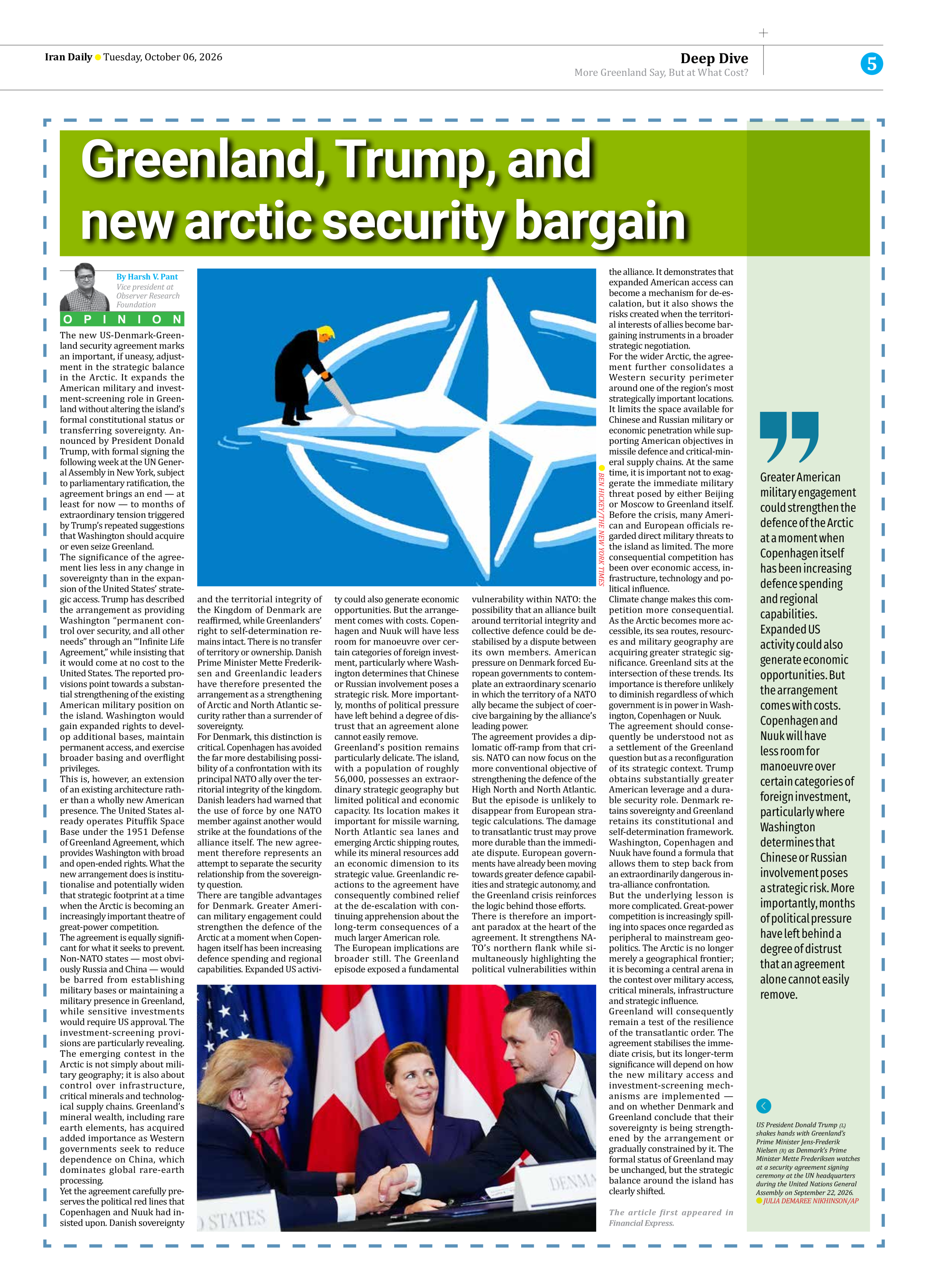
There is therefore an important paradox at the heart of the agreement. It strengthens NATO’s northern flank while simultaneously highlighting the political vulnerabilities within the alliance. It demonstrates that expanded American access can become a mechanism for de-escalation, but it also shows the risks created when the territorial interests of allies become bargaining instruments in a broader strategic negotiation.
For the wider Arctic, the agreement further consolidates a Western security perimeter around one of the region’s most strategically important locations. It limits the space available for Chinese and Russian military or economic penetration while supporting American objectives in missile defence and critical-mineral supply chains. At the same time, it is important not to exaggerate the immediate military threat posed by either Beijing or Moscow to Greenland itself. Before the crisis, many American and European officials regarded direct military threats to the island as limited. The more consequential competition has been over economic access, infrastructure, technology and political influence.
Climate change makes this competition more consequential. As the Arctic becomes more accessible, its sea routes, resources and military geography are acquiring greater strategic significance. Greenland sits at the intersection of these trends. Its importance is therefore unlikely to diminish regardless of which government is in power in Washington, Copenhagen or Nuuk.
The agreement should consequently be understood not as a settlement of the Greenland question but as a reconfiguration of its strategic context. Trump obtains substantially greater American leverage and a durable security role. Denmark retains sovereignty and Greenland retains its constitutional and self-determination framework. Washington, Copenhagen and Nuuk have found a formula that allows them to step back from an extraordinarily dangerous intra-alliance confrontation.
But the underlying lesson is more complicated. Great-power competition is increasingly spilling into spaces once regarded as peripheral to mainstream geopolitics. The Arctic is no longer merely a geographical frontier; it is becoming a central arena in the contest over military access, critical minerals, infrastructure and strategic influence.
Greenland will consequently remain a test of the resilience of the transatlantic order. The agreement stabilises the immediate crisis, but its longer-term significance will depend on how the new military access and investment-screening mechanisms are implemented — and on whether Denmark and Greenland conclude that their sovereignty is being strengthened by the arrangement or gradually constrained by it. The formal status of Greenland may be unchanged, but the strategic balance around the island has clearly shifted.
The article first appeared in
Financial Express.