







Farhadi lashes out at Hollywood’s ‘white savior’ view of Iran
‘Who asked you to come and save us?’
Iranian filmmaker Asghar Farhadi lambasted what he described as the perceived hegemony of American cinema, saying Hollywood films about countries such as Iran could present the world from a superior position and perpetuate the image of an American coming to save others.
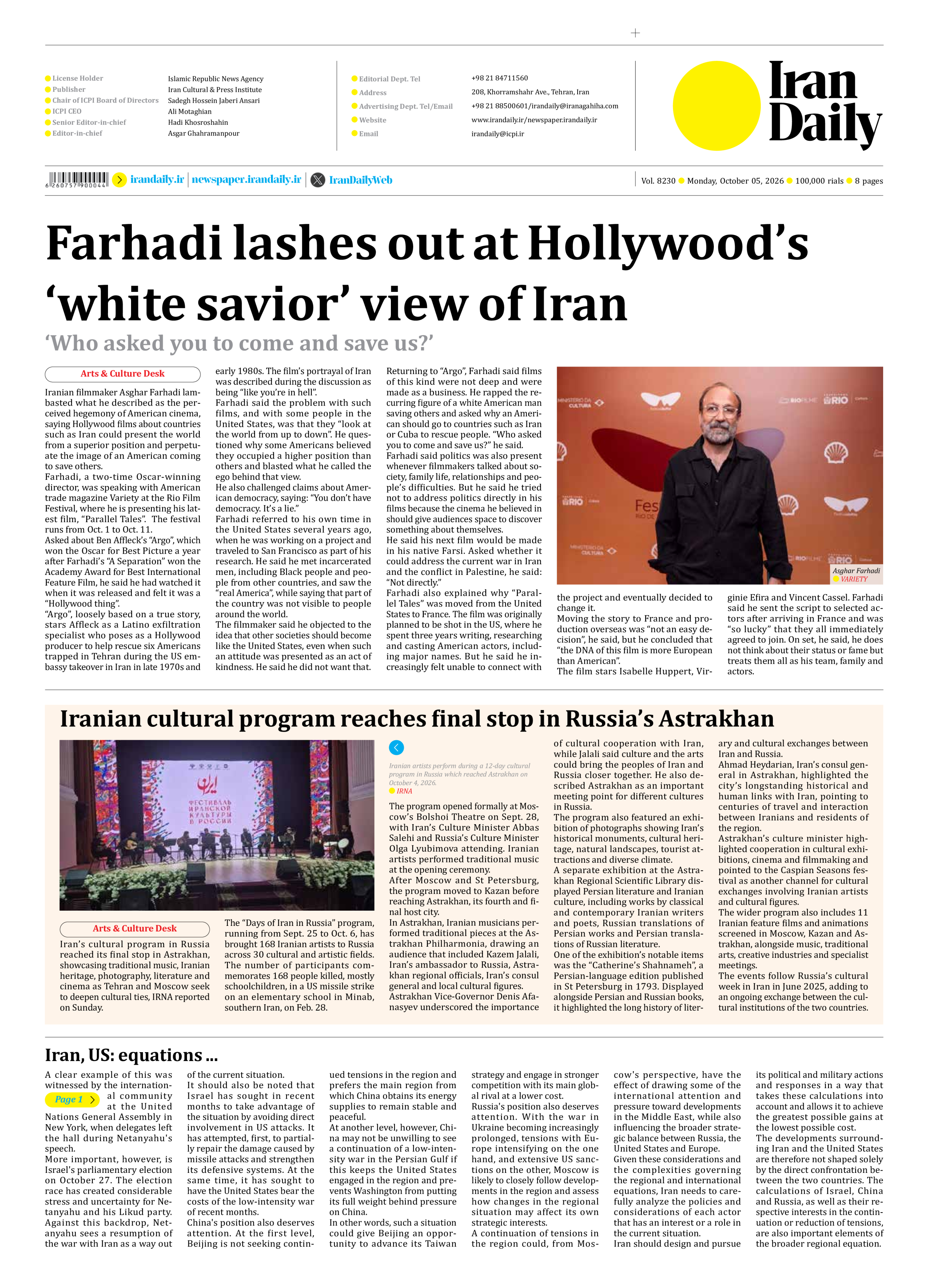
Farhadi, a two-time Oscar-winning director, was speaking with American trade magazine Variety at the Rio Film Festival, where he is presenting his latest film, “Parallel Tales”. The festival runs from Oct. 1 to Oct. 11.
Asked about Ben Affleck’s “Argo”, which won the Oscar for Best Picture a year after Farhadi’s “A Separation” won the Academy Award for Best International Feature Film, he said he had watched it when it was released and felt it was a “Hollywood thing”.
“Argo”, loosely based on a true story, stars Affleck as a Latino exfiltration specialist who poses as a Hollywood producer to help rescue six Americans trapped in Tehran during the US embassy takeover in Iran in late 1970s and early 1980s. The film’s portrayal of Iran was described during the discussion as being “like you’re in hell”.
Farhadi said the problem with such films, and with some people in the United States, was that they “look at the world from up to down”. He questioned why some Americans believed they occupied a higher position than others and blasted what he called the ego behind that view.
He also challenged claims about American democracy, saying: “You don’t have democracy. It’s a lie.”
Farhadi referred to his own time in the United States several years ago, when he was working on a project and traveled to San Francisco as part of his research. He said he met incarcerated men, including Black people and people from other countries, and saw the “real America”, while saying that part of the country was not visible to people around the world.
The filmmaker said he objected to the idea that other societies should become like the United States, even when such an attitude was presented as an act of kindness. He said he did not want that.
Returning to “Argo”, Farhadi said films of this kind were not deep and were made as a business. He rapped the recurring figure of a white American man saving others and asked why an American should go to countries such as Iran or Cuba to rescue people. “Who asked you to come and save us?” he said.
Farhadi said politics was also present whenever filmmakers talked about society, family life, relationships and people’s difficulties. But he said he tried not to address politics directly in his films because the cinema he believed in should give audiences space to discover something about themselves.
He said his next film would be made in his native Farsi. Asked whether it could address the current war in Iran and the conflict in Palestine, he said: “Not directly.”
Farhadi also explained why “Parallel Tales” was moved from the United States to France. The film was originally planned to be shot in the US, where he spent three years writing, researching and casting American actors, including major names. But he said he increasingly felt unable to connect with the project and eventually decided to change it.
Moving the story to France and production overseas was “not an easy decision”, he said, but he concluded that “the DNA of this film is more European than American”.
The film stars Isabelle Huppert, Virginie Efira and Vincent Cassel. Farhadi said he sent the script to selected actors after arriving in France and was “so lucky” that they all immediately agreed to join. On set, he said, he does not think about their status or fame but treats them all as his team, family and actors.