







Excavation points to iron-smelting at Iran’s Malemoun site
By Alireza Sepahvand
Freelance journalist
Archaeological excavations at the historic site of Malemoun, in the Gilvand Rud Valley near Masouleh, northern Iran, have uncovered architectural and industrial remains related to the smelting and processing of iron ore. They have also made it possible to achieve a partial understanding of how those early people produced iron.
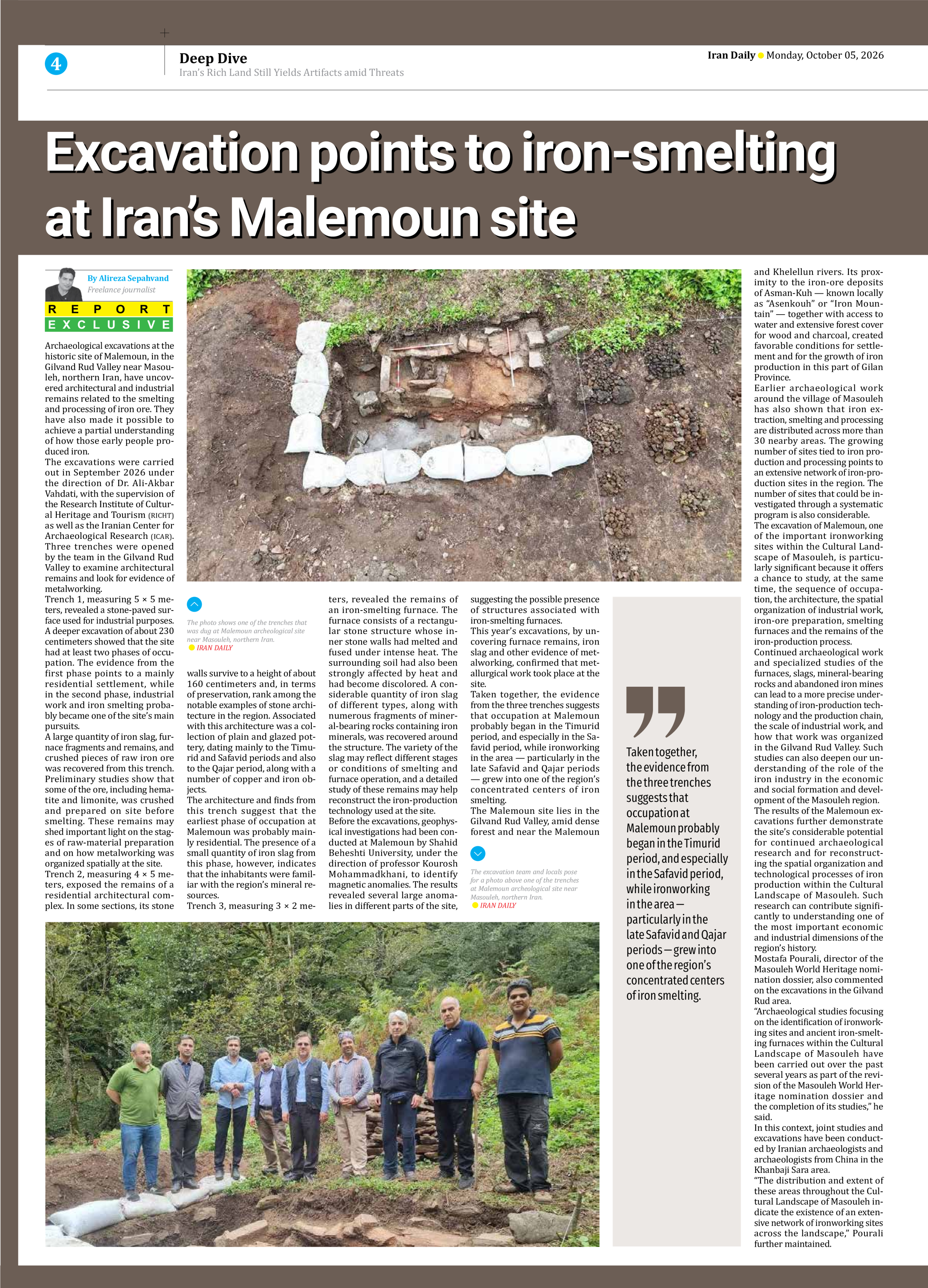
The excavations were carried out in September 2026 under the direction of Dr. Ali-Akbar Vahdati, with the supervision of the Research Institute of Cultural Heritage and Tourism (RICHT) as well as the Iranian Center for Archaeological Research (ICAR). Three trenches were opened by the team in the Gilvand Rud Valley to examine architectural remains and look for evidence of metalworking.
Trench 1, measuring 5 × 5 meters, revealed a stone-paved surface used for industrial purposes. A deeper excavation of about 230 centimeters showed that the site had at least two phases of occupation. The evidence from the first phase points to a mainly residential settlement, while in the second phase, industrial work and iron smelting probably became one of the site’s main pursuits.
A large quantity of iron slag, furnace fragments and remains, and crushed pieces of raw iron ore was recovered from this trench. Preliminary studies show that some of the ore, including hematite and limonite, was crushed and prepared on site before smelting. These remains may shed important light on the stages of raw-material preparation and on how metalworking was organized spatially at the site.
Trench 2, measuring 4 × 5 meters, exposed the remains of a residential architectural complex. In some sections, its stone walls survive to a height of about 160 centimeters and, in terms of preservation, rank among the notable examples of stone architecture in the region. Associated with this architecture was a collection of plain and glazed pottery, dating mainly to the Timurid and Safavid periods and also to the Qajar period, along with a number of copper and iron objects.
The architecture and finds from this trench suggest that the earliest phase of occupation at Malemoun was probably mainly residential. The presence of a small quantity of iron slag from this phase, however, indicates that the inhabitants were familiar with the region’s mineral resources.
Trench 3, measuring 3 × 2 meters, revealed the remains of an iron-smelting furnace. The furnace consists of a rectangular stone structure whose inner stone walls had melted and fused under intense heat. The surrounding soil had also been strongly affected by heat and had become discolored. A considerable quantity of iron slag of different types, along with numerous fragments of mineral-bearing rocks containing iron minerals, was recovered around the structure. The variety of the slag may reflect different stages or conditions of smelting and furnace operation, and a detailed study of these remains may help reconstruct the iron-production technology used at the site.
Before the excavations, geophysical investigations had been conducted at Malemoun by Shahid Beheshti University, under the direction of professor Kourosh Mohammadkhani, to identify magnetic anomalies. The results revealed several large anomalies in different parts of the site, suggesting the possible presence of structures associated with iron-smelting furnaces.
This year’s excavations, by uncovering furnace remains, iron slag and other evidence of metalworking, confirmed that metallurgical work took place at the site.
Taken together, the evidence from the three trenches suggests that occupation at Malemoun probably began in the Timurid period, and especially in the Safavid period, while ironworking in the area — particularly in the late Safavid and Qajar periods — grew into one of the region’s concentrated centers of iron smelting.
The Malemoun site lies in the Gilvand Rud Valley, amid dense forest and near the Malemoun and Khelellun rivers. Its proximity to the iron-ore deposits of Asman-Kuh — known locally as “Asenkouh” or “Iron Mountain” — together with access to water and extensive forest cover for wood and charcoal, created favorable conditions for settlement and for the growth of iron production in this part of Gilan Province.
Earlier archaeological work around the village of Masouleh has also shown that iron extraction, smelting and processing are distributed across more than 30 nearby areas. The growing number of sites tied to iron production and processing points to an extensive network of iron-production sites in the region. The number of sites that could be investigated through a systematic program is also considerable.
The excavation of Malemoun, one of the important ironworking sites within the Cultural Landscape of Masouleh, is particularly significant because it offers a chance to study, at the same time, the sequence of occupation, the architecture, the spatial organization of industrial work, iron-ore preparation, smelting furnaces and the remains of the iron-production process.
Continued archaeological work and specialized studies of the furnaces, slags, mineral-bearing rocks and abandoned iron mines can lead to a more precise understanding of iron-production technology and the production chain, the scale of industrial work, and how that work was organized in the Gilvand Rud Valley. Such studies can also deepen our understanding of the role of the iron industry in the economic and social formation and development of the Masouleh region.
The results of the Malemoun excavations further demonstrate the site’s considerable potential for continued archaeological research and for reconstructing the spatial organization and technological processes of iron production within the Cultural Landscape of Masouleh. Such research can contribute significantly to understanding one of the most important economic and industrial dimensions of the region’s history.
Mostafa Pourali, director of the Masouleh World Heritage nomination dossier, also commented on the excavations in the Gilvand Rud area.
“Archaeological studies focusing on the identification of ironworking sites and ancient iron-smelting furnaces within the Cultural Landscape of Masouleh have been carried out over the past several years as part of the revision of the Masouleh World Heritage nomination dossier and the completion of its studies,” he said.
In this context, joint studies and excavations have been conducted by Iranian archaeologists and archaeologists from China in the Khanbaji Sara area.
“The distribution and extent of these areas throughout the Cultural Landscape of Masouleh indicate the existence of an extensive network of ironworking sites across the landscape,” Pourali further maintained.